The Basic Mechanics: What a Coverage Limit Actually Does
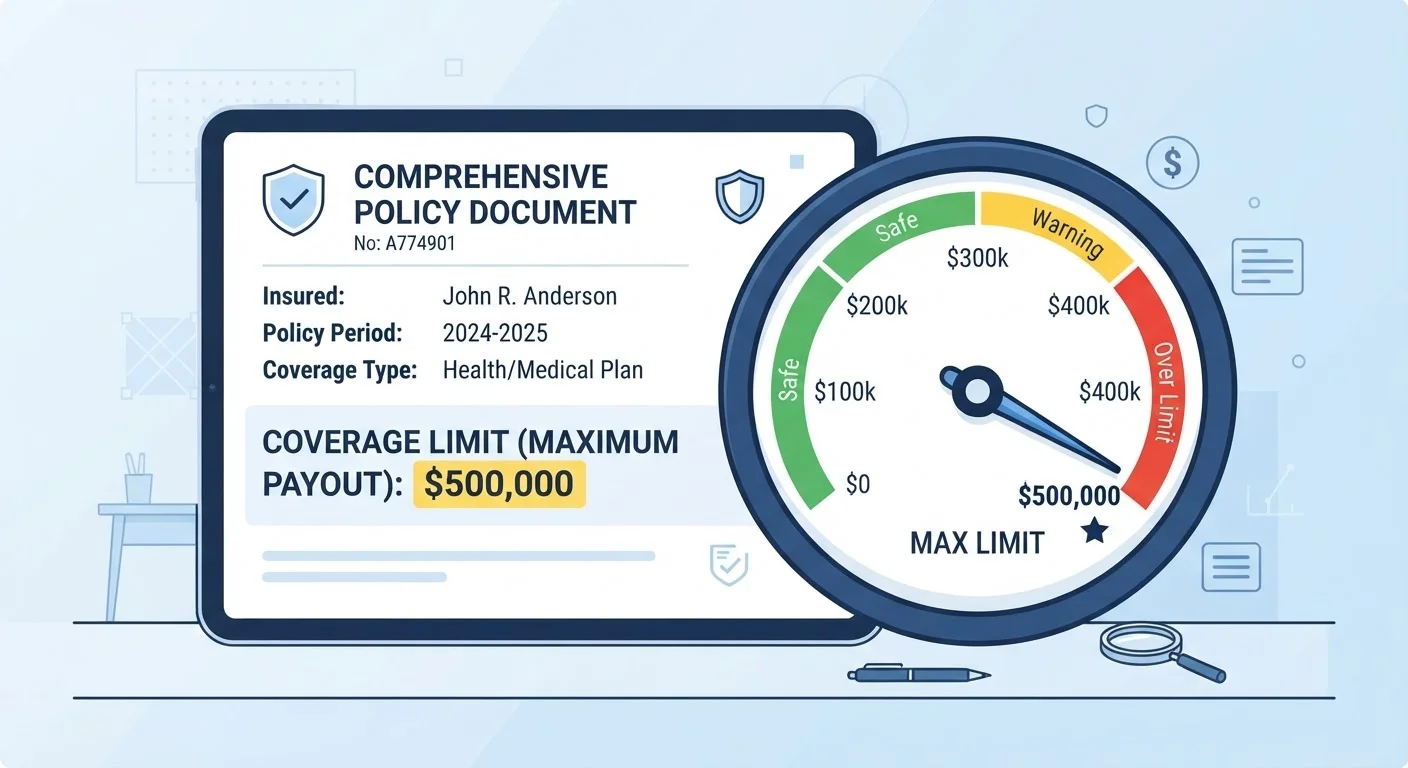
When you buy an insurance policy, you're not purchasing unlimited protection - you're purchasing protection up to a defined ceiling. That ceiling is your coverage limit. Think of it as an agreement: the insurer will pay covered losses up to that amount, and nothing more.
This applies across virtually every type of insurance. A homeowners policy might carry a $300,000 dwelling limit. An auto liability policy might carry $50,000 per person for bodily injury. A business liability policy might cap at $1 million per occurrence. In each case, the limit defines the outer boundary of what the insurer is on the hook to pay.
Understanding your limits is a foundational step in understanding your coverage. As explained in our guide to what insurance coverage actually means, coverage and limit are two distinct concepts - a policy can technically cover a type of loss while still leaving you exposed if the limit is inadequate.
Check Your Declarations Page First
Your policy's declarations page lists every coverage category and its corresponding limit in one place. Pull it out before assuming you know what you're covered for - the actual numbers often surprise policyholders who haven't reviewed them since purchase.
Types of Coverage Limits You'll Encounter
Not all limits work the same way. Understanding the structure matters because it determines exactly how your policy pays out:
- Per-occurrence limit: The maximum paid for a single event, regardless of how many people are affected or how many claims arise from it.
- Per-person limit: Common in auto liability, this caps what the insurer pays for any one injured individual, even if the total per-occurrence limit is higher.
- Aggregate limit: The total maximum the insurer will pay across all claims in a policy period. Once this pool is depleted, no further claims are covered until the policy renews.
- Sub-limits: Some policies set lower caps on specific categories within broader coverage - for instance, a homeowners policy may cover personal property up to $200,000 overall, but cap jewelry losses at $1,500.
This layered structure is why reading the declarations page of your policy - the summary sheet listing your coverages and their corresponding limits - is so important. Liability coverage limits in particular deserve close attention, since liability exposures can easily run into six or seven figures.
1 in 8
Drivers estimated to be uninsured on U.S. roads
According to the Insurance Research Council, approximately one in eight drivers lacks insurance, heightening the risk that insured drivers face gaps when limits are involved in multi-party accidents.
~55%
U.S. homes estimated to be underinsured
CoreLogic research has estimated that a majority of U.S. homes carry dwelling coverage below their actual replacement cost, leaving many homeowners exposed after major losses.
When Your Limit Runs Out: The Real Cost of Underinsurance
Exceeding a coverage limit is not an abstract risk. It happens regularly, particularly in liability situations where injury costs, legal fees, and court awards can escalate far beyond what a standard policy anticipates.
When a claim surpasses your limit, the insurer pays its capped amount and stops. The remaining balance - no matter how large - falls directly to you. Depending on the type of claim, that shortfall could come from your savings, investments, or future income through wage garnishment.
Underinsurance also shows up in property claims. If your home is insured for $250,000 but would cost $380,000 to rebuild at current construction prices, the gap is your problem. Rebuild costs have risen significantly in recent years, which is why limits set years ago may no longer reflect reality.
Our article on common coverage limit miscalculations covers the patterns that lead people to underinsure - many of which are easy to avoid once you know what to look for.
Umbrella Policies: A Common Solution
An umbrella policy is a separate liability policy that activates once an underlying policy's limit - such as your auto or homeowners liability cap - is exhausted. Umbrella policies typically provide $1 million or more in additional coverage and are widely regarded as a cost-efficient way to extend protection for people with meaningful assets to protect. Speak with a licensed insurance professional to understand whether one fits your situation.
How to Evaluate Whether Your Limits Are Adequate
There's no universal right answer to how much coverage is enough - it depends on your assets, your risk exposure, and what you could realistically absorb out of pocket. That said, a few principles can guide the conversation with a licensed insurance professional:
- Match liability limits to your net worth. If you have significant assets, low liability limits leave those assets exposed to judgment creditors. Many financial planning guidelines suggest liability coverage should at least cover your total net worth.
- Use replacement cost, not market value, for property. What you paid for your home - or what it would sell for - is often not what it costs to rebuild it. Make sure dwelling limits reflect current construction costs in your area.
- Review limits at every renewal. Inflation, renovations, new assets, and life changes can all affect how much coverage you actually need.
- Consider an umbrella policy for broader liability protection. These policies extend your liability limits across multiple underlying policies at relatively modest additional cost.
The relationship between coverage limits and premiums isn't always as steep as people assume - and being underinsured to save a few dollars a month can prove far more costly when a major claim arrives.
This article is for general informational and educational purposes only and does not constitute personalized insurance, financial, or legal advice. Coverage terms, limits, and availability vary by insurer, policy, and state. Consult a licensed insurance agent or adviser to assess your specific situation and needs.