What You're Actually Trading
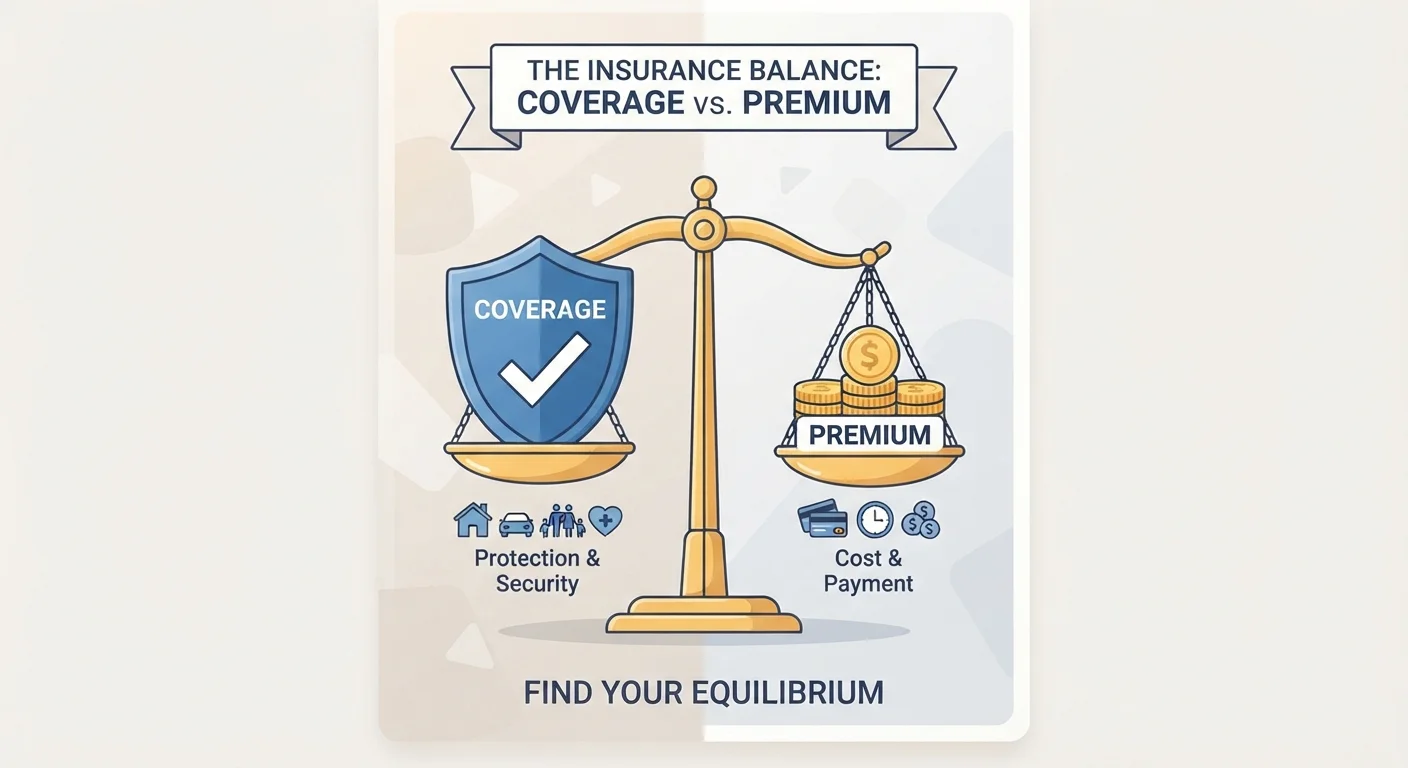
When you buy an insurance policy, the core transaction is a transfer of financial risk. You pay a premium; your insurer agrees to absorb losses up to a defined ceiling - your coverage limit. The higher that ceiling, the more exposure the insurer accepts, and the more they charge to accept it.
This is the fundamental mechanic, but the real-world tradeoff is more nuanced than a simple linear equation. Understanding why that's the case helps you make smarter decisions about where to set your limits - and where not to overpay.
For a deeper look at how premiums are constructed before you even choose a limit, see how insurers calculate your premiums.
~40%
U.S. homeowners estimated to be underinsured
Industry analyses have consistently found that a large share of homeowners carry dwelling limits below the full cost to rebuild, leaving significant gaps in coverage.
15-25%
Typical premium increase for doubling liability limits
Insurance pricing research suggests that significantly raising liability limits often costs a fraction of the proportional increase, reflecting the low probability of catastrophic claims.
Why the Relationship Isn't Linear
Insurers don't price coverage limits by multiplying a flat rate against the dollar amount of protection. They use actuarial data - statistical models that assign probabilities to different loss scenarios. A claim that reaches your full policy limit is typically a rare, catastrophic event. Because those worst-case claims happen less frequently than mid-range claims, insuring the upper tier of a limit often costs less per dollar of coverage than insuring the first layer.
Think of it this way: your auto insurer knows that a minor fender-bender causing $3,000 in damage is far more probable than a catastrophic accident with $300,000 in liability. The first layer of your liability limit is priced to reflect high-frequency, lower-severity losses. The upper layers reflect low-frequency, high-severity scenarios - which cost the insurer more per event, but happen far less often.
This is why raising your liability limit from $100,000 to $300,000 may increase your premium by a modest percentage rather than tripling it. Understanding what your premium actually covers helps clarify this pricing logic.
“Insurance pricing is fundamentally about the cost of transferring risk. The price of the upper layers of a policy is lower per dollar because the catastrophic events they cover, while devastating, are rare. Consumers who understand this often find that buying more protection costs less than they assumed.”
— Insurance Basics Editorial Team, Editorial staff synthesizing actuarial and consumer education principles
How Limits Work Across Insurance Types
The structure of coverage limits varies significantly depending on the type of policy:
- Auto liability: Typically expressed as split limits - for example, $100,000 per person / $300,000 per accident / $100,000 for property damage. Each cap operates independently.
- Homeowners: Dwelling coverage is usually based on estimated replacement cost. Personal property and liability limits are separate. Choosing actual cash value versus replacement cost affects what the limit pays out.
- Life insurance: The coverage limit is the death benefit - a single lump-sum amount. Larger death benefits mean higher premiums, though other factors like age and health status weigh heavily.
- Health insurance: The Affordable Care Act eliminated most lifetime limits for essential health benefits, but annual out-of-pocket maximums function similarly as a cap on your personal exposure.
For a fuller explanation of what coverage limits mean and how exceeding them affects claims, see what a coverage limit really means.
The Interaction With Deductibles
Coverage limits don't operate in isolation - they interact directly with your deductible. Your deductible is the amount you pay first before your insurer steps in; your limit is the ceiling on how much your insurer pays after that. Adjusting one without considering the other can shift risk in ways that aren't immediately obvious.
A high-deductible plan lowers your premium partly because you're absorbing more of the initial loss. But if your coverage limit is also low, you're exposed on both ends - paying more before coverage kicks in and having a lower ceiling once it does. Weighing high-deductible versus low-deductible plans explores how that tradeoff works in practice.
For a complete picture of how premiums, deductibles, and out-of-pocket maximums work as a system, see how premiums, deductibles, and out-of-pocket maximums fit together.
Check Your Limits Alongside Your Deductible
When reviewing your policy, look at your coverage limit and deductible together - not separately. A low limit combined with a high deductible can leave you exposed on both ends of a claim. Ask your insurer to model a few scenarios: what you'd pay out of pocket and what they'd pay at different loss sizes.
Setting Limits That Match Your Actual Exposure
The goal isn't to minimize your premium or maximize your limit in isolation - it's to match your coverage ceiling to the realistic worst-case cost of a loss, relative to what you could absorb out of pocket.
For liability coverage in particular, a useful benchmark is your total net worth and future earning potential. If a judgment against you could exceed your policy limit, the excess becomes a personal liability. For property coverage, replacement cost - not market value - is the right anchor for your dwelling limit.
Setting limits too low is one of the most consequential and underappreciated mistakes in personal insurance. Common miscalculations that cost people later walks through how those errors happen and how to avoid them.
This article is for general informational purposes only and does not constitute personalized insurance, financial, or legal advice. Coverage terms, limits, and premiums vary by insurer, policy, and state. Consult a licensed insurance professional to evaluate the right coverage levels for your situation.