What These Two Terms Actually Mean
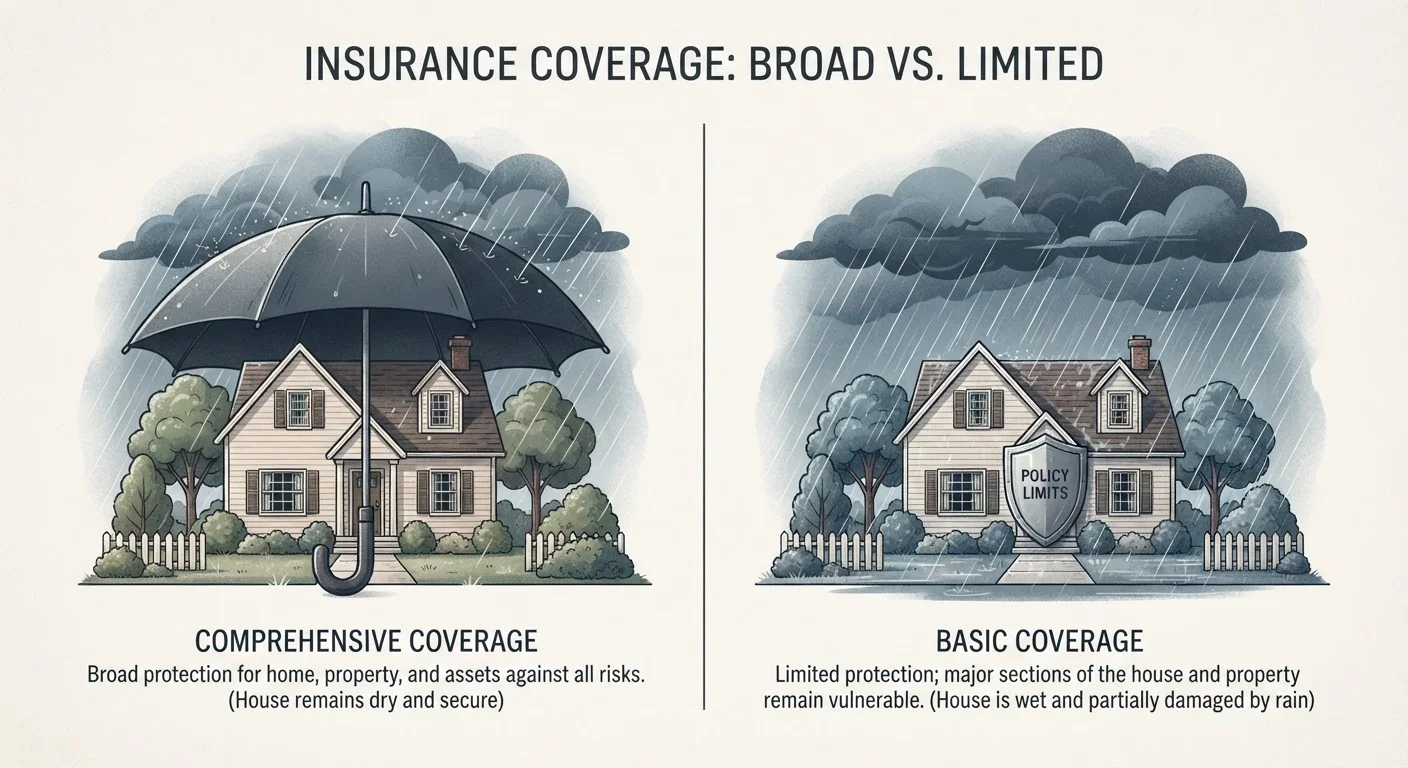
When you purchase a homeowners insurance policy, one of the most consequential decisions embedded in that document is how your covered causes of loss - called perils - are defined. Two structures govern this: open perils (also called "all-risk") and named perils.
Open perils coverage works from an exclusion list. Your policy covers any cause of damage unless the policy specifically excludes it. Common exclusions include flooding, earthquakes, and intentional damage - but anything not mentioned is covered by default. This shifts the burden of proof: if a loss occurs and the insurer wants to deny it, they must point to a written exclusion.
Named perils coverage works from an inclusion list. Your policy only pays for damage caused by risks explicitly named in the document. Typical named perils include fire, lightning, windstorm, hail, theft, and vandalism. If a cause of damage isn't on the list - even if it seems like an obvious accident - the claim can be denied. Here, the burden falls on you to demonstrate that your loss was caused by a listed peril.
Understanding this framework is foundational to reading any home insurance policy. For a broader look at how policy terminology works, our Policy Terms Explained hub is a useful starting point.
| Criterion | Open Perils | Named Perils |
|---|---|---|
| Coverage basis | Covers all causes except exclusions | Covers only listed causes |
| Burden of proof at claim | Insurer must cite a written exclusion | Policyholder must prove a listed peril caused the loss |
| Typical premium | Higher | Lower |
| Coverage gaps | Fewer (limited to explicit exclusions) | More (anything not listed is excluded) |
| Used in HO-3 for dwelling? | Yes | No |
| Used in HO-3 for personal property? | No | Yes |
| HO-5 availability | Applies to both dwelling and contents | Not applicable to HO-5 |
How This Plays Out in a Standard HO-3 Policy
The most common homeowners policy in the United States - the HO-3 - actually uses both structures simultaneously, which surprises many policyholders. The dwelling itself (your home's structure) is covered on an open perils basis, while your personal property is covered on a named perils basis.
This means a mysterious water leak that damages your walls may be covered under the open perils dwelling protection - but if the same event ruins your furniture, your claim for the contents could be denied if that specific cause isn't listed in your named perils section. The asymmetry matters enormously at claim time.
~96%
U.S. homeowners with HO-3 policies
The HO-3 is the dominant homeowners policy form in the U.S., according to industry data from the Insurance Information Institute.
16
Named perils typically listed in HO-8 and HO-2 forms
Standard named perils policies commonly list around 16 covered causes of loss, leaving unlisted events uninsured.
Some insurers offer an HO-5 policy, which extends open perils coverage to both the dwelling and personal property. This provides more consistent, comprehensive protection - and is worth asking about if you have substantial belongings. For a full breakdown of what a standard policy includes and misses, see our guide on homeowners insurance coverages.
Coverage Gaps You Need to Watch For
Even the broadest open perils policy has exclusions that catch homeowners off guard. Flooding is among the most significant - it is excluded from virtually all standard homeowners policies regardless of whether they are open or named perils. You'll need a separate flood insurance policy to address that risk. Our guide on flood insurance vs. homeowners insurance explains the boundary in detail.
Earthquakes, sewer backup, mold from long-term neglect, and wear and tear are other typical exclusions that apply under open perils frameworks. Under named perils, the gap is even wider - if a peril simply wasn't anticipated by the insurer when they drafted your list, it won't appear, and you won't be covered.
Why 'All-Risk' Is a Misleading Label
Open perils coverage is sometimes marketed as 'all-risk,' but that label can be misleading. No policy covers every possible cause of loss - exclusions always apply. When reviewing an open perils policy, focus your attention on the exclusions section just as carefully as you would on the coverage section. What isn't covered matters as much as what is.
For risks tied to natural disasters specifically, coverage varies significantly. Our article on insurance coverage for natural disasters maps which events need their own separate policy.
This article is for general informational and educational purposes only and does not constitute personalized insurance, financial, or legal advice. Coverage terms, exclusions, and availability vary by insurer and state. Read your full policy documents carefully and consult a licensed insurance agent or adviser for guidance specific to your situation.