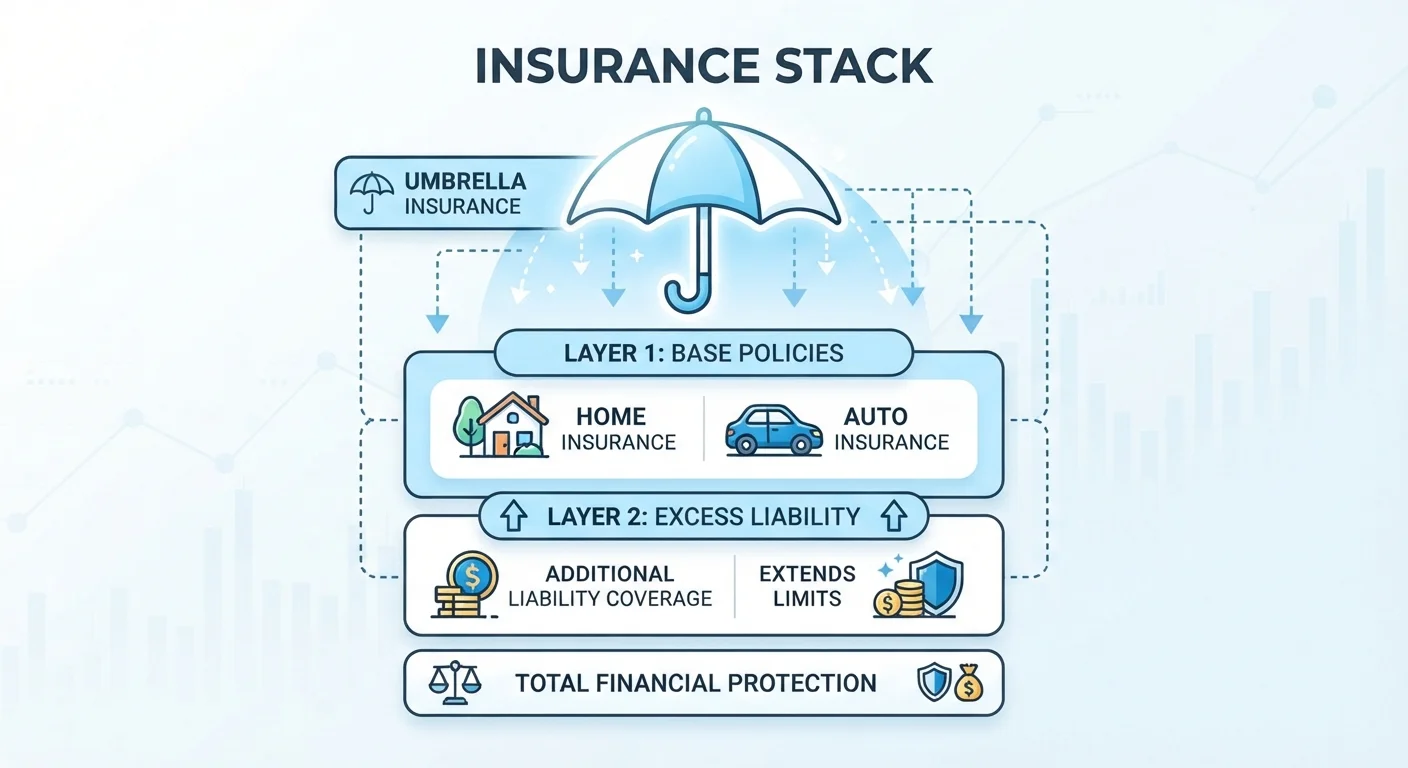
The Layered Structure of Liability Coverage
Think of your insurance coverage as a stack of floors in a building. Your homeowners or auto policy occupies the ground floor - it handles liability claims first, up to a stated dollar limit. The umbrella policy is the floor above it, waiting to carry any weight that the ground floor cannot support alone.
This structure means the umbrella never competes with your primary policy. The two work in sequence. Your auto insurer pays its maximum liability limit; only then does the umbrella insurer step in for anything beyond that threshold. Understanding this sequencing is essential before evaluating whether additional coverage makes sense for your situation.
For a deeper look at how liability coverage functions within individual policies, see how liability limits work across different insurance types.
$1M+
Common starting limit for umbrella policies
Most personal umbrella policies begin at $1 million in additional liability coverage, with higher tiers available in increments.
$300,000
Typical auto liability minimum required by umbrella insurers
Many insurers require policyholders to carry at least $300,000 in auto liability before an umbrella policy can be added.
What "Sitting Above" Your Coverage Actually Means
When insurers say an umbrella policy sits "above" your other coverage, they are describing something called an excess liability arrangement. Your underlying policy has a per-occurrence limit - the maximum it will pay for a single event. Once a claim hits that ceiling, the umbrella policy's coverage begins.
Here is a simplified example: suppose your auto liability limit is $300,000 and a serious accident results in $750,000 in damages awarded against you. Your auto policy covers the first $300,000. The remaining $450,000 would fall to your umbrella policy - provided that amount is within the umbrella's own limit, which is commonly $1 million or more.
Umbrella policies also typically extend to a broader set of situations than your underlying policies. Some cover liability arising from incidents your home or auto policy may exclude entirely, such as claims related to defamation or certain landlord liabilities. See what umbrella insurance covers that your other policies don't for a fuller breakdown.
Check Your Underlying Limits Before Shopping
Before inquiring about an umbrella policy, pull out your current auto and homeowners declarations pages. Note your existing liability limits. Knowing these numbers will help you have a more productive conversation with a licensed agent about whether you meet the underlying minimum requirements and what umbrella options might be appropriate for your situation.
The Underlying Coverage Requirement
One of the most misunderstood aspects of umbrella policies is that they come with a condition: you must carry a minimum level of liability on your underlying policies for the umbrella to remain valid. Insurers set these minimums - often in the range of $250,000 to $300,000 for auto liability and $300,000 for homeowners liability - because the umbrella is designed to kick in after those limits are exhausted, not to serve as a first line of defense.
If your underlying liability coverage falls below the required minimum, your insurer may deny an umbrella claim or leave you responsible for the gap between your actual underlying limit and the required minimum. This gap is sometimes called a retained limit or self-insured retention.
For readers building their understanding of auto coverage from the ground up, auto insurance coverage basics explains each layer and why minimums matter. You can also explore the choosing coverage hub for guidance on evaluating the right combination of policies.
Why the Layered Model Matters for Real-World Claims
Liability judgments and settlements from serious incidents - a multi-vehicle accident, a significant injury on your property, a lawsuit over a rental unit - can reach amounts that standard policy limits were never designed to absorb. The layered model exists precisely because no single policy is intended to be unlimited.
Understanding where your coverage ends and where additional protection would begin is a practical first step before discussing options with a licensed insurance agent. It allows you to ask informed questions: What are my current liability limits? What is the underlying minimum required for an umbrella? What scenarios might fall outside both layers?
To understand where standard liability coverage leaves gaps, umbrella insurance and core policy gaps walks through the common shortfalls. For a complete breakdown of what individual auto policy types cover, see auto insurance coverage types.
This article is for general informational purposes only and does not constitute personalized insurance, financial, or legal advice. Coverage terms, limits, exclusions, and eligibility vary by insurer and state. Always read your actual policy documents and consult a licensed insurance agent or adviser for guidance specific to your situation.