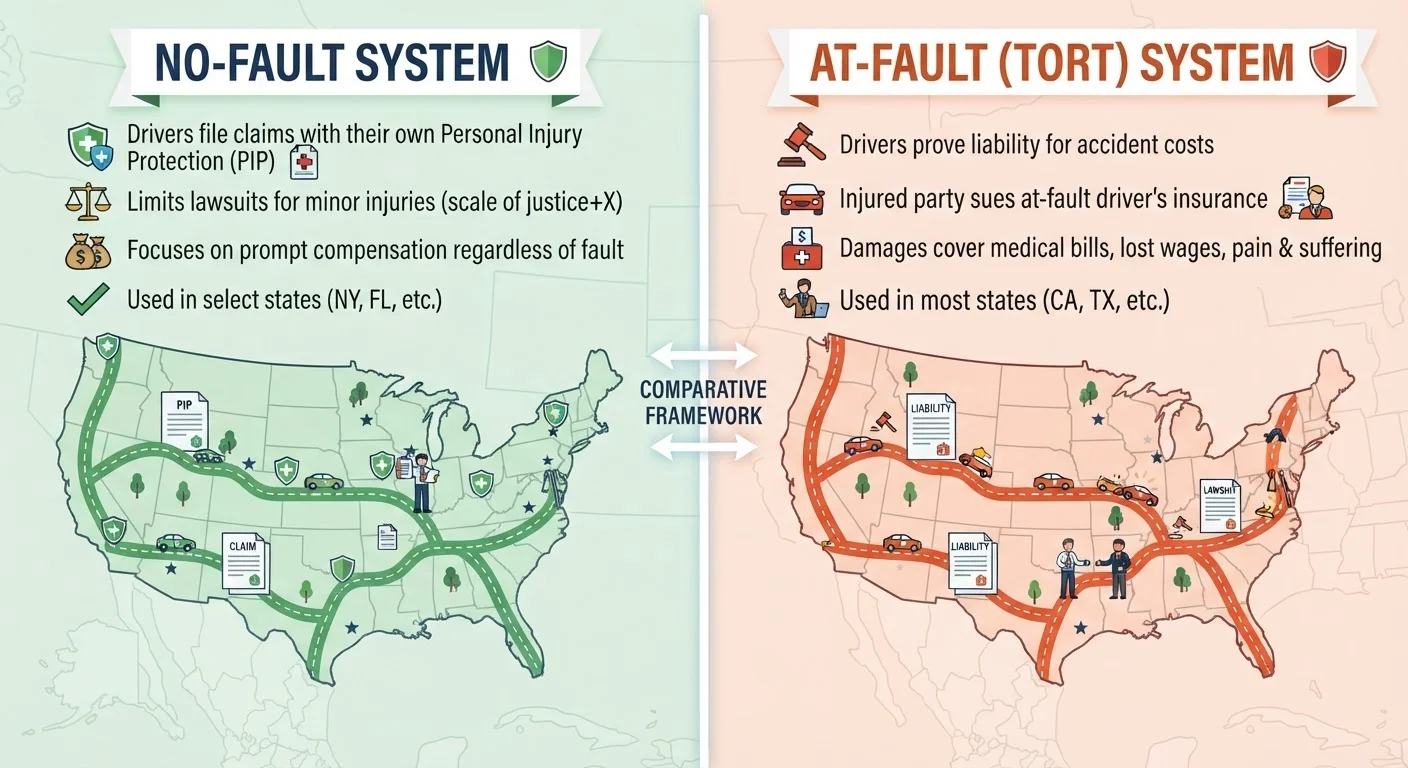
The Two Systems: How Each One Works
Auto insurance in the United States operates under one of two foundational legal frameworks: no-fault or at-fault (also called a tort system). The system in effect where you register and drive your vehicle determines how medical costs and property damage are handled after a collision - and who pays what.
In a no-fault state, each driver turns to their own auto insurance policy after an accident, regardless of who caused it. This coverage is called Personal Injury Protection (PIP). PIP pays for your medical bills, lost wages, and certain other costs up to your policy's limit, without requiring you or your insurer to first establish that another driver was to blame. To learn how PIP compares to Medical Payments coverage, see our breakdown of MedPay vs. PIP.
In an at-fault state, the driver determined to be responsible for the accident - or more precisely, their liability insurance - is expected to cover the injured party's medical expenses and property damage. If the at-fault driver is uninsured or underinsured, the injured party may need to rely on their own uninsured motorist coverage or pursue legal action.
| Criterion | No-Fault States | At-Fault States |
|---|---|---|
| Who pays medical bills first | Your own PIP coverage | At-fault driver's liability insurer |
| Required coverage type | PIP + liability | Liability (bodily injury & property damage) |
| Right to sue other driver | Restricted; serious injury threshold applies | Generally unrestricted via tort claim |
| Fault determination needed to start claim | No - own insurer pays regardless | Yes - fault must be established |
| Speed of medical claim payment | Typically faster | Can be slower pending fault resolution |
| Pain and suffering claims | Limited; threshold must be met | Available through liability claim or lawsuit |
| Number of U.S. states | ~12 states + D.C. | ~38 states |
State-by-State Rules and Required Coverages
As of current state law, approximately twelve states plus Washington D.C. operate under a no-fault framework. These include Florida, Michigan, New York, New Jersey, Pennsylvania, Hawaii, Kentucky, Kansas, Massachusetts, Minnesota, North Dakota, and Utah. The remaining states follow at-fault rules, though a few offer choice no-fault options.
~12
U.S. states operating under no-fault rules
Including Washington D.C., roughly a quarter of U.S. jurisdictions require PIP and restrict direct lawsuits after minor accidents.
~38
States using the at-fault tort system
The majority of U.S. states assign financial responsibility to the driver determined to have caused the accident.
Varies widely
State minimum PIP limits in no-fault states
Required PIP minimums differ substantially by state - from a few thousand dollars to unlimited medical coverage in some jurisdictions, according to state department of insurance resources.
Because no-fault states mandate PIP, drivers there are required to carry at least a minimum level of that coverage in addition to standard liability insurance. The required PIP minimums vary significantly by state - Michigan, for example, has historically required more comprehensive PIP than other no-fault states. Always verify your state's current minimums with your state's department of insurance.
At-fault states require liability coverage - bodily injury and property damage - so that a driver who causes a crash can compensate others. The specific minimum limits differ by state. For a fuller picture of what each coverage type actually protects, see our guide to auto insurance coverage types.
One important nuance: in no-fault states, your right to sue another driver for additional damages is typically restricted. You can generally only file a lawsuit if injuries cross a legally defined serious injury threshold - such as permanent disability, significant disfigurement, or death. This threshold is designed to reduce minor-injury litigation.
Coverage Gaps and Practical Implications
Understanding your state's system matters not just for legal compliance, but for protecting your finances after a real accident. Drivers sometimes hold inaccurate assumptions about what their policy will pay - for a closer look at common misconceptions, see our article on auto insurance myths.
In no-fault states, PIP limits can run out quickly after a serious accident. If your medical costs exceed your PIP ceiling, you may need to rely on your health insurance or, if your injuries meet the serious-injury threshold, pursue the at-fault driver directly. Carrying higher PIP limits reduces this risk.
In at-fault states, your recovery depends heavily on the other driver having sufficient liability coverage. If they carry only the state minimum - which may be quite low - a gap can exist between what their insurer pays and your actual losses. This is precisely why uninsured and underinsured motorist coverage exists. See our explanation of minimum vs. full coverage and how liability-only differs from full coverage for context on those gaps.
Choice No-Fault States Add Complexity
A small number of states - including Kentucky, New Jersey, and Pennsylvania - offer a hybrid or 'choice' no-fault system. In these states, drivers can elect either the no-fault PIP path or the traditional tort path when purchasing their policy. The choice typically affects both your premium and your legal rights after a crash. If you live in a choice state, reviewing both options carefully with a licensed agent is especially important.
This article provides general educational information about auto insurance frameworks and is not personalized legal or insurance advice. Coverage requirements, terms, and exclusions vary by state and by policy. Consult a licensed insurance professional and review your actual policy documents to understand the rules that apply to your specific situation.