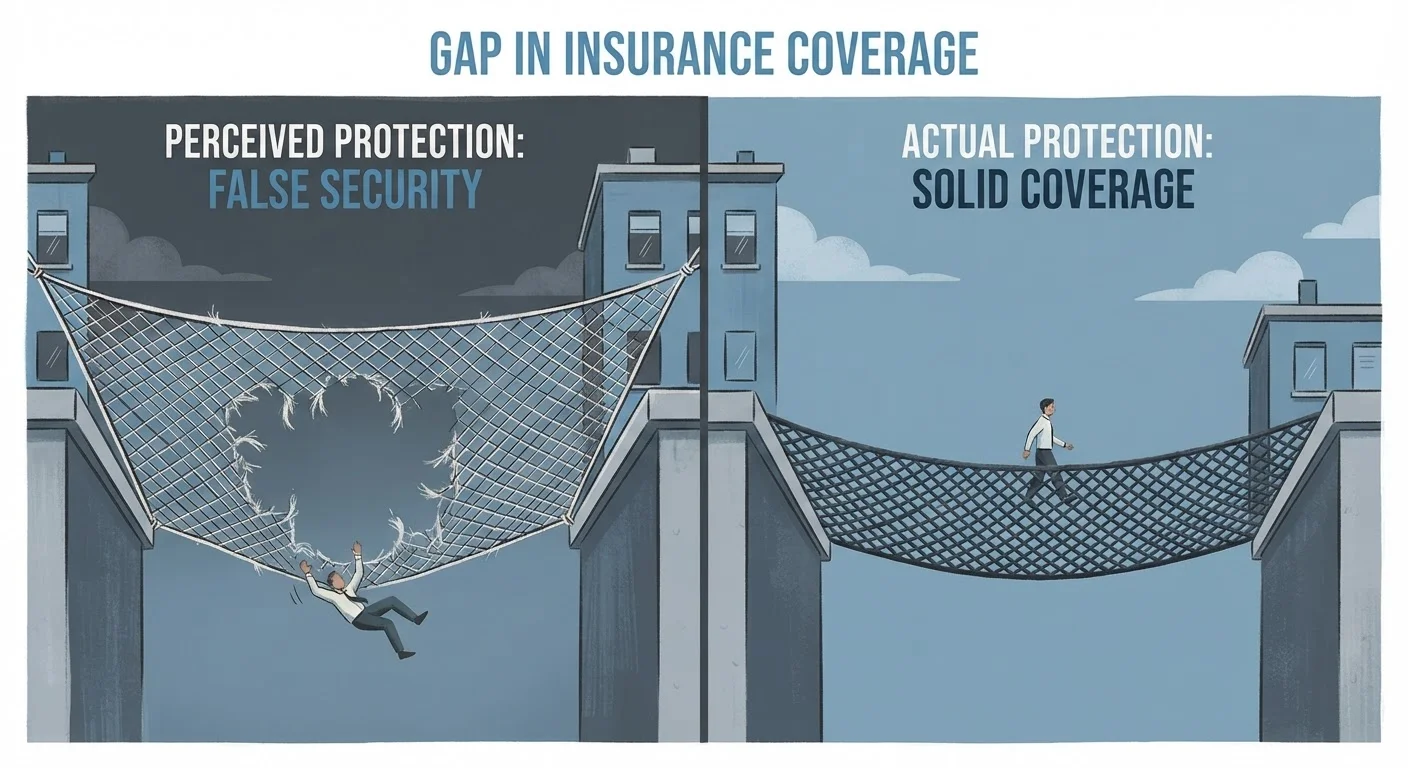
The Hidden Risk in Policies People Already Hold
Most conversations about insurance risk focus on the uninsured - people with no policy at all. But a quieter and equally serious problem affects millions of American households: carrying coverage that simply isn't enough. As explained in our article on what coverage limits really mean, an insurer's obligation ends at the policy cap, regardless of the size of your actual loss.
Underinsurance doesn't announce itself. Your premium arrives, you pay it, and you assume you're protected. The gap only becomes visible in a crisis - a house fire, a serious car accident, a medical emergency - at which point the insurer fulfills its contractual obligation to the policy limit and the rest falls to you.
Underinsurance Is Not a Legal Violation
Unlike driving without any auto insurance - which is illegal in most states, as covered in our article on driving without car insurance - being underinsured is not against the law. The consequences are purely financial: your insurer pays what the policy allows, and you absorb the rest. That distinction matters because it means underinsurance often goes unaddressed - there's no penalty that forces a review.
This article provides general information about insurance concepts. Coverage terms, limits, and exclusions vary significantly by policy and by state. Consult a licensed insurance professional about your specific situation.
How Underinsurance Develops Over Time
Underinsurance is rarely a deliberate choice. It develops through a combination of inaction and changing circumstances. Consider the most common ways it happens:
- Stagnant coverage limits: A homeowner buys a policy a decade ago reflecting rebuild costs at that time. Construction costs have since risen sharply, but the coverage limit hasn't moved.
- Improvements not reported: A kitchen remodel or finished basement adds significant value to a home - but if the insurer isn't informed, that added value isn't covered.
- Low-limit plans chosen for premium savings: To reduce monthly costs, some people select higher deductibles or lower liability caps, not fully accounting for what they'd owe in a worst-case scenario.
- Life changes that outpace coverage: An income increase, a new dependent, or a valuable inheritance can raise financial exposure without triggering a policy review.
Our guide to common coverage limit miscalculations explores how these errors compound over time.
~80%
U.S. homes estimated to be underinsured
Insurance industry analyses have long estimated that a large majority of American homes are insured for less than their full replacement cost, with the gap often exceeding 20%.
1 in 8
Drivers on U.S. roads without insurance
According to the Insurance Research Council, approximately one in eight drivers is uninsured - a figure that doesn't account for those with liability limits too low to cover a serious accident.
$7,500
Average out-of-pocket health maximum (individual, 2024)
The IRS sets annual out-of-pocket limits for high-deductible health plans; even fully compliant plans can expose enrollees to thousands in costs before full coverage begins.
Where Underinsurance Shows Up Most Often
Underinsurance touches virtually every major insurance category, though it takes different forms in each:
Homeowners Insurance
The most documented form of underinsurance. If your dwelling coverage limit is lower than the actual cost to rebuild your home - using current labor and material prices - you will face an out-of-pocket shortfall after a total loss. Standard replacement cost estimates can become outdated quickly in volatile construction markets.
Auto Insurance
State minimum liability limits are often far lower than the real-world cost of a serious accident. If you cause an accident that results in significant injuries or property damage, your insurer pays up to your limit - and plaintiffs can pursue you personally for the rest. Separately, if another driver hits you with inadequate insurance, that's where underinsured motorist coverage matters, as detailed in our piece on underinsured motorist protection.
Health Insurance
High-deductible plans have made health underinsurance more common. A policy that requires $7,000 in out-of-pocket costs before full coverage kicks in provides genuine protection against catastrophic bills - but only if the policyholder has the financial reserves to absorb that deductible.
Renters Insurance
Many renters set personal property limits without a full home inventory, leaving high-value electronics, jewelry, or musical instruments unaccounted for.
Request a Replacement Cost Estimate
For homeowners, ask your insurer or agent for an updated replacement cost estimate - not your home's market value, but the cost to rebuild it from the ground up at today's material and labor prices. These figures can diverge significantly, especially after periods of rapid construction cost increases. Doing this every few years is a straightforward way to catch a coverage gap before it becomes a claim-time problem.
Assessing Your Own Coverage Without Guesswork
You don't need to be an insurance expert to identify whether your coverage is adequately sized. A few practical steps help clarify the picture:
- Pull out your declarations page - the summary sheet at the front of each policy. This shows your coverage limits, deductibles, and any endorsements. Compare your dwelling limit to local construction cost estimates, not your home's market value.
- Conduct a home inventory. Walk through your home and document your belongings with photos or video. This exercise often reveals coverage gaps in personal property limits.
- Check your liability exposure. If your net worth or income has grown, your liability limits on auto and homeowners policies should reflect that - otherwise, a judgment could exceed your coverage.
- Revisit coverage after any major life event. Marriage, divorce, a new child, a raise, a home renovation - each changes your risk profile.
Our article on mapping your insurance needs provides a broader framework for evaluating your full coverage picture before making any changes.
This article is for general informational purposes only and does not constitute insurance, financial, or legal advice. Coverage terms vary by policy and jurisdiction. Consult a licensed insurance professional for guidance specific to your situation.