Who Holds the Policy - and Why It Matters
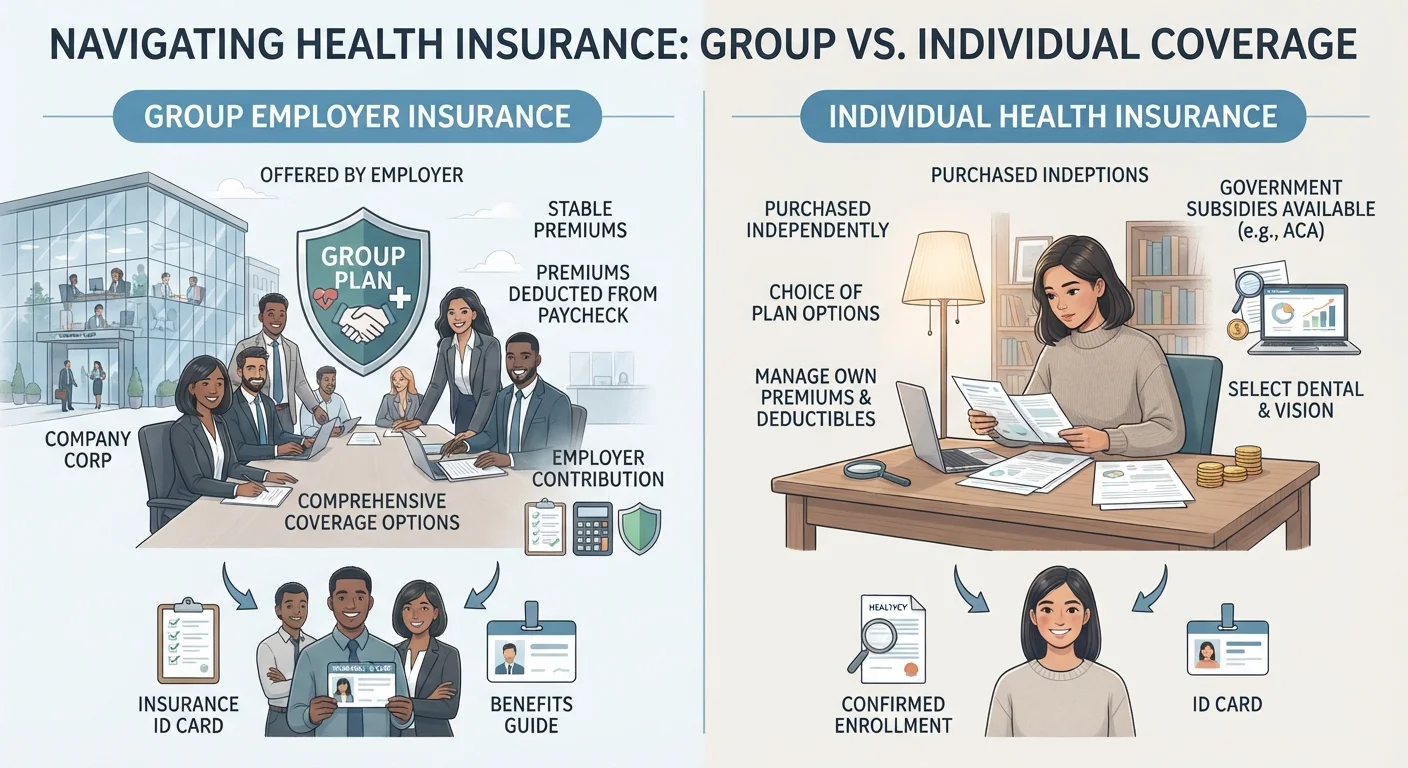
The most fundamental distinction between group and individual insurance is who actually purchases and owns the policy. In a group plan, the policyholder is the employer, union, or association - not you. You participate in coverage that the organization has arranged and partly finances on your behalf. In an individual plan, you are the policyholder. You shop for, purchase, and maintain the coverage yourself.
This structural difference cascades into almost every other aspect of how the two plan types work: pricing, eligibility, plan design, and what happens when your life circumstances change. Before comparing premiums or deductibles, it helps to understand that you're comparing two fundamentally different contractual relationships - and that understanding gives you a clearer lens for evaluating your options. For a grounding in what coverage actually entails at the policy level, see what insurance coverage really includes.
How Risk Pooling Shapes Cost and Access
Group insurance works by pooling risk across all eligible members of the group. Insurers price group plans based on the overall health and demographic profile of the enrolled population, not on any single individual's medical history. This pooling typically produces lower per-person premiums than a comparable individual plan would cost - and employers usually contribute a portion of those premiums, reducing your out-of-pocket share further.
Individual insurance prices coverage based on the specific applicant. Depending on the market and plan type, insurers may use age, location, tobacco use, and - in some market segments - health history to set premiums. The Affordable Care Act (ACA) prohibits most individual-market plans sold through state and federal marketplaces from charging more based on health status or pre-existing conditions, but that protection does not apply uniformly to all plan types (such as short-term health plans or certain association plans).
| Group Insurance | Individual Insurance | |
|---|---|---|
| Policyholder | Employer or organization | The individual consumer |
| Risk pricing basis | Pooled across group members | Based on individual profile |
| Premium contribution | Employer typically shares cost | Consumer pays full premium |
| Medical underwriting | Generally not required at enrollment | May apply outside ACA marketplace |
| Portability | Ends when employment ends | Stays with the individual |
| Plan choice | Limited to employer's offerings | Wider market selection |
| Primary regulation | ERISA (federal) | State insurance departments + ACA |
This difference in risk logic also explains why group plans generally don't require medical underwriting for employees who enroll during open or initial enrollment periods. Individual applicants purchasing outside marketplace protections may face more rigorous review. For a deeper look at how underwriting affects eligibility and cost, see how guaranteed-issue and underwritten products differ.
Regulatory Frameworks and Consumer Protections
Group plans offered by private employers with 50 or more full-time employees fall primarily under ERISA, a federal law that governs plan administration, disclosure requirements, and claims processes. Smaller employer plans and individual plans are more heavily regulated by state insurance departments, meaning the consumer protections you receive can vary significantly depending on where you live and how your employer is structured.
ACA-compliant individual marketplace plans must cover ten categories of essential health benefits, cap out-of-pocket costs, and cannot deny coverage based on pre-existing conditions. Large group plans must also meet certain ACA requirements, but have more flexibility in plan design. Individual plans purchased outside the ACA marketplace - including short-term plans - may carry fewer mandated protections.
Review Your Summary of Benefits Carefully
Whether you're enrolled in a group or individual plan, your insurer is required to provide a Summary of Benefits and Coverage (SBC) - a standardized document explaining what the plan covers, what it costs, and its key limitations. Reading the SBC before you need care is one of the most effective ways to avoid unexpected gaps. If anything is unclear, a licensed insurance agent or broker can help you interpret the terms without obligation to sell you a specific product.
Understanding which regulatory framework governs your plan tells you which appeals processes, external review rights, and minimum benefit standards apply to you. This is information worth knowing before you need to file a claim.
Portability and What Happens When Coverage Ends
One of the most practically significant differences between group and individual insurance is portability. Individual plans stay with you regardless of where you work. Group plans do not - when employment ends, your participation in the group plan ends as well.
Federal law (COBRA) allows most workers leaving a job to temporarily continue group health coverage, but at the full unsubsidized premium plus an administrative fee. This can be substantially more expensive than what you paid as an active employee. Alternatively, losing group coverage generally qualifies you for a Special Enrollment Period to purchase an individual marketplace plan outside of the standard open enrollment window.
If you're navigating coverage across multiple plans - for example, if you're covered by both a group plan and an individual or spousal plan - the question of which pays first becomes important. See how coordination of benefits works between primary and secondary coverage for guidance on that scenario.
Plan Design, Choice, and Flexibility
In a group plan, your employer typically selects from a menu of plan designs offered by the insurer and presents those options to employees. You choose among what's offered - you don't design the coverage from scratch. This can mean limited choice of plan type, network, or cost-sharing structure, though larger employers sometimes offer multiple tiers.
Individual plans give you more control over plan design. On the ACA marketplace, you can compare plans across metal tiers (Bronze, Silver, Gold, Platinum), network types, and insurers. For a side-by-side look at how HMO, PPO, EPO, and HDHP structures differ within these markets, see how HMO, PPO, EPO, and HDHP structures compare.
Greater choice also means greater responsibility. Without an employer filtering options, individual buyers must evaluate networks, formularies, and cost-sharing structures independently. Before you begin comparing plans, it's worth mapping your actual coverage needs - assessing your risk profile before you shop provides a structured starting point for that process.
This article is for general informational purposes only and does not constitute personalized insurance, financial, or legal advice. Coverage terms, costs, and regulations vary by provider, plan type, and state. Always review actual policy documents and consult a licensed insurance professional for guidance specific to your situation.