What Each Approach Actually Means
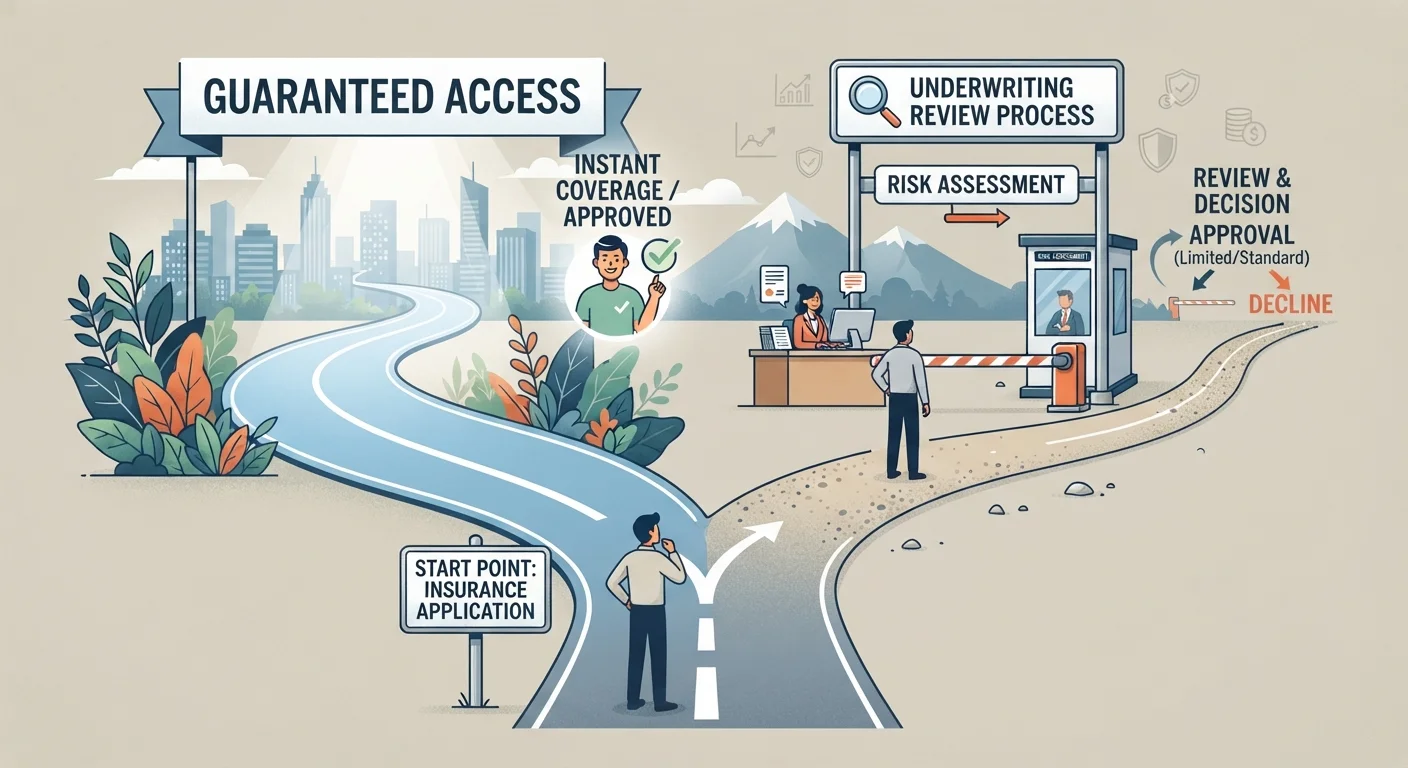
Guaranteed issue (sometimes called guaranteed acceptance) means an insurer agrees to cover anyone who meets basic eligibility criteria - usually age or residency - without asking about health status, medical history, or financial background. The insurer accepts the risk of an unknown applicant pool, so it prices premiums and structures benefits accordingly.
Underwritten insurance involves a review process before a policy is issued. Underwriters - the people or systems that assess risk - evaluate factors like your medical history, current health, occupation, lifestyle, and sometimes finances. Based on that review, the insurer may approve you at a standard rate, charge a higher premium to offset elevated risk, exclude certain conditions from coverage, or decline your application entirely. For a deeper look at how that evaluation works, see how underwriters assess risk before issuing a policy.
Both structures appear across multiple insurance types - life, health, disability, and long-term care - so recognizing which model a product uses helps you predict both your odds of qualifying and what you will pay.
Side-by-Side: How the Two Models Compare
The structural differences between guaranteed issue and underwritten policies affect more than just the application process. They shape premiums, benefit design, waiting periods, and long-term value.
| Criterion | Guaranteed Issue | Underwritten |
|---|---|---|
| Application health questions | None required | Questionnaire or full exam |
| Risk of denial | Very low (eligibility-based only) | Possible based on risk profile |
| Premium relative to benefit | Higher cost per dollar of coverage | Lower for favorable risk profiles |
| Benefit limits | Generally lower caps | Broader coverage available |
| Waiting periods | Common (graded benefits) | Typically none after approval |
| Pre-existing condition treatment | Usually covered after waiting period | May be excluded or rated higher |
| Approval speed | Fast - often immediate | Can take days to weeks |
One structural feature worth noting: many guaranteed issue life insurance policies include a graded death benefit - a waiting period (commonly two to three years) during which full benefits are not paid for non-accidental death. This limits the insurer's exposure in the short term. Underwritten policies typically pay the full face value from day one, because the review process has already filtered the risk.
For context on how pre-existing condition rules interact with these two models, see how pre-existing condition clauses work and have changed.
Tradeoffs You Should Factor Into Your Decision
Neither model is inherently superior - each makes different tradeoffs that suit different circumstances.
~15%
Adults potentially uninsurable under traditional underwriting
Estimates from health policy researchers suggest a meaningful share of the working-age population has conditions that could lead to coverage denial or exclusion under individual underwritten products outside of ACA-regulated markets.
2-3 years
Typical graded benefit waiting period on guaranteed issue life policies
Most guaranteed issue whole life policies limit the death benefit for the first two to three years of the policy to return-of-premium plus interest for non-accidental death, according to standard industry product structures.
Guaranteed issue tradeoffs: Access is broad, but benefit limits are usually lower, premiums are higher relative to the coverage amount, and waiting periods may delay full benefit eligibility. These products serve an important role for people with limited options, but they are rarely the most cost-efficient choice for someone who can qualify through standard underwriting.
Underwritten policy tradeoffs: Competitive pricing and richer benefits come at the cost of uncertainty. Even a thorough, honest application can result in a higher-rated policy or outright denial. The process can also take time - medical exams, records requests, and reviews can span several weeks. Renewability terms are another variable to evaluate once you've been issued a policy, since underwritten products sometimes allow insurers more latitude at renewal.
Insurance is also not limited to individual human policyholders. Products like pet insurance use underwriting-adjacent processes. See how pet insurance coverage is structured for a parallel example of how eligibility rules and exclusions are applied in a different context.
Applying This Knowledge Before You Sign
Knowing which model a policy uses should come before you evaluate premiums or benefit schedules. Ask directly: Does this policy require any health or financial underwriting? If the answer is no, set expectations accordingly - access will be easier, but the cost-per-dollar-of-benefit will likely be higher and limitations may apply early in the policy term.
If underwriting is involved, gather your medical records, understand what conditions might affect your application, and ask whether the insurer uses simplified underwriting (a short questionnaire) or full underwriting (a medical exam and records review). The type of underwriting affects how long the process takes and what information you will need to provide.
Simplified Issue: A Middle Ground
Some policies use a simplified underwriting model - a short health questionnaire without a medical exam or records request. Simplified issue products sit between full guaranteed acceptance and comprehensive underwriting. They are faster than traditional underwriting but still screen for certain conditions, so approval is not guaranteed. If you see this term on an application, understand it is not the same as guaranteed issue.
Before committing to any policy - guaranteed issue or underwritten - review the full document carefully. Key questions to ask before signing any insurance policy walks through what to verify, from exclusions to renewal terms, so you are not surprised after the policy is in force. And if you are comparing how employer-sponsored and individual policies handle these access rules differently, see group vs. individual coverage structural differences.
This article is for general informational and educational purposes only and does not constitute personalized insurance, financial, or legal advice. Coverage terms, eligibility rules, premiums, and exclusions vary by insurer and by state. Always read actual policy documents carefully and consult a licensed insurance agent or adviser before making coverage decisions.