Why Two Policies Don't Simply Double Your Coverage
Many people find themselves covered by more than one insurance policy at the same time. A spouse may be on an employer plan while also enrolling in a partner's group health plan. A driver may have personal auto coverage and a policy through a car rental. In each case, a reasonable question arises: which policy actually pays?
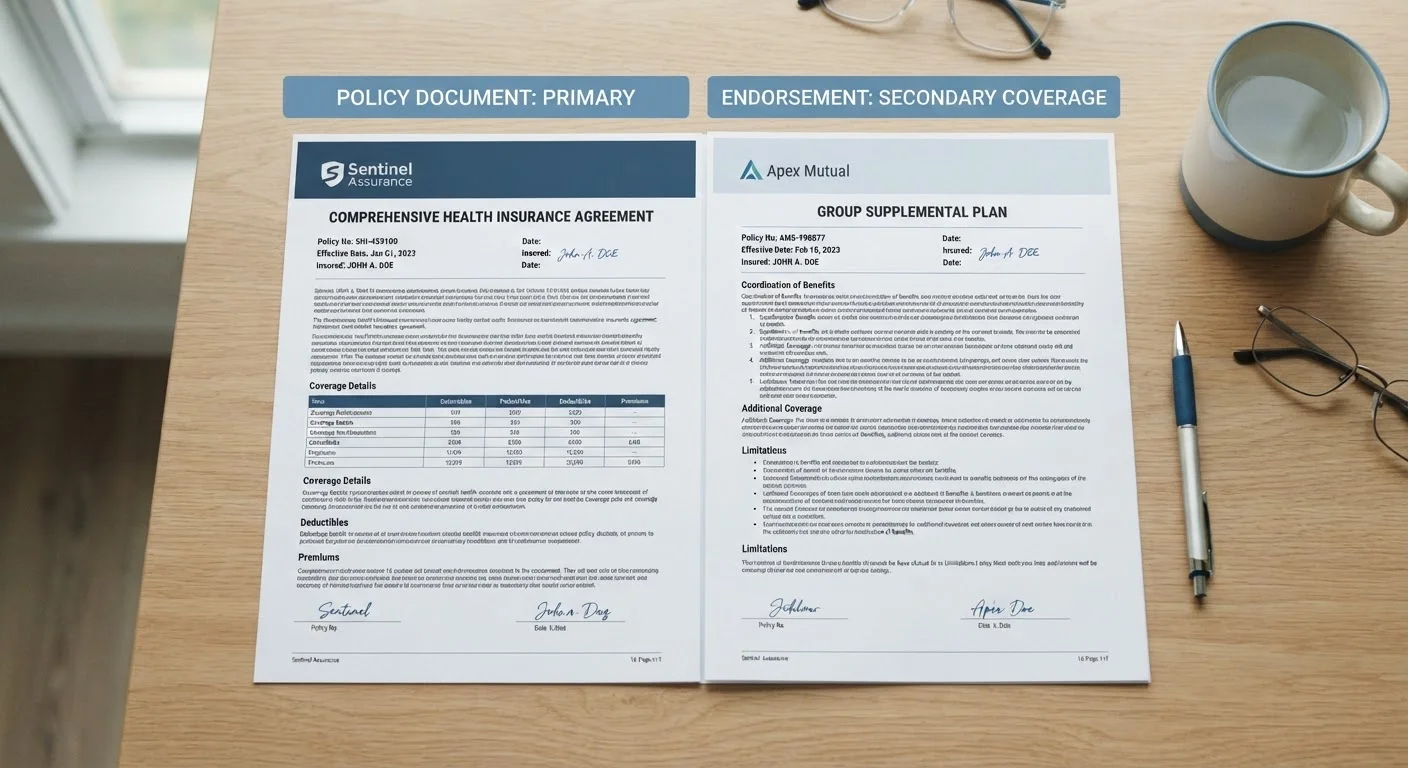
The answer lies in the concept of coordination of benefits - the set of rules that determines how two policies work together without allowing a policyholder to collect more than their actual loss. To understand how coordination of benefits works, you first need to understand the roles each policy plays.
The primary insurer pays first, processing the claim as if no other coverage exists and paying up to its own limits. The secondary insurer then reviews what remains - things like deductibles, coinsurance, or costs above the primary's limits - and applies its own coverage rules to those leftovers. The combined payout from both plans, however, will not exceed the actual cost of the claim.
~43 million
Americans with dual health coverage
Research from the Kaiser Family Foundation has estimated tens of millions of Americans hold coverage under more than one health plan at some point, including through spousal or dependent enrollment.
50
States with coordination of benefits regulations
All U.S. states regulate coordination of benefits in some form, though the specific rules - including the birthday rule and order-of-benefit determination - vary by state and insurer.
How the Primary Payer Gets Determined
The designation isn't arbitrary. Insurers use established coordination rules - often set or approved by state regulators - to decide which policy takes the lead. Some common principles include:
- Employment status: A plan tied to your own employer is usually primary over a plan you hold as a dependent on someone else's policy.
- The birthday rule (for dependents): For children covered under both parents' plans, most insurers use the birthday rule - the parent whose birthday falls earliest in the calendar year holds the primary plan for the child. This is a widely adopted standard, though variations exist.
- Active vs. continuation coverage: An active employer-sponsored plan typically takes priority over a continuation plan such as COBRA.
If the designation isn't immediately obvious, your insurers can clarify it. You can also review key insurance terms every consumer should know before comparing your plans.
Always Notify Both Insurers Upfront
When you have dual coverage, inform both insurers at the time of enrollment or when a new policy begins - not after a claim arises. Most policies require disclosure of other applicable coverage. Proactively sharing this information helps each insurer coordinate correctly and prevents delays or disputes at claim time.
What Secondary Coverage Actually Covers
Secondary coverage doesn't guarantee a zero-dollar bill - it simply takes another look at what the primary left unpaid. What happens next depends entirely on the secondary policy's own rules.
For instance, if your primary health plan pays 80% of an in-network visit after your deductible, the remaining 20% (your coinsurance) becomes the starting point for your secondary insurer. That insurer may cover some or all of it, depending on its terms. It may also apply its own deductible first, potentially leaving you with a remaining balance.
Understanding what insurance coverage actually means - including exclusions and cost-sharing - is essential before assuming secondary coverage will eliminate your out-of-pocket costs.
This article provides general insurance information for educational purposes only. It is not personalized financial, legal, or insurance advice. Coverage rules, terms, and regulations vary by insurer and by state. Always read your actual policy documents and consult a licensed insurance agent or adviser for guidance on your specific situation.