What Each Valuation Method Actually Calculates
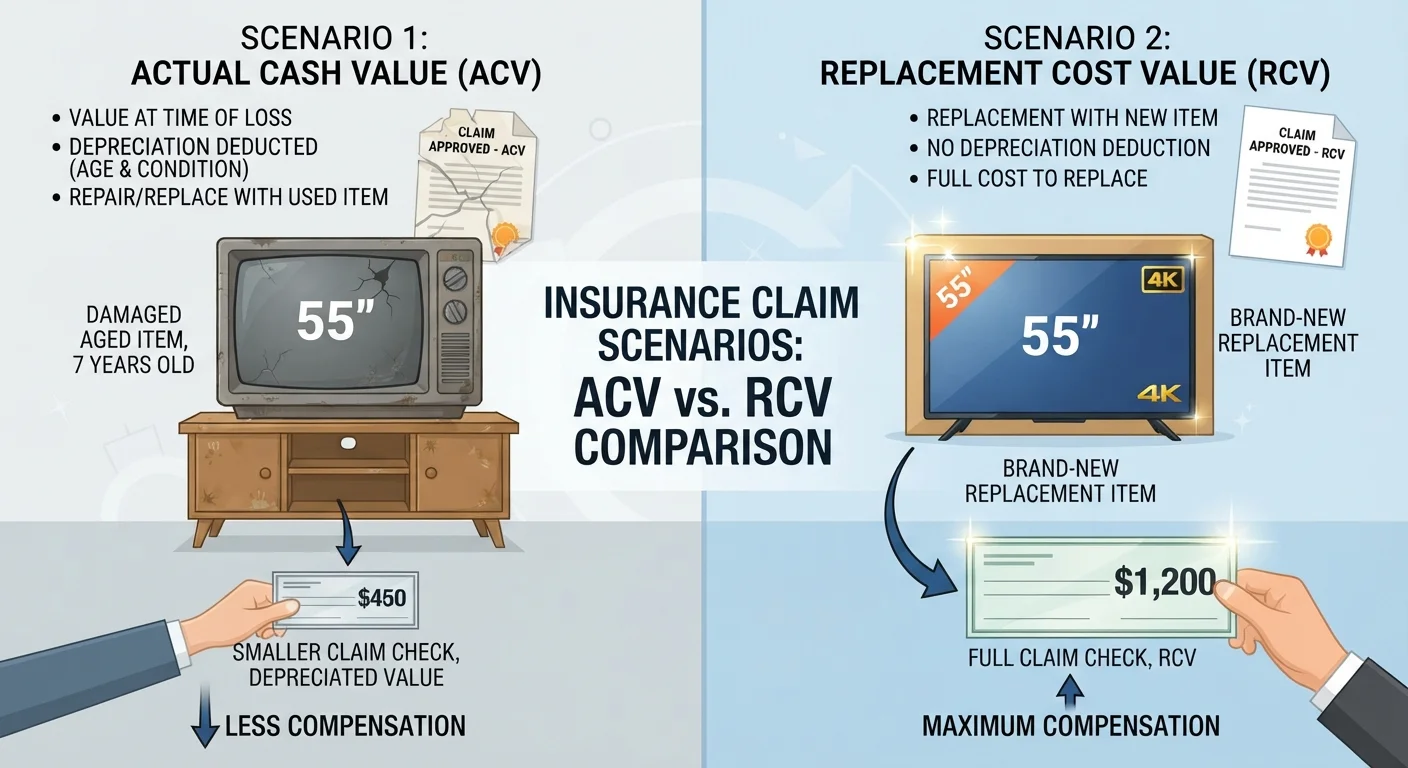
When a covered loss occurs - a fire, theft, or storm - your insurer determines how much to pay based on the valuation method written into your policy. The two most common methods are Actual Cash Value (ACV) and Replacement Cost Value (RCV), and they produce meaningfully different dollar amounts.
Actual Cash Value starts with what it would cost to replace your property today, then subtracts depreciation - a reduction based on the item's age, condition, and expected useful life. If a five-year-old roof originally cost $10,000 and has depreciated by 40%, an ACV payout would be approximately $6,000. You cover the remaining $4,000 yourself.
Replacement Cost Coverage skips the depreciation step. The insurer pays whatever it costs - at current market prices - to repair or replace the damaged property with a comparable new item, up to your policy's coverage limit. That same roof would be covered at its current replacement cost, which might be $12,000 given material price increases.
Understanding this distinction is foundational to evaluating any property policy. For a deeper look at how these methods apply specifically to homeowners and renters policies, see how ACV and RCV differ in property insurance.
| Criterion | Actual Cash Value (ACV) | Replacement Cost Coverage (RCV) |
|---|---|---|
| How payout is calculated | Replacement cost minus depreciation | Full current replacement cost, no depreciation deduction |
| Out-of-pocket gap after a claim | Potentially large, especially on older property | Minimal (typically limited to your deductible) |
| Typical premium cost | Lower than RCV for same coverage amount | Higher than ACV for same coverage amount |
| Best suited for | Older property; budget-sensitive policyholders | Newer property; full-recovery priority |
| Depreciation impact | Directly reduces claim payout | Not applied to the final payout |
| Payment timing | Single lump-sum at settlement | Sometimes staged: ACV first, holdback released after repair |
The Real-World Dollar Gap - and Why It Matters
The difference between ACV and RCV is not merely technical - it directly determines whether a claim payout lets you fully recover or leaves you financially short.
~40%
Typical depreciation on a 10-year-old roof
Depreciation rates vary by item category and insurer methodology; roofing, HVAC, and appliances often depreciate significantly within 5-10 years.
2x+
Potential payout difference on major structural claims
On large losses involving aged structural components, RCV payouts can be more than double ACV payouts due to accumulated depreciation and rising material costs.
15-20%
Estimated premium increase for RCV over ACV
The premium difference varies by insurer and property type, but RCV policies are broadly estimated to cost more annually than comparable ACV policies.
Consider a homeowner whose HVAC system fails after a covered event. The unit cost $6,000 when installed eight years ago. With an expected lifespan of 15 years, it is roughly 53% through its life. An ACV payout might be approximately $2,820. But a new comparable unit today could cost $7,500. An RCV policy would pay closer to that full replacement amount (less any deductible), leaving a far smaller out-of-pocket gap.
This gap grows larger with older property and in periods of rising material or labor costs. It also compounds when multiple items are damaged in a single event - say, a burst pipe that damages flooring, drywall, and appliances simultaneously.
Your coverage limit interacts directly with whichever valuation method you carry. A limit that seemed adequate years ago may not reflect today's replacement costs. Coverage limits explained covers how to assess whether your limit actually matches your real exposure.
Depreciation Schedules Vary by Insurer
There is no universal depreciation table - insurers use their own schedules to calculate how much value an item loses per year. Two insurers may reach different ACV figures for the same damaged property. If you receive an ACV settlement and believe the depreciation calculation is inaccurate, you generally have the right to request the insurer's depreciation methodology and, in many states, to invoke an appraisal process to dispute the figure. Consult your policy documents or a licensed professional for guidance on your specific situation.
How to Identify Which Method Your Policy Uses
Your policy's declarations page and the policy language itself will specify the valuation method. Look for terms like "actual cash value," "replacement cost," or occasionally "extended replacement cost" - a variant that pays a percentage above your stated limit if rebuilding costs exceed it.
If the language is ambiguous, your insurer or a licensed insurance agent can clarify in writing. Do not assume RCV applies simply because you pay higher premiums, and do not assume ACV applies to every item - some policies apply RCV to the dwelling structure but ACV to personal property, or vice versa.
Also worth noting: even with an RCV policy, some insurers release payment in two stages. They pay the ACV amount upfront, then release the depreciation holdback once repairs are completed or replacement is confirmed. Understanding this process in advance prevents surprises at claim time.
For additional policy benefits that often go unnoticed, loss of use coverage explains how temporary housing or transportation costs may be covered while your property is being repaired - regardless of which valuation method your policy uses.
This article is for general informational and educational purposes only and does not constitute personalized insurance, financial, or legal advice. Coverage terms, valuation methods, exclusions, and premium costs vary by insurer, policy, and state. Always review your actual policy documents and consult a licensed insurance agent or adviser for guidance specific to your situation.