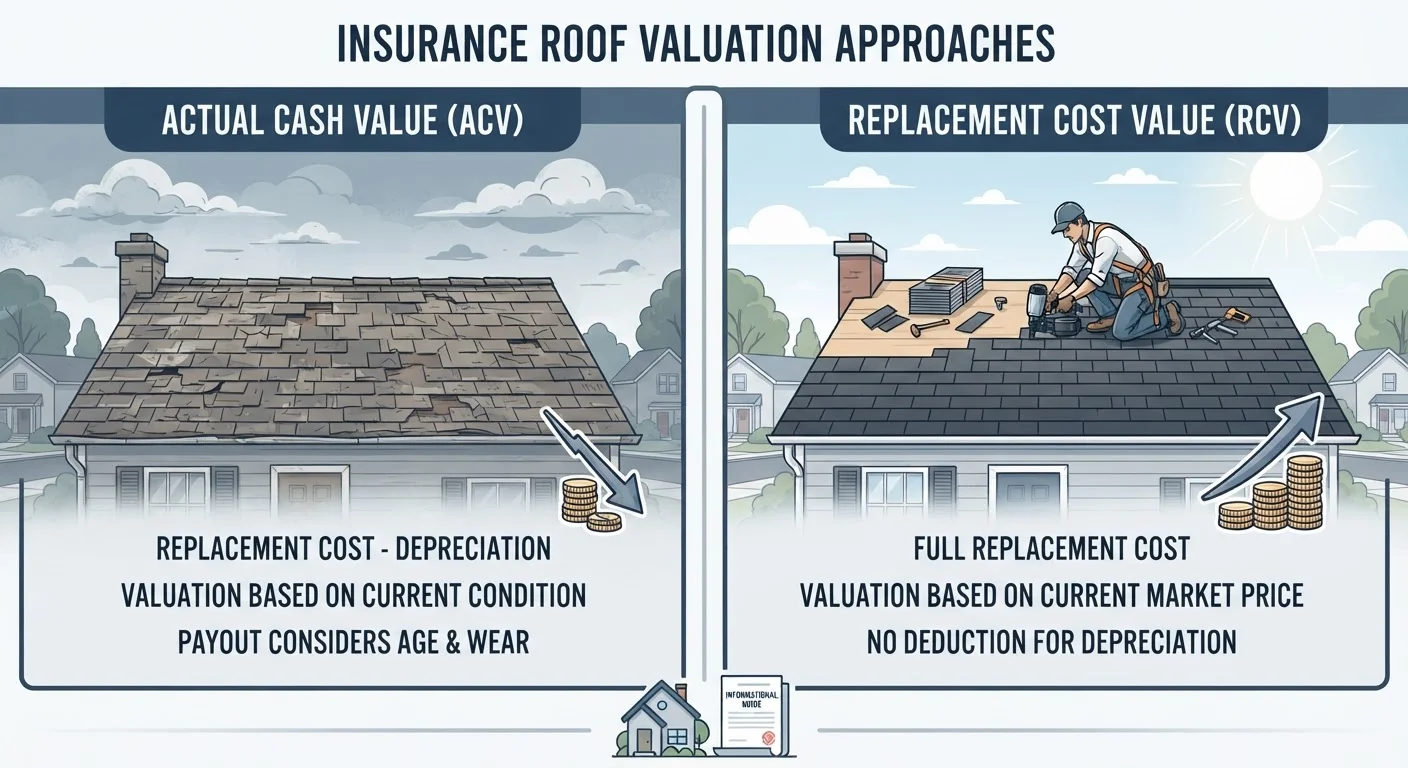
What These Two Terms Actually Mean
When you file a property insurance claim, the dollar amount your insurer pays depends largely on one detail buried in your policy: the valuation method. Two policyholders with seemingly identical homes and nearly identical losses can receive very different claim checks based on whether their policy uses Actual Cash Value (ACV) or Replacement Cost Value (RCV).
Understanding what insurance coverage actually means starts here - with how your insurer calculates what it owes you.
Actual Cash Value is calculated by taking the cost to replace a damaged item and subtracting depreciation. Depreciation accounts for age, wear, and obsolescence. A roof that cost $15,000 to install twelve years ago and has a 20-year expected lifespan has depreciated significantly. Your ACV payout reflects what that roof is worth today, not what it costs to put a new one on.
Replacement Cost Value, by contrast, pays what it actually costs to repair or replace the damaged property with new materials of similar kind and quality - without subtracting depreciation. Using the same example, an RCV policy would pay closer to the current market cost of a comparable new roof installation.
| Criterion | Actual Cash Value (ACV) | Replacement Cost Value (RCV) |
|---|---|---|
| Payout calculation | Replacement cost minus depreciation | Full cost to repair or replace with new |
| Effect of depreciation | Reduces your payout directly | Not deducted from your payout |
| Typical premium cost | Lower than RCV | Higher than ACV |
| Out-of-pocket risk after a claim | Higher - you absorb the depreciation gap | Lower - insurer covers full rebuild cost |
| Best suited for | Budget-conscious owners with older property | Owners wanting full restoration coverage |
| Common in | Basic or entry-level homeowners policies | Standard and comprehensive homeowners policies |
The Financial Gap Between ACV and RCV
The practical difference between these two methods becomes most visible when a significant loss occurs - a fire, a hailstorm, or a burst pipe that damages flooring and drywall throughout a home.
~40%
Typical depreciation gap on a 10-year-old roof claim
Depreciation schedules vary by insurer and material, but a decade-old roof can see 30-50% deducted under ACV valuation.
$3,000-$10,000+
Estimated out-of-pocket gap on a major ACV claim
For significant losses like roofs, HVAC systems, or flooring, the depreciation deduction frequently runs into the thousands of dollars.
Consider a homeowner whose 10-year-old HVAC system is destroyed in a covered event. A new equivalent unit costs $8,000 installed. If the insurer applies a 40% depreciation factor for age and wear, the ACV payout would be approximately $4,800. The policyholder must cover the remaining $3,200 out of pocket to restore their home to a functioning state.
With an RCV policy, the insurer would pay the full $8,000 (less any applicable deductible). To understand how your deductible interacts with either valuation method, see our guide on how deductibles, copays, and coinsurance shape your real coverage experience.
This gap is not hypothetical - it is the single most common source of surprise for policyholders after a major claim. Many assume their insurer will simply pay to make them whole. Whether that is true depends on which valuation method governs their policy.
Some Policies Offer a Hybrid Approach
Certain insurers offer policies that initially pay ACV at the time of loss and then release an additional depreciation holdback once repairs are completed and documented. This structure encourages timely repairs while still offering some of the payout protection associated with RCV. Ask your insurer or agent whether your policy includes this feature, and confirm exactly what documentation triggers the holdback release.
How to Evaluate Which Coverage Fits Your Situation
There is no universally correct answer between ACV and RCV - the right choice depends on your property, your financial cushion, and your risk tolerance. Here are the key factors to weigh:
- Age and condition of your property: Older structures and aging systems depreciate more steeply, making the ACV gap larger. Newer homes or recent renovations typically see smaller depreciation deductions.
- Premium difference: RCV policies cost more. Get quotes for both and determine whether the premium gap is manageable relative to the coverage improvement.
- Your emergency savings: If you can comfortably absorb several thousand dollars in out-of-pocket costs after a claim, ACV may be tolerable. If that would create a financial hardship, RCV provides important protection.
- Lender requirements: Some mortgage lenders require RCV coverage as a loan condition. Check your loan agreement before selecting ACV.
For a deeper dive into how these valuation methods play out in specific claim scenarios, the Actual Cash Value vs. Replacement Cost Coverage article walks through additional examples. You can also explore the Choosing Coverage hub for related guidance on selecting the right policy terms for your needs.
This article is for general informational and educational purposes only and does not constitute personalized insurance, financial, or legal advice. Coverage terms, exclusions, and eligibility vary by insurer and by state. Always read your full policy documents and consult a licensed insurance agent or adviser before making coverage decisions.