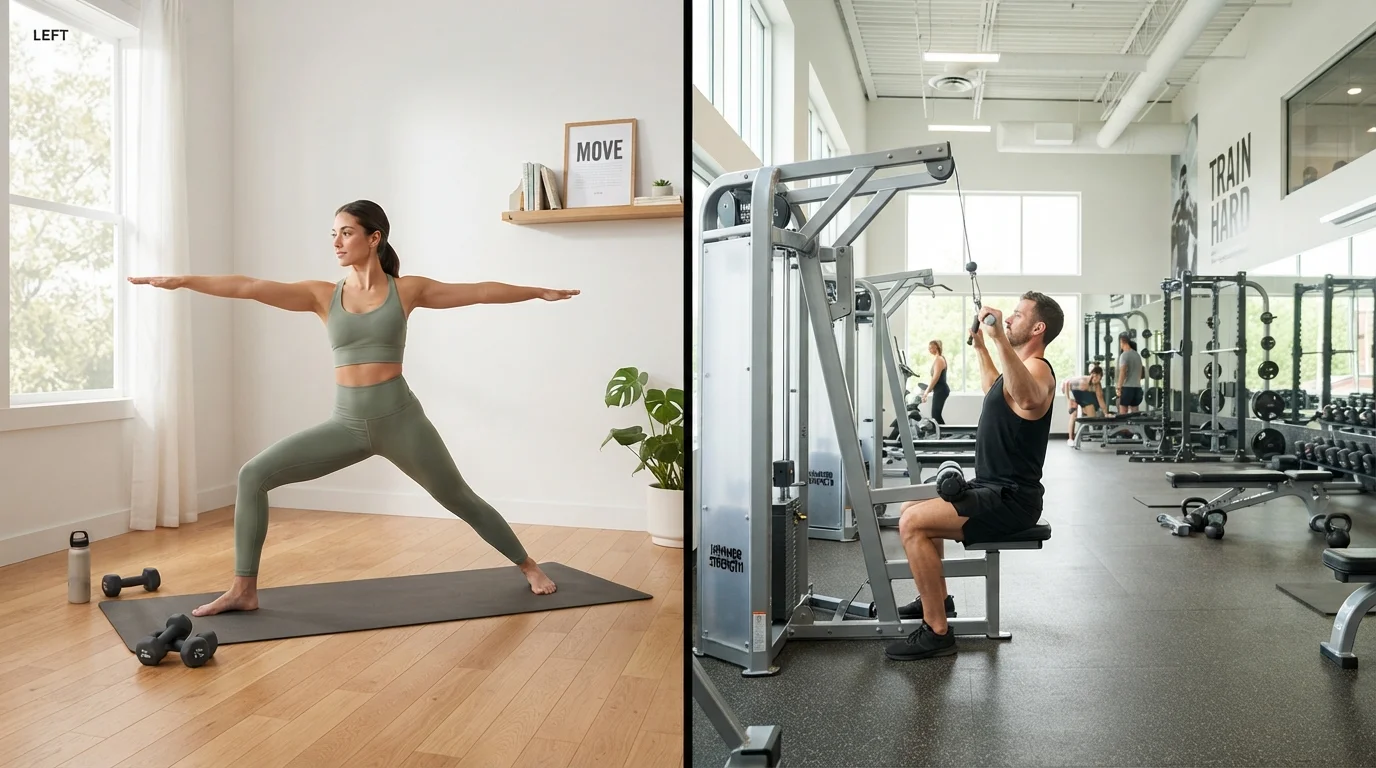
Cost and Long-Term Value
Cost is often the first consideration - and it cuts both ways. A standard gym membership in the U.S. typically runs between $30 and $80 per month, which adds up to $360-$960 annually. Premium gyms or those with specialized amenities can run considerably higher. Over several years, those fees represent a meaningful budget commitment. For a broader look at managing recurring expenses like memberships, see our budgeting basics hub.
Home workouts carry higher upfront costs if you're purchasing equipment, but lower ongoing expenses. A quality set of resistance bands, adjustable dumbbells, or a pull-up bar can serve you for years without additional fees. That said, a fully equipped home gym - power rack, barbell, bench, and plates - can rival or exceed several years of gym dues. The honest comparison depends on what equipment you actually need for your goals. Our resistance bands vs. free weights comparison can help clarify what's worth investing in.
| Criterion | Home Workouts | Gym Workouts |
|---|---|---|
| Monthly cost | Low (after equipment purchase) | $30-$80+ per month |
| Equipment variety | Limited by investment | Extensive, included in membership |
| Commute required | None | Yes - varies by location |
| Privacy | Complete | Shared, public environment |
| Social/community element | Minimal (unless virtual) | Strong, built-in |
| Schedule flexibility | Fully flexible, 24/7 | Limited by opening hours |
| Suitability for heavy lifting | Requires significant investment | Well-supported |
Equipment Access and Training Variety
One of the gym's clearest advantages is sheer equipment variety. Cable machines, leg presses, Smith machines, and a full range of free weights allow for precise progressive overload - gradually increasing resistance over time, which is central to strength and hypertrophy (muscle growth) adaptations. If your goals involve heavy compound lifts or body composition changes that require significant load, a gym environment is hard to replicate at home without considerable expense.
Home workouts, however, are more capable than many people assume. Bodyweight training, resistance bands, and minimal free weights support effective cardiovascular conditioning, muscular endurance, and even moderate strength gains. Formats like HIIT (high-intensity interval training) translate particularly well to home settings. For a closer look at that approach, see what HIIT actually involves and who it suits.
~$565
Average annual U.S. gym membership cost
According to data aggregated by fitness industry analysts, the average American spends roughly $40-$50 per month on gym membership fees.
50%+
Gym members who rarely use their membership
Industry estimates consistently suggest that a significant portion of gym members attend fewer than once per week, raising questions about per-visit value.
67%
Adults citing "lack of time" as a fitness barrier
Surveys by organizations including the CDC have identified time constraints as the most commonly reported obstacle to regular physical activity among U.S. adults.
Motivation, Accountability, and Consistency
Environment shapes behavior more than most people realize. Research in behavioral science consistently shows that social cues and environmental design influence habit formation. A gym dedicated solely to exercise creates a context that primes physical effort - there are no dishes to do, no couch nearby, and the presence of others exercising reinforces the activity.
For home workouts, the challenge is maintaining that psychological separation. Designating a specific space - even a corner of a room - for exercise and keeping it consistently set up helps establish the mental association between place and action. Those who train alone at home also benefit from structured plans; without one, sessions can feel purposeless. Building a realistic weekly exercise schedule is a practical step that applies regardless of where you train.
If group energy fuels your consistency, it's worth noting that gyms often include fitness classes. Our group fitness vs. solo training comparison explores how those dynamics differ.
Home Doesn't Mean Isolated
Virtual fitness platforms and live-streamed group classes have significantly narrowed the community gap between home and gym training. Many people now maintain strong accountability structures entirely through online communities, workout-sharing apps, or virtual training partners. If social motivation is important to you, it's worth exploring these options before ruling out home training altogether.
Which Setting Fits Your Lifestyle?
The right environment is the one you'll actually use. Both home and gym training can support a wide range of fitness goals - from improving cardiovascular health to building strength - when approached with appropriate frequency and progressive challenge. For guidance on how often to train, see how often you should actually exercise.
Many exercisers find the most sustainable approach is a hybrid: home workouts for busy weekdays and gym sessions on days when more time and equipment access are available. What matters most is consistency over time - not perfection in any single session or setting.
This article is for general informational purposes only and does not constitute medical or fitness advice. Consult a qualified healthcare provider or certified fitness professional before beginning or significantly changing an exercise program, especially if you have an existing health condition.