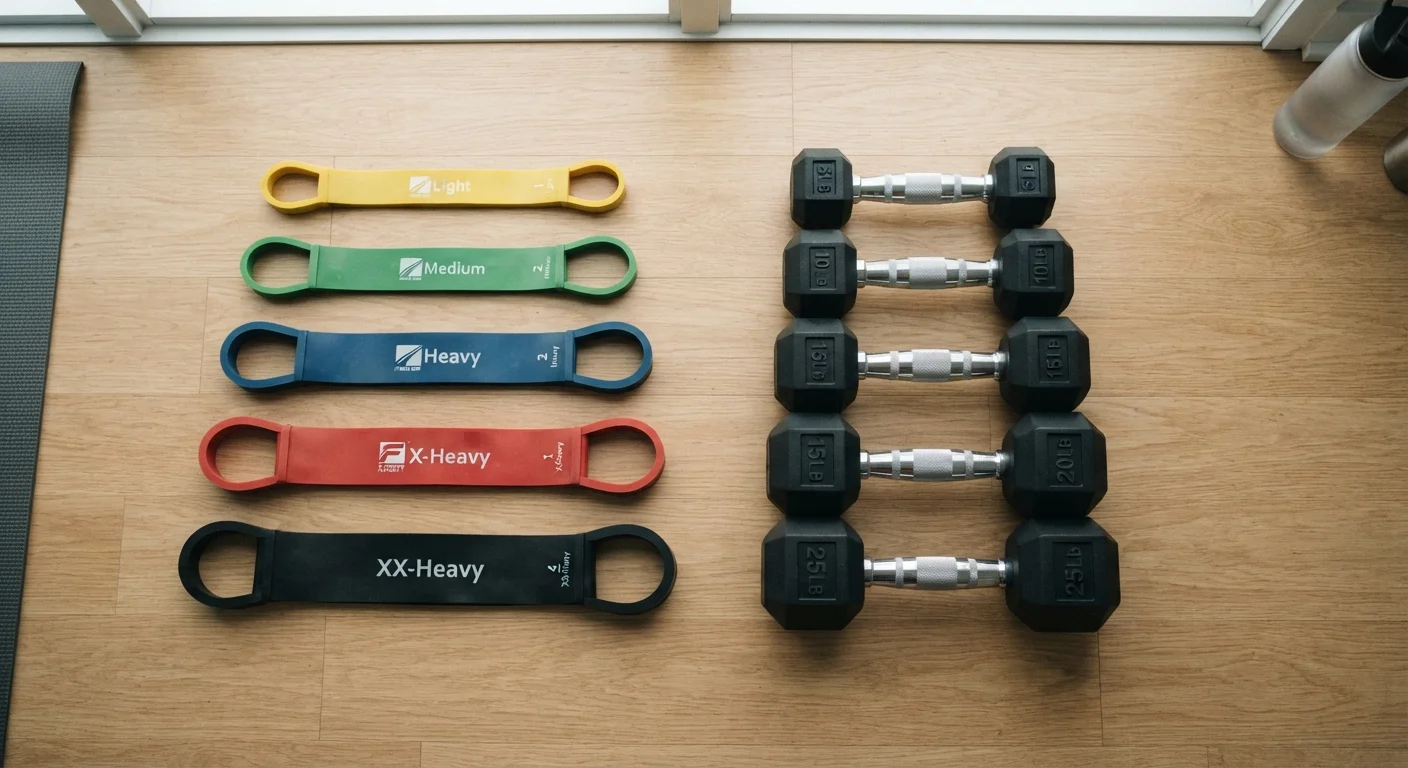
How Each Tool Actually Loads Your Muscles
Understanding the mechanical difference between resistance bands and free weights is the starting point for any honest comparison. Free weights - dumbbells, barbells, kettlebells - rely on gravity. The load stays constant throughout a movement. When you curl a 20-pound dumbbell, you're lifting 20 pounds at every point in the arc.
Resistance bands work differently. Their tension is elastic, meaning resistance increases as the band stretches. In practical terms, this means the hardest part of a banded exercise is usually at the end of the range of motion - the opposite of many gravity-based movements. This variable resistance can be beneficial for certain goals but means the loading profile is fundamentally different from free weights.
For a deeper look at how load, reps, and rest interact in any strength program, see our guide to strength training fundamentals.
| Criterion | Resistance Bands | Free Weights |
|---|---|---|
| Resistance type | Elastic - increases with stretch | Gravitational - constant throughout |
| Load precision | Less precise; varies by band type | Precise, incremental, measurable |
| Cost (starter set) | ~$15-$50 | ~$100-$400+ |
| Portability | Highly portable; travel-friendly | Heavy; not portable |
| Joint stress | Lower compressive joint load | Higher compressive joint load |
| Exercise variety | Wide; includes mobility and rehab | Wide; strongest for compound lifts |
| Progressive overload | Possible but less granular | Straightforward and well-documented |
| Beginner-friendliness | High - forgiving and low-risk | Moderate - technique matters more |
Practicality, Cost, and Accessibility
For many everyday Americans, the most relevant factors aren't biomechanical - they're logistical. A full set of resistance bands typically costs between $15 and $50, fits in a drawer, and weighs almost nothing. A comparable set of dumbbells covering light to moderate loads can cost several hundred dollars and requires dedicated storage space.
This makes bands a strong default for home training environments. If you're weighing the trade-offs between working out at home versus a gym, our home vs. gym workout comparison covers that decision in depth.
~$30
Average cost of a resistance band set
Consumer fitness retail data suggests a full-range resistance band kit typically costs far less than a comparable dumbbell set of equivalent resistance levels.
Equal
Muscle activation potential vs. free weights
A review published in the Journal of Human Kinetics found elastic resistance produced comparable muscle activation to free weights in several upper- and lower-body exercises.
Free weights, on the other hand, are a fixture in most commercial gyms - which means if you already have gym access, the cost barrier is already cleared. Their standardized increments (typically 2.5-5 lb jumps) also make it easier to track and plan progression systematically.
Strength Gains and Progressive Overload
Both tools can produce genuine strength gains. Research consistently shows that muscle adaptation responds to mechanical tension regardless of its source - elastic or gravitational. The critical factor is applying progressive overload over time: gradually increasing the challenge placed on muscles.
Free weights have a practical edge here because load increments are precise and measurable. Moving from a 15-lb to a 17.5-lb dumbbell is a documented, repeatable step. With bands, progression is less granular - you move to a heavier resistance band or shorten the band's effective length, which isn't as easily quantified.
That said, bands are highly effective for accessory movements, warm-up activation, and mobility work that complements heavier free-weight training. They're also a legitimate primary training tool for beginners or those in rehabilitation contexts - though anyone recovering from injury should work with a qualified healthcare professional before resuming or starting any exercise program.
If you're curious how strength training compares to cardio for overall health outcomes, our cardio vs. strength training breakdown offers a useful framework.
No Equipment? Bodyweight Is Also Worth Considering
If cost or access is a barrier to both bands and free weights, bodyweight training is a well-established third option. Push-ups, squats, and planks can build real functional strength with zero equipment. Our introduction to bodyweight training covers how to get started effectively.