What Is Bodyweight Training?
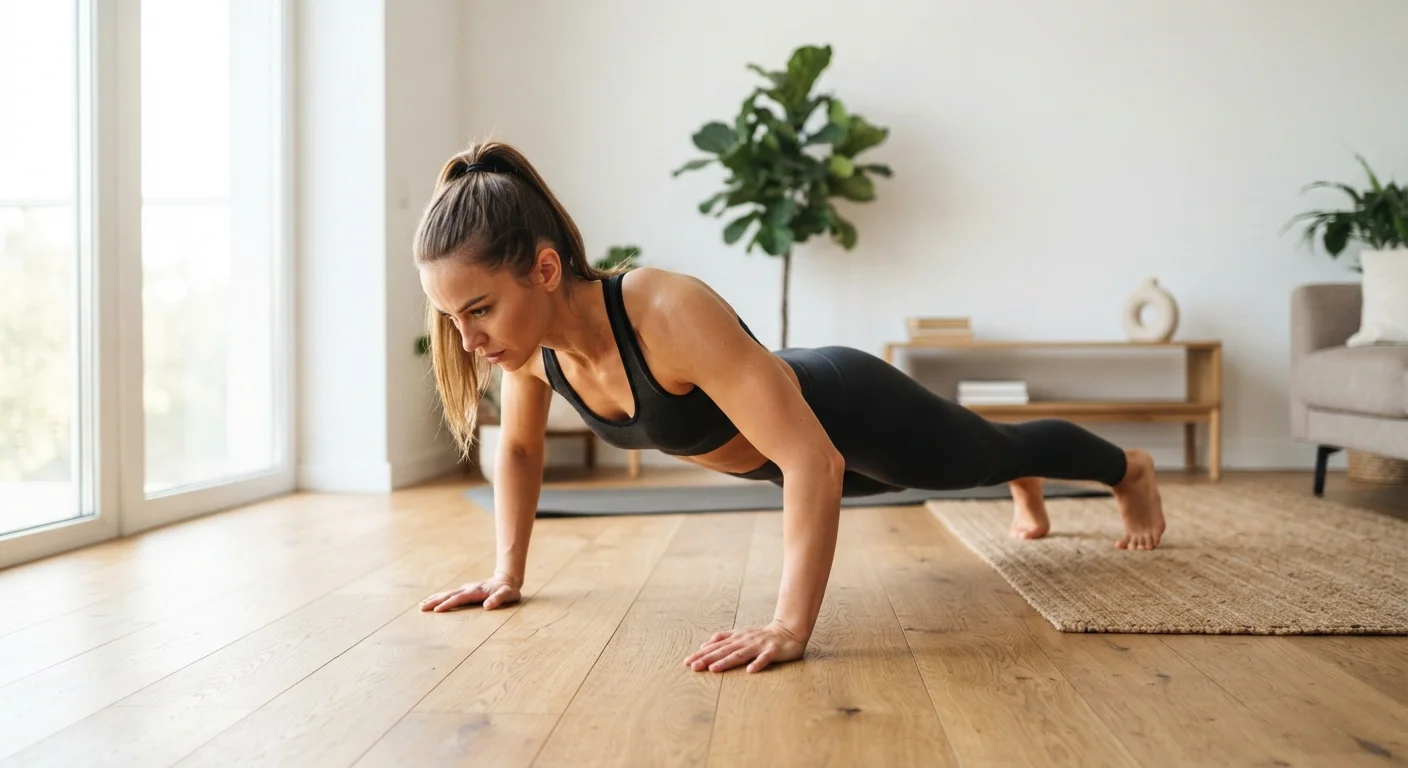
Bodyweight training is a form of resistance exercise that uses your own body weight - rather than dumbbells, machines, or barbells - as the primary source of resistance. Push-ups, squats, lunges, planks, and dips are classic examples, but the approach spans hundreds of movements ranging from beginner-accessible to highly athletic.
Unlike gym-based programs, bodyweight training can be done anywhere: your living room, a hotel room, a park, or your backyard. That accessibility is one of its greatest practical advantages for people who are new to exercise or returning after a long break. See our guide to restarting exercise after inactivity if you haven't been active in some time.
Resistance training
Any exercise that challenges your muscles to work against a force - including your own body weight, bands, or weights - to build strength and endurance.
Progressive overload
Gradually increasing the difficulty of your workouts over time so your muscles continue to adapt and grow stronger, rather than plateauing.
Isometric hold
An exercise where your muscles contract without movement, such as holding a plank position. Builds stability and endurance in a sustained position.
Posterior chain
The group of muscles running along the back of your body - including glutes, hamstrings, and lower back - important for posture and injury prevention.
Eccentric phase
The lowering portion of a movement (e.g., going down in a push-up) when the muscle lengthens under load. Slowing this phase increases training stimulus.
Core Benefits for Everyday People
Bodyweight training offers several well-documented benefits that make it an appealing starting point for general fitness:
- No equipment or cost required. You eliminate barriers like gym memberships, commute time, and gear purchases.
- Builds functional strength. Many bodyweight movements mimic real-life actions - squatting, pushing, pulling - which supports everyday mobility and reduces injury risk.
- Scalable to your level. Almost every exercise can be made easier or harder by adjusting your angle, range of motion, or leverage.
- Supports cardiovascular fitness when combined with circuits. Moving through exercises with minimal rest elevates your heart rate, contributing to overall endurance.
To understand how strength training differs from cardio and why most people benefit from both, see our overview of cardio vs. strength training.
Foundational Exercises to Know
A solid beginner bodyweight routine is built around a small set of movement patterns. Mastering these before adding complexity pays dividends in both safety and results.
- Push-up
- Trains the chest, shoulders, and triceps. Beginners can start with an incline variation (hands on a raised surface) to reduce load.
- Bodyweight squat
- Strengthens the quadriceps, hamstrings, and glutes. Focus on keeping your chest tall and knees tracking over your toes.
- Hip hinge (glute bridge)
- Develops the posterior chain - glutes and hamstrings - while reinforcing safe lower-back mechanics.
- Plank
- Builds isometric core stability. For a deeper look at what core strength actually involves, see our article on core strength beyond sit-ups.
- Reverse lunge
- Works each leg independently, improving balance and exposing strength imbalances between sides.
Prioritize Form Over Reps
When learning a new exercise, perform each repetition slowly and deliberately before adding volume. Poor form not only reduces effectiveness but increases injury risk. If you're unsure about your technique, record yourself from the side or consult a certified fitness professional.
How to Structure Your First Routine
A simple, effective beginner session includes a brief warm-up, a main block of two to four exercises, and a short cool-down. Aim for two to three sessions per week on non-consecutive days.
A sample full-body session might look like this:
- Incline or standard push-ups - 2 sets
- Bodyweight squats - 2 sets
- Glute bridges - 2 sets
- Plank hold - 2 sets
Perform each exercise for a comfortable number of repetitions - stop before your form begins to break down. Rest 60 to 90 seconds between sets. Total workout time will typically fall between 20 and 30 minutes, which research consistently shows is sufficient for meaningful fitness gains in beginners. For a plain-language explanation of core training concepts like sets, reps, and rest, see our strength training fundamentals guide.
Don't Train Through Sharp Pain
Muscle fatigue and mild discomfort during exercise are normal; sharp, localized, or joint pain is not. If you experience pain beyond normal effort during any exercise, stop and rest. Persistent pain warrants evaluation by a healthcare professional before you continue training.
Progressing Over Time
The principle of progressive overload - gradually increasing the challenge placed on your muscles - is the engine behind all strength gains, whether you use bodyweight or equipment. Without it, your body adapts and progress stalls.
In bodyweight training, you can apply progressive overload by:
- Adding more repetitions or sets
- Slowing down the lowering (eccentric) phase of a movement
- Reducing the angle to increase leverage (e.g., moving from incline to standard to decline push-ups)
- Progressing to harder movement variations (e.g., from a standard squat to a single-leg squat)
If you're curious how bodyweight compares to other tools like resistance bands or free weights, our resistance bands vs. free weights comparison offers useful context. Progress is rarely linear, and some weeks will feel harder than others - that's normal. Avoid chasing soreness as a sign of a good workout; consistent effort over months is what produces lasting change. For a reality check on common exercise misconceptions, our article on fitness myths that hold people back is a helpful companion read.
This article is for general informational and educational purposes only and does not constitute medical or professional fitness advice. Consult a qualified healthcare provider before beginning any new exercise program, especially if you have existing health conditions or injuries.