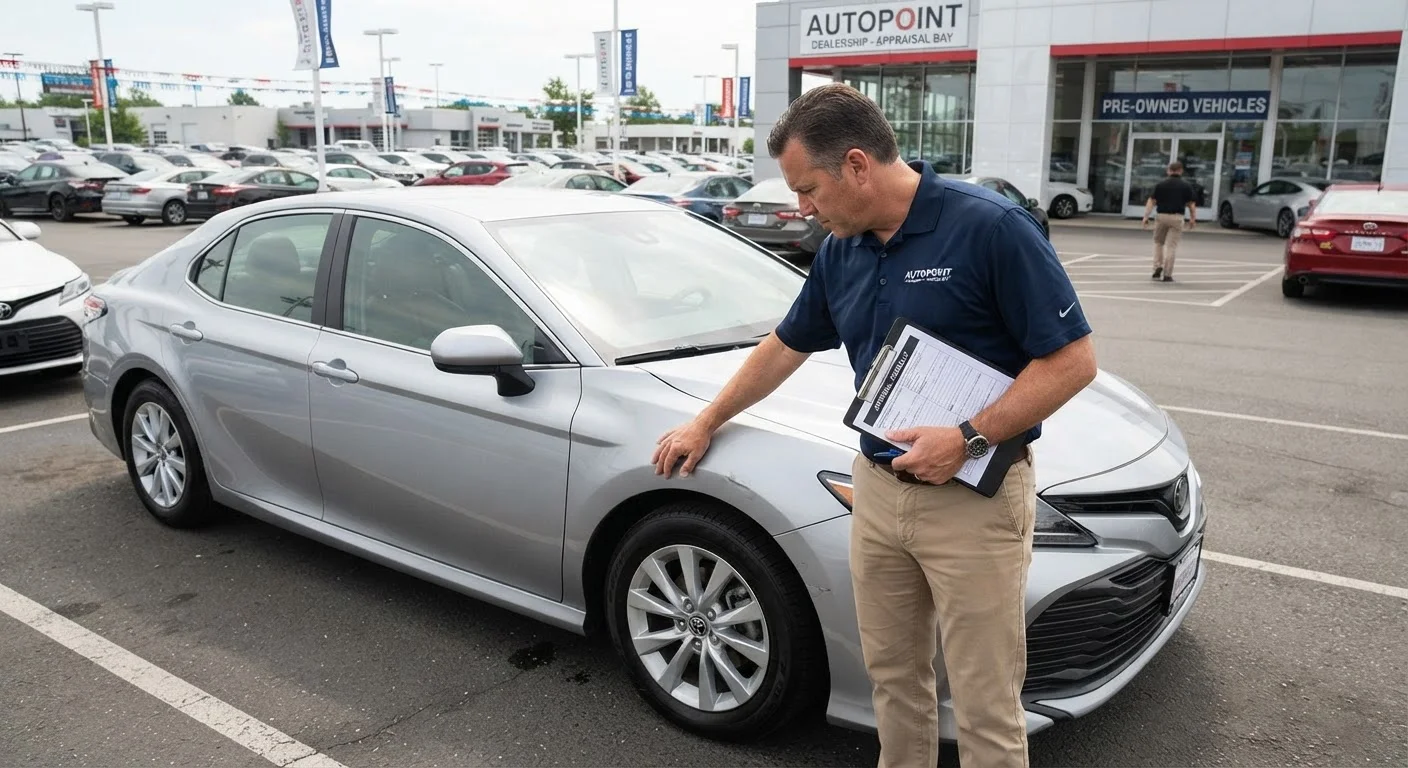
What Dealers Are Actually Calculating
When a dealer appraises your vehicle, they aren't simply looking it up in a guide and handing you the number. They're running a quick mental profit-and-loss on the car: what can we sell this for, and what will it cost us to get there?
The dealer's offer is essentially their estimated retail resale price - minus reconditioning costs (detailing, mechanical repairs, new tires, etc.), minus holding costs for time on the lot, minus their desired gross profit. What's left is your trade-in offer. This is why the number often surprises sellers - it's a wholesale figure, not a retail one.
Dealers typically validate their estimate using two sources: retail pricing guides (such as Kelley Blue Book or NADA) to understand what the car might sell for on their lot, and wholesale auction data (such as Manheim or Black Book) to understand what they could recover if they sent it to auction instead. Both numbers inform the offer floor and ceiling.
“The trade-in offer is the dealer's starting point, not a final verdict. Sellers who come in with competing quotes and documented market data consistently walk away with better outcomes than those who accept the first number.”
— Autos & Driving Editorial Team, Vehicle Transactions Analysis
The Five Factors That Shift Your Appraisal
While every appraisal involves some dealer discretion, five objective factors carry the most weight:
- Mileage: Higher mileage signals more wear and a shorter remaining service life. Most guides use specific mileage thresholds where value drops noticeably, typically around 30,000-mile increments.
- Mechanical condition: An appraiser or technician will inspect for warning lights, unusual noises, tire wear, fluid leaks, and brake life. Any deferred maintenance becomes a deduction from your offer.
- Accident and title history: Dealers pull a vehicle history report immediately. Reported accidents - especially those involving structural or airbag damage - reduce value significantly. A salvage or rebuilt title can cut value by 20-40% or eliminate dealer interest entirely.
- Cosmetic condition: Dents, scratched paint, torn upholstery, and cracked glass all increase reconditioning costs, which come directly off your offer.
- Local market demand: A fuel-efficient compact may command strong offers at a dealership in a dense urban market and weaker ones at a rural truck-focused store. Dealers stock what their customers buy.
20-40%
Value reduction for salvage or rebuilt title vehicles
Industry appraisers consistently apply significant discounts to vehicles with salvage or rebuilt titles due to financing restrictions and reduced buyer demand.
$1,000-$3,000+
Typical spread between dealer trade-in offers
Automotive consumer research consistently finds that the same vehicle can receive dramatically different offers depending on each dealer's current inventory needs.
~6%
Average dealer gross margin on used vehicle resale
According to National Automobile Dealers Association data, front-end gross profit on used vehicles averages in the single-digit percentage range, illustrating why dealers price trade-ins conservatively.
Why Offers Vary Dramatically Between Dealers
It's common for sellers to receive appraisals that differ by $1,000 to $3,000 - or more - for the same vehicle. This isn't arbitrary. A dealership that happens to be short on pre-owned inventory in your vehicle's segment has strong financial incentive to offer more to acquire it directly rather than buying it at auction. A dealer with six similar vehicles already on the lot has little reason to stretch.
This is why shopping your trade-in is one of the highest-return activities you can do before selling. For more on why these gaps can be so wide, see why appraisal offers vary thousands between dealers.
Consider getting appraisals from at least three sources - a franchise dealership, an independent used-car dealer, and a standalone car-buying service - before committing. Each operates with different inventory needs and margin expectations.
Separate the Trade-In from the Purchase Deal
Always negotiate your trade-in value and your purchase price as two independent transactions. If you allow them to be combined, it becomes difficult to evaluate whether the overall deal is truly favorable. Settle on the trade-in offer first, then move to the purchase price.
Trade-In vs. Private Sale: A Value Trade-Off
Trading in is fast and low-friction - no listings, no test drives with strangers, no title transfer hassles. But that convenience has a measurable cost. Private buyers pay closer to retail value because they're the end consumer; dealers pay wholesale because they need room to profit on resale.
For many sellers, the difference between a trade-in offer and a private sale price can range from several hundred to several thousand dollars depending on the vehicle. Whether that gap is worth the time and effort of a private sale depends on your situation. Selling privately vs. trading in breaks down the full trade-off in detail.
One frequently overlooked advantage of a trade-in: in many states, you only pay sales tax on the difference between the trade-in value and the price of the vehicle you're buying, which can offset some of the value gap.
Sales Tax Offset Varies by State
Many U.S. states allow buyers to deduct the trade-in value from the taxable purchase price of the new vehicle, which reduces the total sales tax owed. The rules and caps on this benefit vary significantly by state. Check your state's DMV or department of revenue for the specific rules that apply to your transaction.
How to Prepare Before Your Appraisal
Arriving informed changes the dynamics of the appraisal conversation. Before walking into a dealership, take these steps:
- Look up your vehicle on at least two pricing guides using your exact mileage and an honest condition assessment to establish a realistic range.
- Pull your own vehicle history report so there are no surprises in the dealer's report.
- Gather your service records. Documented maintenance - especially timing belt replacements, recent brake work, or new tires - reduces perceived risk for the appraiser and can support a higher offer.
- Address easy presentation items: wash and vacuum the car, replace burned-out bulbs, and clear personal items. First impressions influence the condition grade assigned during a visual walk-around.
For a deeper look at what preparation actually moves the needle on value, see what preparation actually moves the needle before your appraisal.
Once you have an offer in hand, keep the trade-in negotiation separate from the purchase price discussion. Bundling them gives the dealer more room to shift numbers between the two deals in ways that are hard to track. For more on structuring that conversation, see our guide on negotiating a fair price when buying a used vehicle.