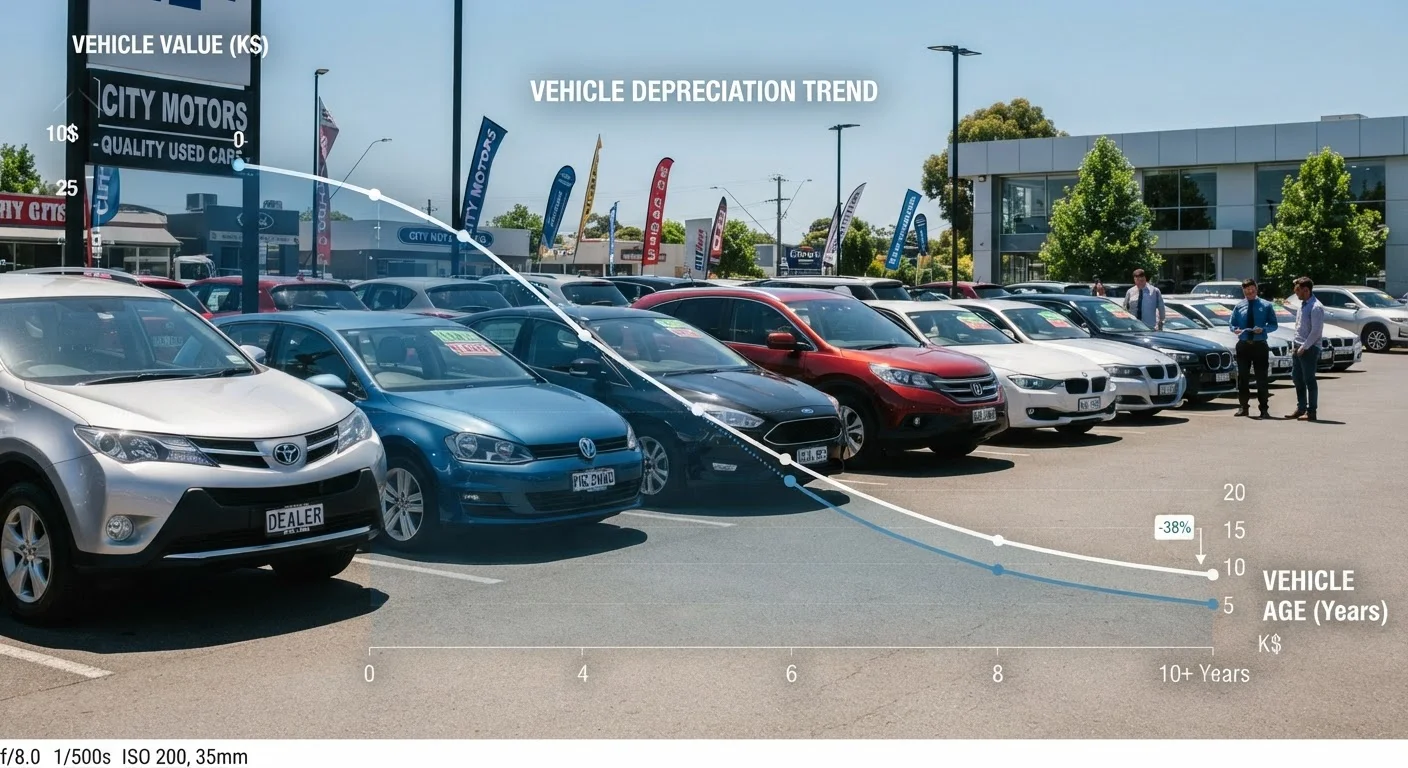
Why New Cars Lose Value So Fast
The moment a brand-new vehicle is driven off the lot, its resale value begins to fall - and the drop in the first year is typically the sharpest. This happens for a straightforward reason: the market immediately prices a used vehicle differently from a new one, regardless of how little it has been driven. Add to that the new model year arriving each fall, and last year's car becomes less desirable almost on schedule.
By the end of year three, a vehicle that originally stickered for $35,000 may be worth considerably less in private-sale or trade-in terms. The depreciation curve then tends to flatten - the car still loses value, but more gradually. This is the structural dynamic that creates opportunity for used-vehicle buyers.
~20%
Typical first-year value loss for a new car
Industry estimates commonly suggest new vehicles lose roughly 15-25% of their value in year one, though this varies significantly by model and market.
40-60%
Cumulative depreciation by year five
Many automotive analysts estimate a typical vehicle retains 40-60% of its original value after five years, depending on make, model, and conditions.
Years 2-5
Commonly cited used car sweet spot window
This range is widely referenced by consumer automotive analysts as the period when depreciation savings are significant and remaining vehicle life is still substantial.
It's worth noting that depreciation rates are not uniform. Market disruptions, fuel prices, and shifts in consumer preference (toward SUVs, for example, or away from sedans) can accelerate or slow depreciation for entire segments. Individual model reputation for reliability also plays a significant role.
Identifying the Sweet Spot
The sweet spot is not a single point - it's a range where price, remaining useful life, and risk intersect favorably for a buyer. For many mainstream vehicles, that range broadly falls between two and five years old. At two years, much of the first-owner depreciation hit has already been absorbed. At five years, most vehicles still have significant life remaining if they have been maintained properly, and the purchase price reflects years of accumulated value loss.
Check Market Value Tools Before You Shop
Before visiting a seller or dealer, look up the vehicle's estimated market value using widely available automotive valuation resources. Knowing what comparable vehicles are selling for in your region helps you evaluate whether a specific asking price reflects the depreciation advantage - or has already been priced to eliminate it.
Mileage interacts with age to shift the sweet spot. A three-year-old vehicle with very high mileage may have depreciated further than its age alone suggests, while a low-mileage example of the same model might hold more value. Neither scenario is inherently better - the key is matching the price to the actual condition and likely remaining life of the vehicle.
Vehicle type matters too. Trucks and SUVs in high demand often retain value better than average, meaning the depreciation benefit of buying used may be smaller. Conversely, segments that fall out of fashion can offer buyers steeper discounts on still-serviceable vehicles. For a broader look at how ownership timelines affect overall costs, see our article on long-term ownership vs. frequent upgrades.
What Buyers Should Weigh Before Acting
Understanding depreciation is useful context, but it doesn't make a specific used car a good deal on its own. A vehicle's service history, accident history, remaining warranty (if any), and the seller's asking price relative to market benchmarks all shape the actual value proposition.
Buyers should also think about total cost of ownership beyond the purchase price. An older, cheaper vehicle might carry higher insurance costs, require more maintenance, or lack modern safety features. The private seller vs. dealership comparison is another dimension worth understanding, since where you buy affects pricing dynamics, protections, and paperwork.
Finally, broader personal financial circumstances matter. A car purchase is a significant expense for most households, and concepts like depreciation are most useful when they inform - rather than override - a decision grounded in your own budget and needs. The Saving & Debt hub offers additional context on how large purchases fit into personal financial planning.
“Depreciation is the single biggest cost most car owners never think about - because you don't write a check for it. You just get less money when you sell.”
— Consumer Automotive Research Community, Widely cited framing among automotive financial educators
This article is for general informational and educational purposes only. It does not constitute financial, legal, or professional advice. Consult a qualified financial adviser or automotive professional for guidance specific to your situation.