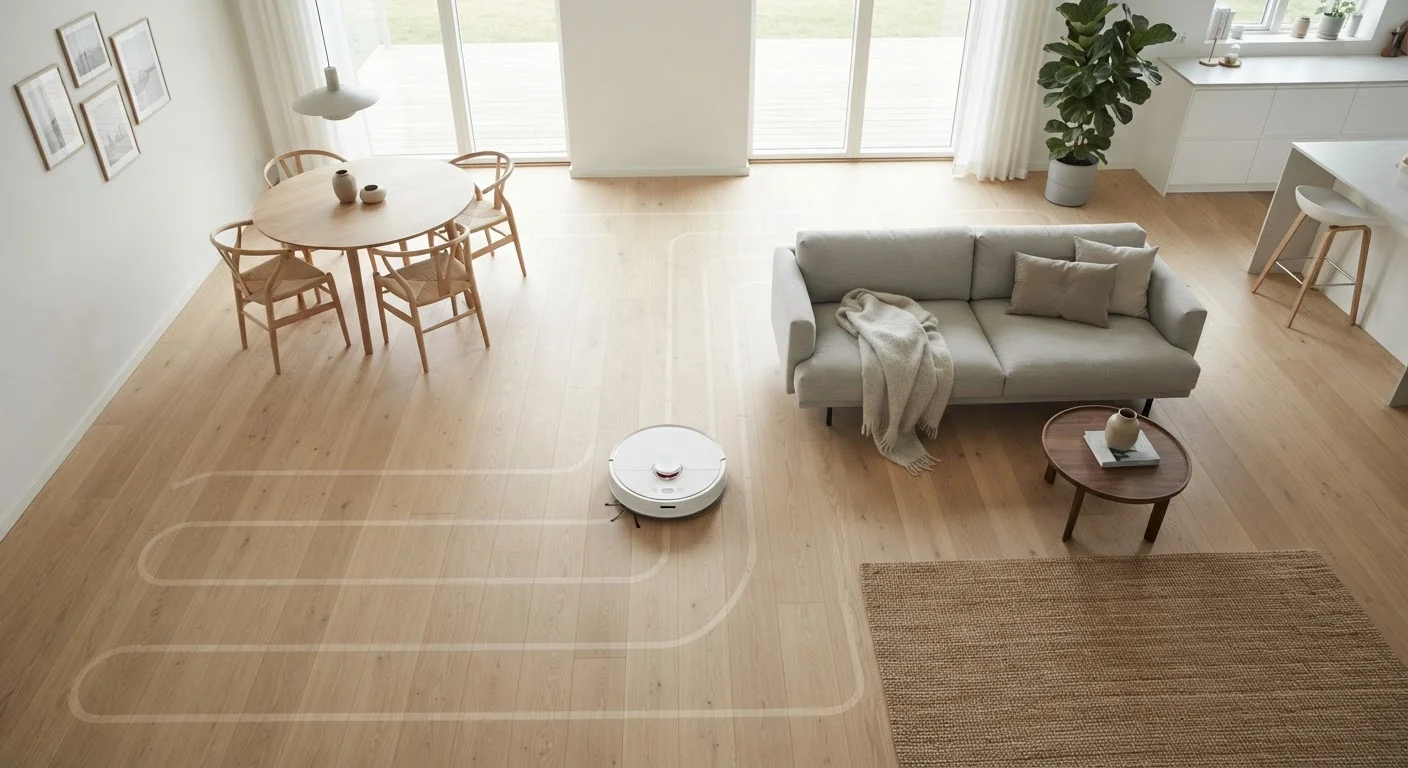
What Robot Vacuums Actually Clean Well
Robot vacuums have matured significantly over the past decade, and for certain floor types and routines, they genuinely deliver. Their core strength is frequent, low-effort maintenance - running a scheduled pass every day or two prevents the buildup of dust, pet hair, and debris that would otherwise accumulate between manual cleaning sessions.
Hard flooring surfaces - including hardwood, tile, laminate, and vinyl - are where robot vacuums perform most reliably. The flat, consistent surface allows suction and brush-roll action to work efficiently, and edge-cleaning brushes can sweep debris toward the main intake without interference. Low-pile carpet also suits most robot vacuums well; the device can transition smoothly and agitate fibers enough to lift embedded particles.
Pet hair is a notable use case. Because shedding is constant, daily robot vacuum runs can meaningfully reduce the hair that accumulates on floors and along baseboards, which is especially useful for allergy-sensitive households.
Reduces daily floor maintenance with minimal effort
Scheduled runs keep hard floors and low-pile carpets consistently clear of dust and debris without requiring any active involvement from the user.
Effective at managing pet hair between deep cleans
Daily runs can significantly reduce shed hair accumulation on floors and along baseboards, which benefits households with pets or allergy sensitivities.
Integrates with smart home schedules and apps
Most current models connect to smartphone apps, allowing time-based scheduling, zone cleaning, and integration with broader home automation ecosystems.
Navigates under furniture that uprights cannot reach
The low-profile design allows robot vacuums to clean under beds, sofas, and other furniture that is otherwise difficult to reach with traditional vacuums.
For households exploring broader home automation, robot vacuums integrate naturally into scheduled routines. See how they fit into a larger system in our guide on home automation routines that reduce daily friction.
Where Robot Vacuums Consistently Fall Short
Understanding the limitations of robot vacuums is just as important as knowing their strengths. Several common household realities reduce their effectiveness significantly.
Thick or high-pile rugs present a mechanical challenge: the robot may struggle to transition onto them, get stuck mid-rug, or fail to agitate deep fibers effectively. Dark-colored flooring is a lesser-known issue - some robots use infrared sensors to detect drop-offs like stairs, and very dark surfaces can trigger false positives, causing the robot to avoid areas of the floor entirely.
Clutter at floor level is the most consistent problem in real-world use. Charging cables, shoes, pet toys, and low-hanging furniture skirts can trap, tangle, or stop a robot mid-run. Preparation time - picking items up before each run - is a hidden cost many buyers underestimate.
Corners and tight edges also remain a persistent weakness. Round robot bodies physically cannot reach square corners, meaning debris accumulates in those spots regardless of how advanced the mapping system is.
Struggles with thick rugs and high-pile carpet
High-pile surfaces can cause the robot to get stuck or fail to agitate fibers deeply, leaving embedded dirt behind and reducing cleaning effectiveness.
Cannot reach corners due to round body design
The circular shape of nearly all robot vacuums means square corners consistently accumulate debris that the device physically cannot access.
Clutter preparation adds a hidden time cost
Cables, toys, and loose items at floor level must be picked up before each run, which can offset some of the convenience benefit the device is meant to provide.
Multi-floor homes require additional units or manual carrying
A single robot vacuum cannot move between floors independently, making multi-level homes significantly less compatible with fully automated cleaning routines.
Dark flooring can trigger false drop-off detection
Infrared cliff sensors used to detect stairs may misread very dark or black floor surfaces as a drop-off, causing the robot to avoid those areas entirely.
Multi-level homes require either purchasing multiple units or carrying the robot between floors manually - a friction point that undermines the convenience case. For a broader look at smart home pitfalls, our article on mistakes that make your smart home harder to live with covers patterns worth avoiding before committing to any connected device.
Why Floor Plan Complexity Changes Everything
A robot vacuum's navigation system is the single biggest factor in how well it handles a real home. There are two dominant approaches: LiDAR-based mapping, which uses laser pulses to build a precise room map, and camera or optical flow navigation, which relies on visual landmarks and movement tracking.
LiDAR-equipped robots generally produce more accurate and persistent maps, allowing them to plan efficient cleaning paths, remember room boundaries across multiple runs, and recover more reliably from interruptions. Camera-based systems have improved considerably but can struggle in low-light conditions or in rooms with few distinct visual features.
How Map Quality Affects Cleaning Coverage
Robots that build and store persistent maps of your home clean more efficiently on subsequent runs because they can plan logical paths rather than navigating reactively. If your robot is producing a new map each session, it may miss sections or overlap excessively. Check whether your model supports saved maps and, if so, allow it to complete several full runs before evaluating its coverage. Most mapping systems improve noticeably after two to four complete cleaning cycles.
Open floor plans with clear sightlines between rooms suit both navigation types well. The challenge grows with narrow hallways, doorways close to walls, furniture legs close together, and rooms with many small obstacles. In these environments, even high-end robots can miss sections, require multiple passes, or get stuck.
Virtual boundary tools - whether physical magnetic strips or app-defined no-go zones - give users meaningful control over where the robot travels. Configuring these correctly, particularly around problem areas like pet feeding stations or low furniture, is often the difference between a robot that runs reliably and one that needs constant rescue. This kind of thoughtful setup is also discussed in our room-by-room look at where home technology adds practical value.
~80%
Floor area covered per run on open layouts
Independent testing by consumer electronics reviewers consistently finds open-plan rooms yield significantly higher coverage rates than cluttered or compartmentalized spaces.
2-4x
More frequent runs needed on high-pet-traffic floors
Flooring specialists generally recommend running a robot vacuum daily rather than every few days in homes with multiple shedding pets to maintain meaningful cleanliness.