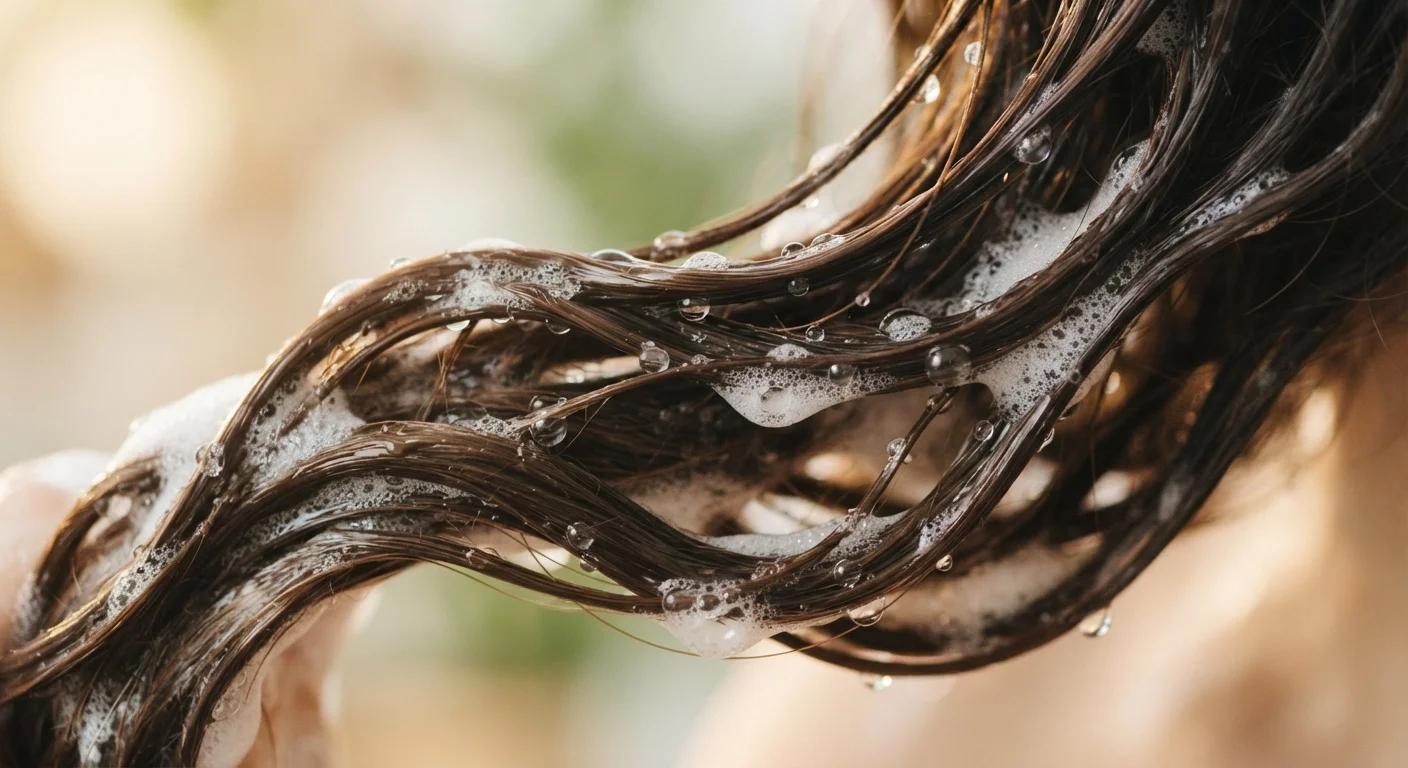
What Shampoo Is Actually Doing
Every shampoo's workhorse is its surfactants - molecules that have a water-loving end and an oil-loving end. When you massage shampoo into wet hair, those molecules wrap around sebum, styling product residue, and environmental debris, then rinse away with water, taking the grime with them.
The scalp produces sebum naturally, and that oil isn't the enemy. It lubricates and protects the hair shaft. The problem is that sebum accumulates, traps particulates, and - especially for people who use styling products regularly - can become the base layer for significant buildup. Shampoo's job is to reset that baseline.
Most shampoos are slightly acidic to neutral in pH, which helps keep the hair cuticle (the outermost protective layer of each strand) relatively flat. However, the scrubbing action of washing, combined with the surfactant activity, can temporarily lift the cuticle scales and leave strands feeling rougher immediately after washing - which is exactly where conditioner picks up the story. For a deeper look at how buildup accumulates between washes, see our guide on ingredients in hair products that can cause buildup.
Scalp Health Is a Separate Consideration
While shampoo addresses surface cleansing, the health of your scalp - its microbiome, oil glands, and follicle environment - operates on a different level. Conditions like dandruff, scalp sensitivity, or excessive oiliness often require targeted approaches beyond standard shampoo. Our guide on scalp health basics covers this in more depth.
What Conditioner Is Actually Doing
Here's where the science gets genuinely interesting. Hair fiber carries a slight negative electrical charge - especially after shampooing lifts the cuticle. Conditioners are formulated with cationic (positively charged) ingredients, most commonly compounds called quaternary ammonium salts, or "quats." Opposites attract: those positively charged molecules are drawn to the hair strand's surface and deposit there as water rinses away.
This deposition does several things at once: it smooths lifted cuticle scales back down, reduces static and friction between strands, and leaves behind a thin film that gives hair its familiar post-conditioning softness and manageability. Some conditioners also include humectants like glycerin to draw moisture into the cortex (the inner layer of the hair shaft), and emollients like fatty alcohols and plant oils to seal that moisture in.
Where you apply conditioner matters, too. The ends of your hair are the oldest part of each strand and typically the most porous and damaged - they benefit most. The scalp produces its own oils and generally doesn't need the additional coating. Understanding your hair's porosity level is one of the most useful things you can do to get more out of this step.
Let Conditioner Sit for 2-3 Minutes
Rinsing conditioner out immediately limits how much of those cationic ingredients actually deposit on the hair shaft. Leaving it in for a couple of minutes gives the charged molecules time to bond properly, delivering noticeably better softness and detangling. For very dry or high-porosity hair, a warm towel wrapped around the head while conditioning can help open the cuticle further and improve absorption.
How the Two Steps Work Together
Shampoo and conditioner aren't just two separate products - they're designed to function as a sequence. Shampoo creates the clean, slightly charged canvas that makes conditioner work more effectively. Skip the shampoo and conditioner still deposits, but often over existing oils and residue, which can reduce its effectiveness and contribute to buildup over time.
That said, the "rules" around washing frequency are more flexible than old beauty advice suggested. How often you shampoo depends on your scalp type, hair texture, activity level, and styling habits. Coarser, drier, or chemically processed hair often does better with less frequent shampooing - perhaps once or twice a week - while oily or fine hair may need washing more often to avoid limpness. For people curious about alternatives, co-washing vs. shampooing is worth exploring.
What you do between wash days also plays a role. Heat styling, environmental exposure, and product layering all affect the condition of the cuticle - see our piece on heat styling and hair damage for more context on how strands respond to daily stress. If you're ready to put it all together, building a haircare routine that matches your hair's actual needs walks through how to translate this understanding into a consistent, practical routine.
~80%
Hair fiber composed of keratin protein
Keratin is the structural protein that makes up the majority of each hair strand's cortex, which conditioning agents aim to protect and reinforce.
4.5-5.5
Optimal pH range for hair and scalp
Hair and scalp function best in a mildly acidic environment; products significantly outside this range can lift the cuticle or disrupt scalp microbiome balance.
3 layers
Structural layers of a single hair strand
Each strand consists of the medulla (innermost core), cortex (middle layer where pigment and strength live), and cuticle (outer protective scale layer that shampoo and conditioner most directly interact with).