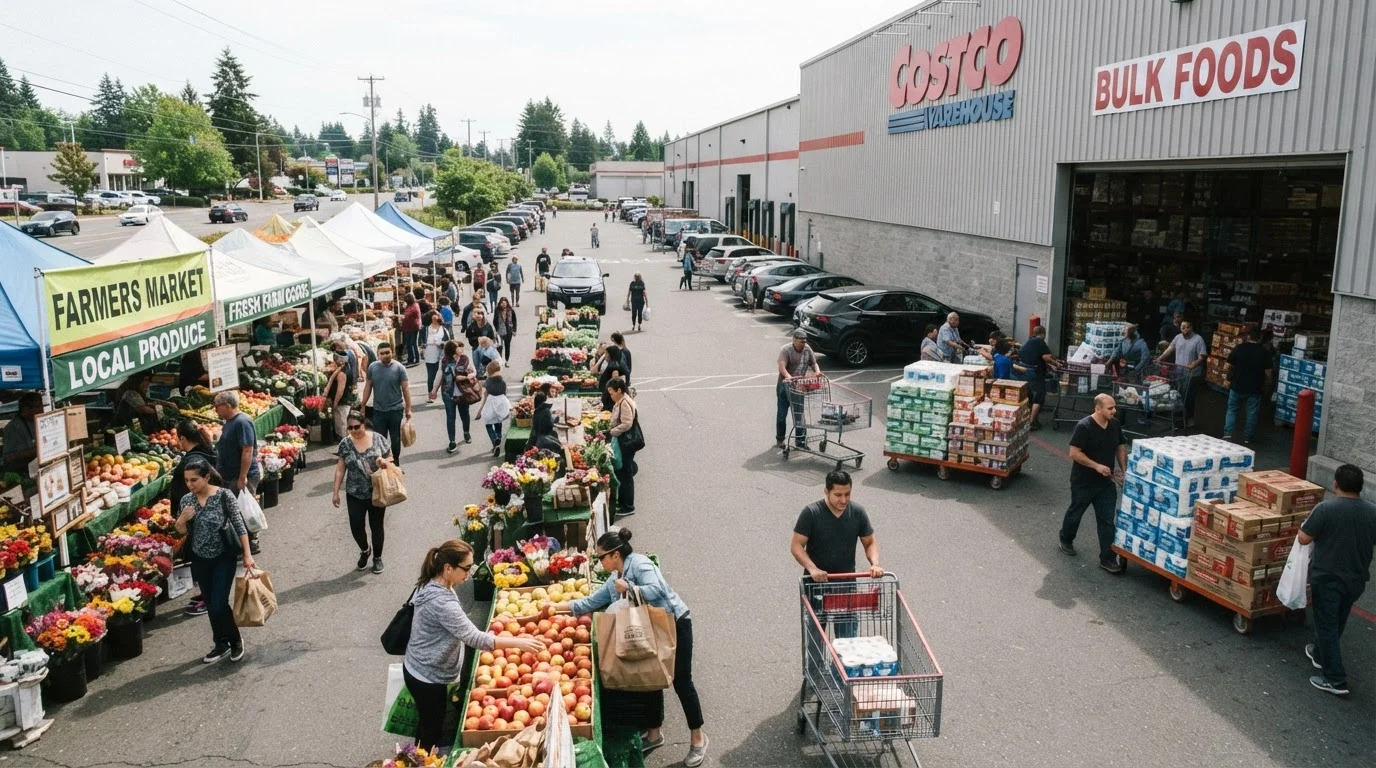
Why Some Places Are Structurally Cheaper
Retail pricing isn't random. Every store format reflects its cost structure: the overhead of its real estate, supply chain, labor model, and margin expectations. When those structural costs are lower, prices can follow - permanently, not just during a weekend promotion.
The channels below aren't secrets, but they're frequently underused because their advantages aren't marketed loudly. Understanding why they're cheaper helps you decide whether a particular channel fits your situation, rather than chasing surface-level discounts that rarely reflect real savings. As we explore in our piece on anchoring bias and original pricing, crossed-out prices are often more persuasion than reality.
Warehouse clubs for non-perishable staples
Membership warehouse clubs charge an annual fee but offset it through dramatically lower per-unit prices on shelf-stable goods - cleaning supplies, paper products, canned goods, cooking oils, and similar staples. The model works because these stores carry fewer SKUs, move high volume, and strip out conventional retail overhead.
The math favors warehouse shopping when: you can use what you buy before it expires, you have storage space, and your annual fee is recouped within a few months of purchases. Our article on bulk buying as real savings or a trap details exactly when this arithmetic works - and when it silently doesn't.
Lower overhead and high volume allow warehouse clubs to sustain per-unit prices most standard retailers can't match.
Store-brand and private-label products
Private-label goods - products manufactured under a retailer's own label - are frequently produced in the same facilities as name-brand equivalents. The price gap exists because private-label items carry no national advertising costs and shorter supply chains. For commodity categories like flour, over-the-counter medications, cooking oils, canned vegetables, and basic cleaning products, the quality difference is often negligible while the price difference is real and persistent.
The key is treating private-label as a default starting point for undifferentiated categories, rather than an inferior fallback. Federal labeling requirements mean ingredient and concentration disclosures apply equally to store brands and name brands, giving you the information to compare directly.
Private-label products in commodity categories often match name-brand quality at structurally lower prices, not just promotional ones.
Ethnic and specialty grocery stores
Grocery stores that serve specific immigrant or regional communities frequently carry staple ingredients - dried legumes, rice varieties, spices, specialty produce, cooking sauces - at prices substantially below mainstream supermarket equivalents. This isn't because quality is lower; it's because these retailers source directly through more efficient import channels and face less brand-markup pressure on items their core customers buy routinely.
Spices in particular are a well-documented example: the same quantity of cumin, turmeric, or chili powder can cost five to ten times more in a mainstream spice aisle versus a specialty or ethnic grocery. These aren't promotional prices - they reflect a different supply model.
Specialty grocery stores often source staples through more direct import channels, producing prices a mainstream supermarket can't replicate.
Direct-from-producer and farmers market channels
Buying directly from producers - at farmers markets, farm stands, or community-supported agriculture (CSA) programs - eliminates several layers of the conventional distribution chain. This doesn't guarantee the lowest sticker price on every visit, but for in-season produce and locally produced goods, direct sourcing can consistently undercut a supermarket's pricing while delivering fresher product with less transport time.
Seasonal alignment matters here: buying what's abundant and local keeps prices low; requesting out-of-season items at a farmers market removes that structural advantage. Understanding how savings work differently across shopping channels helps put direct-produce markets in context alongside other format options.
Farmers market pricing advantages are real but seasonal - buying what's abundant locally is where the structural savings actually live.
Discount grocery and salvage food stores
Discount grocery chains operate on a fundamentally different overhead model: smaller footprints, limited SKU counts, fewer staff per square foot, and sourcing from overstock, short-dated, or packaging-change inventory. The result is shelf-stable and packaged goods priced 20-40% below conventional supermarket equivalents, not because of a sale, but as the everyday baseline.
Savvy shoppers treat these stores as a primary source for packaged and canned goods, reserving conventional supermarkets for specialty items or fresh categories where the discount grocer's selection is thinner. The tradeoff is less consistent selection week to week - but for commodity pantry staples, the pricing floor is reliably lower.
Discount grocers use structural cost advantages - not weekly sales - to maintain a lower everyday price floor on packaged goods.
Manufacturer direct and factory outlet channels
For household goods, apparel, and kitchenware, direct-from-manufacturer channels and genuine factory outlets (as distinct from outlet malls that stock outlet-only lines at manufactured price points) can offer meaningful savings by removing distributor and retailer margin layers. This advantage is most reliable for items that aren't heavily differentiated by retail experience - basics, replacement parts, standard sizes, and utility goods.
A useful caution: outlet pricing is frequently paired with 'compare at' reference prices that are not always verifiable. The relevant question is the absolute price relative to your alternatives, not the discount percentage from an asserted original - a dynamic explored in our piece on how shipping and pricing framing can shift real costs.
Direct and outlet channels save money by removing markup layers - evaluate the absolute price, not the advertised discount percentage.
Putting It Together Without Overcomplicating It
The goal isn't to shop in seven places simultaneously - that trades money costs for time costs. Instead, identify one or two channels that fit your household's regular spending and apply them consistently. A basic budget framework can help you see where routine grocery and household spending actually goes, making it easier to redirect those dollars toward consistently lower-cost channels.
Calculate Unit Price, Not Sticker Price
Before comparing channels, divide the total price by quantity (ounces, count, or liters) to get a true unit cost. Most grocery store shelf tags show this automatically. A larger package at a warehouse club may show a lower unit price but cost more upfront - factor in whether you'll actually use the full quantity. This single habit reliably cuts through most pricing theater.
One practical audit: for your five most frequently purchased items, look up the unit price at your current source, then compare it to one alternative channel listed above. Even a single switch that saves $0.30 per unit across items you buy weekly compounds meaningfully over a year. That's a structural gain - not a coupon.
It's also worth understanding the limits of rewards programs before assuming they offset higher base prices. Our comparison of loyalty programs versus simply paying less walks through when points actually close the gap and when they don't.
This article provides general consumer information and education. It is not financial advice. For guidance tailored to your personal financial situation, consult a qualified financial professional.