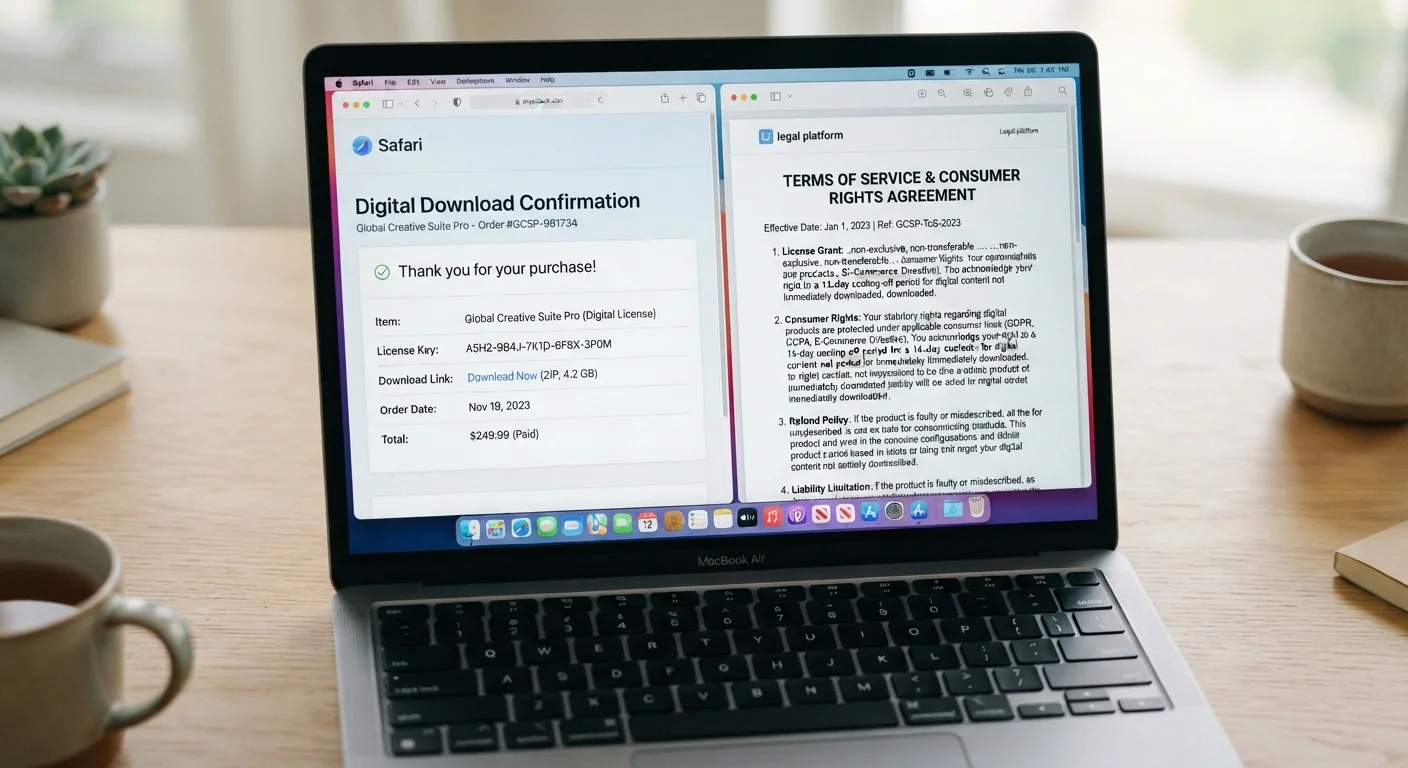
Why Digital Products Are Different Under the Law
When you buy a physical book or a DVD, longstanding commercial law gives you clear ownership and a predictable set of remedies if the product is defective. Digital products - apps, e-books, software downloads, music files - don't fit as neatly into those frameworks.
The core issue is classification. Most digital purchases are structured as licenses, not sales. The end-user license agreement (EULA) you click through grants you permission to use a product under specific conditions. That means the seller retains ownership, and your rights to transfer, resell, or claim refunds are shaped by what the license permits - not by the broader consumer protections that apply to goods you actually own.
For a broader grounding in how purchase protections work across all transaction types, see this overview of consumer rights from purchase to return.
License vs. Ownership: A Critical Distinction
When you 'buy' a digital product, you are almost always purchasing a license to use it under specified conditions - not acquiring the product as property. This means the seller's terms, not general property law, define most of your rights. Reading the EULA before purchase, while rarely convenient, is the clearest way to understand what you're actually agreeing to.
What Federal Law Currently Covers
No single federal statute is dedicated to digital product consumer rights. Instead, several overlapping frameworks offer partial coverage:
- FTC Act Section 5 prohibits unfair or deceptive trade practices. If a digital product is materially misrepresented - a game advertised with features it doesn't have, or software that doesn't perform as described - the FTC has authority to act against the seller.
- The Fair Credit Billing Act (FCBA) allows consumers to dispute charges on credit cards for goods or services not received or significantly different from what was advertised. This is one of the most reliable practical tools for digital purchase disputes.
- The Magnuson-Moss Warranty Act governs written warranties on consumer products, but its application to digital goods is inconsistent and frequently litigated.
The absence of a unified digital goods statute means that enforcement is fragmented and results vary widely depending on the specific product and seller.
~50%
U.S. states with private digital goods consumer protection laws
Roughly half of U.S. states have consumer protection statutes that allow private lawsuits for deceptive trade practices, which can apply to digital product disputes, according to the National Consumer Law Center's state law surveys.
$0
Federal statutory minimum refund for digital downloads
No federal law mandates a minimum refund right for digital purchases - any refund obligation comes from voluntary platform policy or state-level statute, not federal consumer law.
Platform Policies: The Practical First Line of Defense
For most consumers, the most immediately applicable protections come not from law but from platform refund policies. App stores, e-book marketplaces, and software retailers each establish their own standards for eligibility, time limits, and approved reasons for returns.
These policies tend to be more protective than the legal floor requires - but they are contractual, not statutory, meaning platforms can change them. Key variables to check before any digital purchase include:
- Whether the platform offers a refund window (common windows range from 14 to 30 days, though some are much shorter or nonexistent after download).
- Whether refund eligibility requires the product to be unused or unopened - a concept that translates awkwardly to digital goods.
- How the platform handles products that fail to function as described, versus buyer's remorse.
Understanding the distinction between platform policies and legal warranties is worthwhile. Warranties and return policies work very differently - and that gap matters even more for digital goods.
Screenshot Your Purchase Confirmation and Product Description
Before downloading any digital product, capture the product listing page, advertised features, and your purchase confirmation. If you need to dispute the transaction later - through the platform or your credit card issuer - documented evidence of what was promised is essential. Screenshots with timestamps are particularly useful.
State Law and Remaining Gaps
State consumer protection statutes can provide an additional layer of recourse, particularly when a digital purchase involves deception or significant non-delivery. Many states have laws modeled on the FTC Act that allow private lawsuits - not just regulatory action - against sellers who engage in unfair or deceptive practices.
However, substantial protection gaps remain:
- No right of resale: The first-sale doctrine, which allows you to resell a physical book or CD, does not extend to digital copies under current federal copyright law.
- Access loss risk: Because digital products are typically licensed, platform shutdowns or service discontinuation can result in permanent loss of access to purchased content, with no guaranteed legal remedy.
- EULA disclaimers: Sellers routinely disclaim implied warranties in license agreements. Courts vary on whether these disclaimers are enforceable, especially against consumers.
Digital purchase disputes also intersect with e-commerce law more broadly. Online purchases aren't always governed the same way as in-person transactions - and digital goods add another layer of complexity to that picture.
If you're navigating a subscription-based digital service rather than a one-time download, the rules shift again. Subscription services carry their own set of consumer protections around cancellation and billing transparency.
This article is for general informational purposes only and does not constitute legal advice. Readers with specific disputes or legal questions should consult a qualified attorney or their state's consumer protection office.