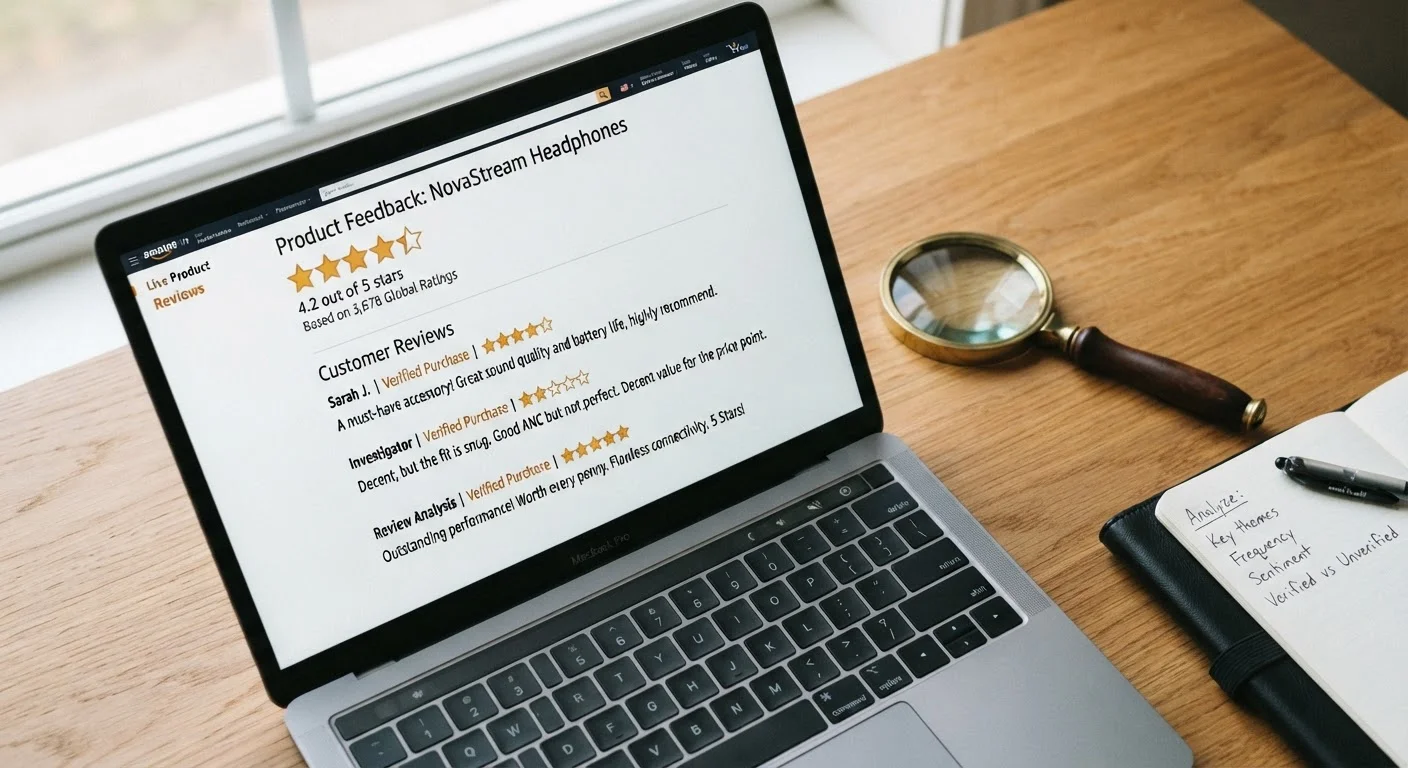
Why Review Manipulation Is a Real Problem
Online reviews have become a primary decision-making tool for American consumers, yet the ecosystem is deeply imperfect. The Federal Trade Commission has taken enforcement action against companies that incentivize or fabricate reviews without disclosure, recognizing fake feedback as a form of deceptive advertising. Understanding this context is the first step to reading reviews defensively - much like learning to decode deceptive advertising claims in other contexts.
Manipulation takes many forms: sellers paying for positive reviews, suppressing or flagging legitimate negative ones, using review-swap networks, or seeding accounts with vague praise. None of these practices are invisible once you know the patterns to spot.
Treat the Rating as a Starting Point
The aggregate star rating is a headline, not a verdict. Your goal is to understand the distribution - how many one-star versus five-star reviews exist, and whether the negative reviews share a common thread. A product with a polarized distribution (many fives and many ones, few in between) often tells a more complicated story than its average suggests.
What You Need Before You Start
No specialized tools are required, but having these resources available will make your review evaluation more thorough and consistent.
What you will need
Step-by-Step: Evaluating Reviews Critically
Work through each step below before making a purchase decision. For high-stakes or expensive items, complete all steps. For routine, lower-cost purchases, prioritize steps 1 through 4.
Check the total review count and date range
A high star average means little without context. Look at how many reviews exist and when they were written. A product with 4.8 stars from 11 reviews warrants more skepticism than one with 4.3 stars from 2,400 reviews spread over two years. Conversely, a sudden surge of reviews within a short window - especially when the product is not newly launched - is a red flag for coordinated review activity.
Look for the 'verified purchase' label
Many platforms distinguish between reviews left by confirmed buyers and unverified accounts. While the verified label is not foolproof - sellers can still game it - it raises the baseline credibility of a review. Prioritize verified reviews and treat unverified ones as secondary data points rather than reliable signals.
Read the one- and two-star reviews first
Negative reviews are typically harder to manipulate at scale and often contain the most specific, actionable detail. Look for recurring complaints about the same issue - a zipper that fails, a battery life that falls short of the spec, a customer service problem that never resolves. One or two outlier complaints are noise; the same complaint appearing across dozens of independent reviews is a signal worth taking seriously.
Evaluate review language for authenticity markers
Genuine reviews tend to be specific: they mention the exact use case, describe a concrete experience, and sometimes note trade-offs. Inauthentic reviews often share a different profile - overly enthusiastic language, minimal detail, no mention of how the product was used, and phrasing that sounds more like marketing copy than personal experience. If multiple five-star reviews use nearly identical sentence structures or the same unusual phrase, treat that as a red flag.
Cross-reference on at least one additional platform
A product that has been manipulated on one marketplace will often have a different - sometimes starkly different - profile on another. Search for the same product on a second retailer site, a dedicated review community, or an independent consumer testing organization. Significant discrepancies in average rating or the nature of complaints between platforms are informative. Consistent patterns across independent sources carry much more weight.
Check the seller or brand's response pattern
How a seller responds to negative reviews reveals a lot about their accountability. Thoughtful, specific responses that acknowledge problems and offer resolution suggest a business that stands behind its product. Defensive, dismissive, or copy-pasted responses to every negative review suggest the opposite. No responses at all on a product with many complaints is also a useful data point.
Review Gating Is a Deceptive Practice
Some sellers use 'review gating' - asking customers to rate their experience privately first and only inviting satisfied customers to leave public reviews. This inflates visible ratings and suppresses genuine negative feedback. The FTC considers this practice potentially deceptive. If a product's public reviews seem uniformly positive with no meaningful criticism, it may be a sign that gating has occurred.
Going Deeper: Context and Cross-Referencing
Even after running through the steps above, some product categories warrant extra diligence. Electronics, health-adjacent products, and high-ticket items are the categories most frequently targeted by review manipulation, partly because the financial incentive for sellers is highest.
For health and wellness products in particular, treat review claims about outcomes with caution. Anecdotal reviews are not clinical evidence, and a product with thousands of glowing reviews can still be ineffective or inappropriate for your specific situation. Always verify health-related purchase decisions with qualified guidance - see our Nutrition & Diet hub for grounded information on evaluating food and supplement claims.
Reviews are just one signal in a broader information ecosystem. For a structured approach to weighing all your sources before committing to a purchase, see evaluating information sources before making a purchase decision. The same skepticism that protects you from misleading reviews applies when reading a rental listing or interpreting food marketing language on packaging.
Fake Reviews Violate Consumer Protection Law
The FTC has authority to pursue enforcement actions against businesses that use fake or undisclosed incentivized reviews. If you believe a product's reviews are systematically fraudulent, you can file a complaint at ftc.gov/complaint. Reporting helps regulators identify patterns across sellers and platforms. Exercising this right supports a fairer marketplace for all consumers.