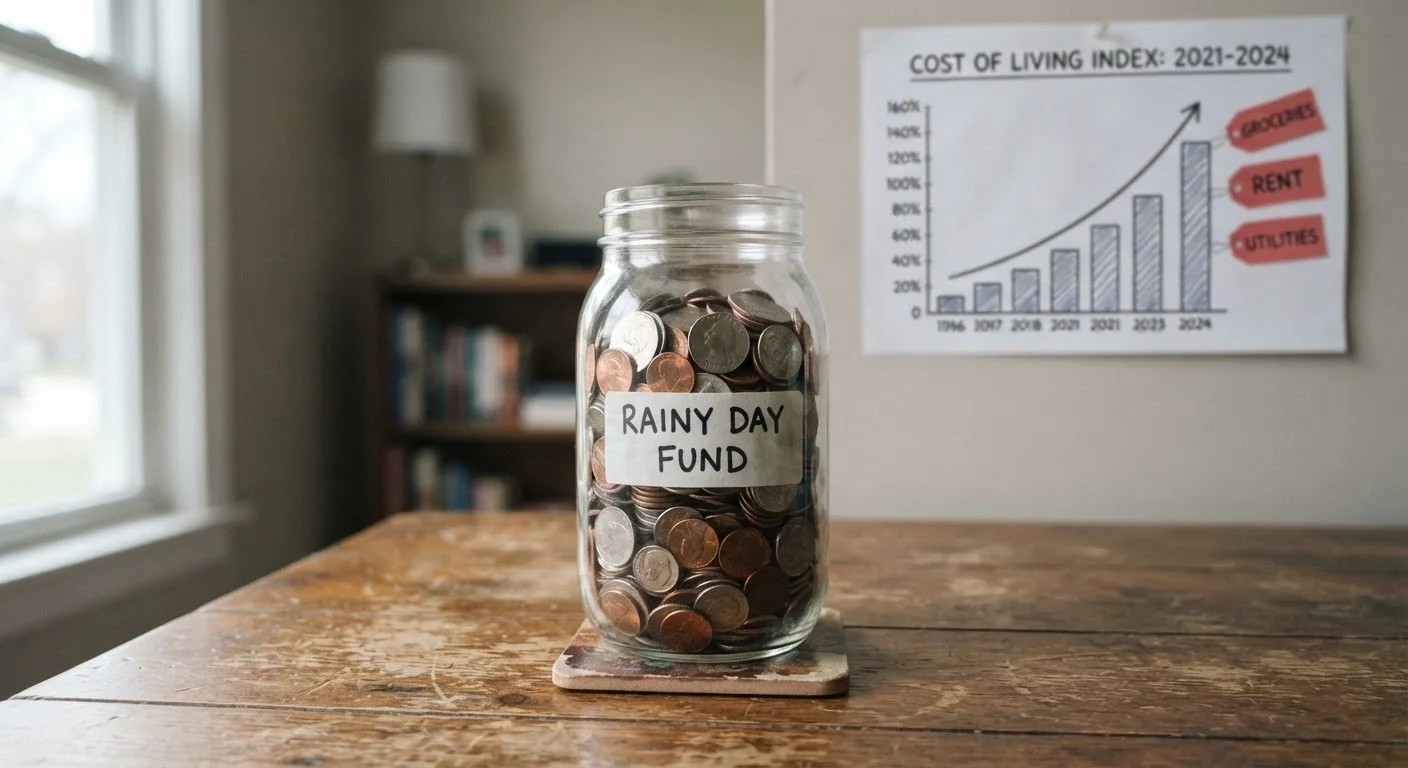
The Gap Between Your Interest Rate and Inflation
Most traditional savings accounts at large banks pay an Annual Percentage Yield (APY) well below 1%. Meanwhile, inflation - as measured by the Consumer Price Index (CPI) - has historically averaged around 2-3% per year, and has climbed significantly higher during certain economic periods. When the rate your savings earns is lower than inflation, your account balance may increase in dollar terms, but the real value of that money shrinks.
Think of it this way: if a basket of groceries costs $100 today and inflation runs at 3% annually, that same basket costs roughly $103 next year. If your savings account only grew by $1 over that period, you're effectively behind. The number in your account is bigger, but your purchasing power is smaller.
Emergency Funds Still Belong in Savings Accounts
Despite the inflation gap, a savings account remains the right place for your emergency fund - typically three to six months of living expenses. Liquidity and principal protection matter more than yield for money you may need on short notice. The inflation concern is most relevant for savings held over longer time horizons beyond your immediate safety net.
This is not a reason to avoid savings accounts entirely. Understanding the mechanics helps you make smarter decisions about where to keep different portions of your money based on purpose and time horizon.
Why Traditional Savings Rates Lag So Far Behind
Banks set savings account interest rates based largely on the federal funds rate - the benchmark rate set by the Federal Reserve. When the Fed keeps rates low to stimulate the economy, banks have little incentive to offer savers competitive yields. Large traditional banks, in particular, often maintain very low rates because they already have large, stable deposit bases and face less competitive pressure to attract new deposits.
The result: many savers park money in accounts that effectively do very little to protect its long-term value. Over a decade, even a modest inflation gap compounds into a meaningful erosion of purchasing power.
0.01%-0.5%
Typical APY at large traditional banks
Many major US retail banks have historically offered savings account rates in this range, according to FDIC national rate data.
2-3%
Average US inflation rate, long-term historical
The Federal Reserve targets a 2% average inflation rate over time, as measured by the Personal Consumption Expenditures (PCE) price index.
Negative
Real interest rate for most traditional savers
When nominal savings rates fall below the inflation rate, the resulting real interest rate is negative - meaning savings lose purchasing power each year.
What Savers Can Do About It
The first step is understanding that not all savings accounts are equal. High-yield savings accounts typically offer APYs several times higher than traditional accounts, often through online banks or credit unions that operate with lower overhead costs. These accounts still carry FDIC or NCUA insurance, meaning your principal remains protected up to applicable limits.
Beyond account type, consider how compounding frequency affects your balance growth. How interest compounds in a savings account matters - daily compounding, for instance, produces slightly better outcomes than monthly compounding at the same stated rate.
Compare APYs Before Settling for the Default
Before accepting the rate your current bank offers, check what other federally insured institutions are paying on savings accounts. Online banks and credit unions frequently offer meaningfully higher APYs with the same deposit protections. Even a 1-2 percentage point difference compounds significantly over several years.
It is also worth examining whether behavioral patterns are compounding the problem. Spending habits that quietly stall savings progress can reduce the amount you save in the first place, leaving less money to grow over time regardless of interest rate.
This article is for general informational purposes only and does not constitute personalized financial, investment, or tax advice. Consult a qualified financial professional for guidance specific to your situation.