How Credit Utilization Is Calculated
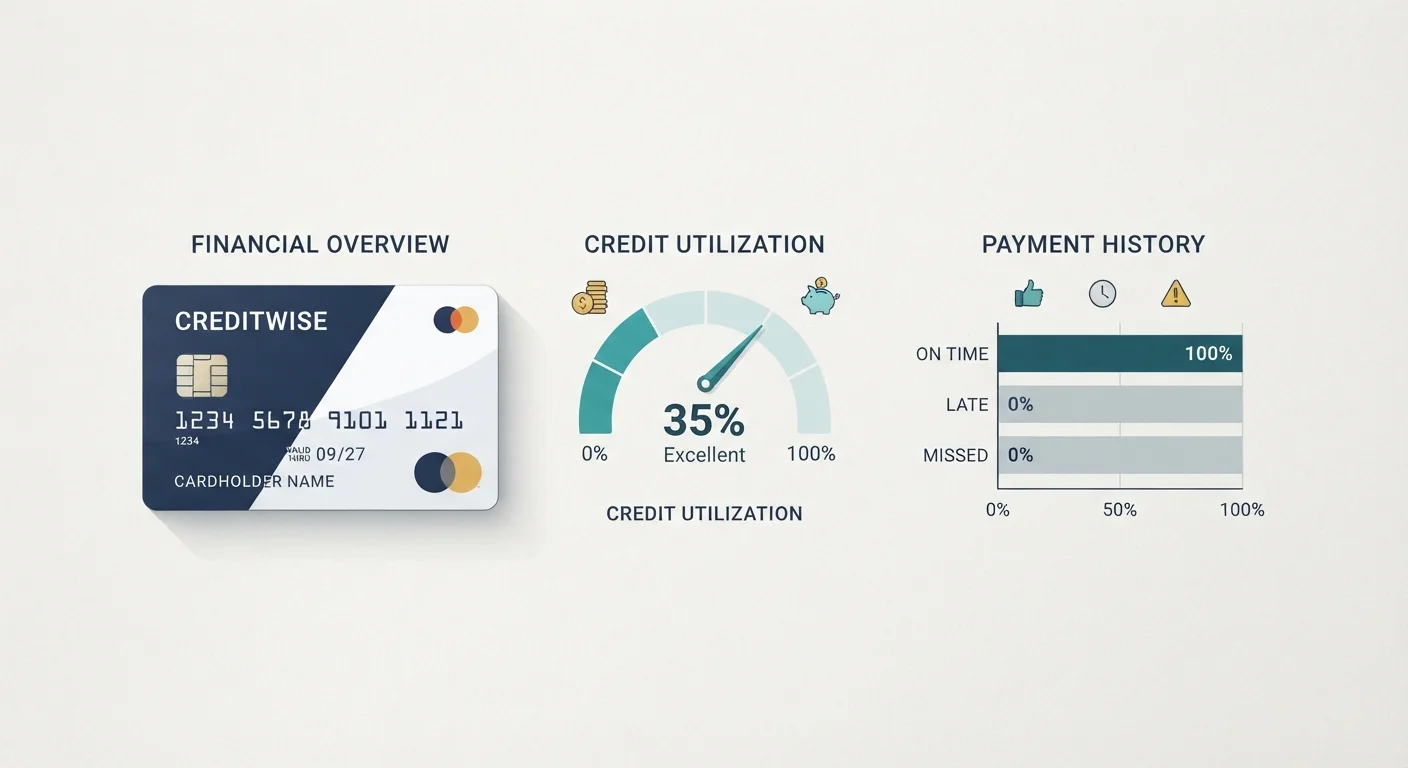
The math behind credit utilization is straightforward. Add up the current balances on all your revolving credit accounts, then divide that total by the sum of all your credit limits. Multiply the result by 100 to get a percentage.
Example: You have two credit cards. Card A has a $600 balance and a $2,000 limit. Card B has a $400 balance and a $3,000 limit. Your total balance is $1,000 and your total limit is $5,000, giving you 20% overall utilization.
Scoring models look at two dimensions simultaneously: your aggregate utilization (all cards combined) and your per-card utilization (each card individually). Maxing out a single card can hurt your score even if your overall ratio looks fine. For a deeper look at how utilization fits into the full scoring picture, see how credit scores are built.
30%
Commonly cited utilization threshold to avoid
Credit scoring guidance from major bureaus and financial educators consistently references 30% as a general upper boundary, though lower ratios produce better outcomes.
~30%
Share of FICO score driven by amounts owed
According to FICO's published scoring model breakdown, the 'amounts owed' category-which includes utilization-accounts for approximately 30% of a standard FICO score.
1-2
Billing cycles for balance changes to reflect
Because issuers report balances once per cycle, a meaningful paydown can appear on your credit report within one to two billing cycles in most cases.
Why Lenders Care About This Number Beyond Your Score
Your credit score is a summary, but lenders often dig into the underlying report. A mortgage underwriter, for instance, may review each tradeline individually. A borrower with a 720 score and 55% utilization on several cards may face harder scrutiny than one with the same score and 10% utilization. Learn more about this process in our article on how lenders use credit scores in mortgage underwriting.
High utilization can also affect the interest rate you are offered. Lenders price risk into rates, and a borrower leaning heavily on available credit is seen as a higher-risk customer-even if payments are never late. This connects closely to another metric lenders watch: your debt-to-income ratio, which measures monthly debt obligations relative to gross income. Together, these two ratios paint a picture of how stretched your finances may be.
“Lenders are not just looking at a score number-they are reading a story. High utilization tells them that a borrower may be living close to the edge of their available credit, regardless of whether they pay on time.”
— Consumer Financial Protection Bureau, Federal agency providing consumer financial education and oversight
Practical Ways to Lower Your Utilization Ratio
Reducing your ratio comes down to two levers: lower your balances or raise your available credit. Here are actionable approaches for each:
- Pay down balances strategically. Focus on the card with the highest individual utilization first. Even a partial paydown before the statement closing date can lower what gets reported to bureaus.
- Request a credit limit increase. If your account is in good standing, asking your issuer for a higher limit instantly improves your ratio-as long as you do not increase spending alongside it.
- Avoid closing old accounts. Older accounts with low or zero balances contribute available credit to your total. Closing them shrinks the denominator and raises your ratio.
- Time large purchases carefully. A big purchase right before your statement closes temporarily spikes utilization. If timing allows, pay it down before the statement date.
Pay Before Your Statement Closes
Your card issuer typically reports the balance shown on your monthly statement to credit bureaus-not the balance after your payment. Making a payment a few days before your statement closing date can reduce the balance that gets reported, lowering your utilization ratio for that cycle.
It is also worth understanding what lenders actually see when they pull your report-not just your score. Review common misconceptions about credit checks to avoid surprises.
The Broader Financial Picture
Credit utilization is a snapshot, not a verdict. It reflects your current balances relative to your limits on the day it is measured, and it can improve meaningfully within one or two billing cycles when you pay down debt. This makes it one of the more responsive elements of your credit profile.
That said, consistently high utilization often signals a pattern worth examining: spending that outpaces income, reliance on revolving credit to cover regular expenses, or limited liquid savings acting as a buffer. Addressing the root cause-whether through budgeting, building an emergency fund, or restructuring debt-tends to produce more durable improvement than credit-management tactics alone.
For readers building credit from a limited history, it is worth noting that rent and utility payments can sometimes contribute to your credit file, though they do not factor into utilization calculations since they are not revolving credit accounts.
This article is for general informational and educational purposes only and does not constitute personalized financial or credit advice. Consult a qualified financial professional for guidance specific to your situation.