How Lifestyle Inflation Develops
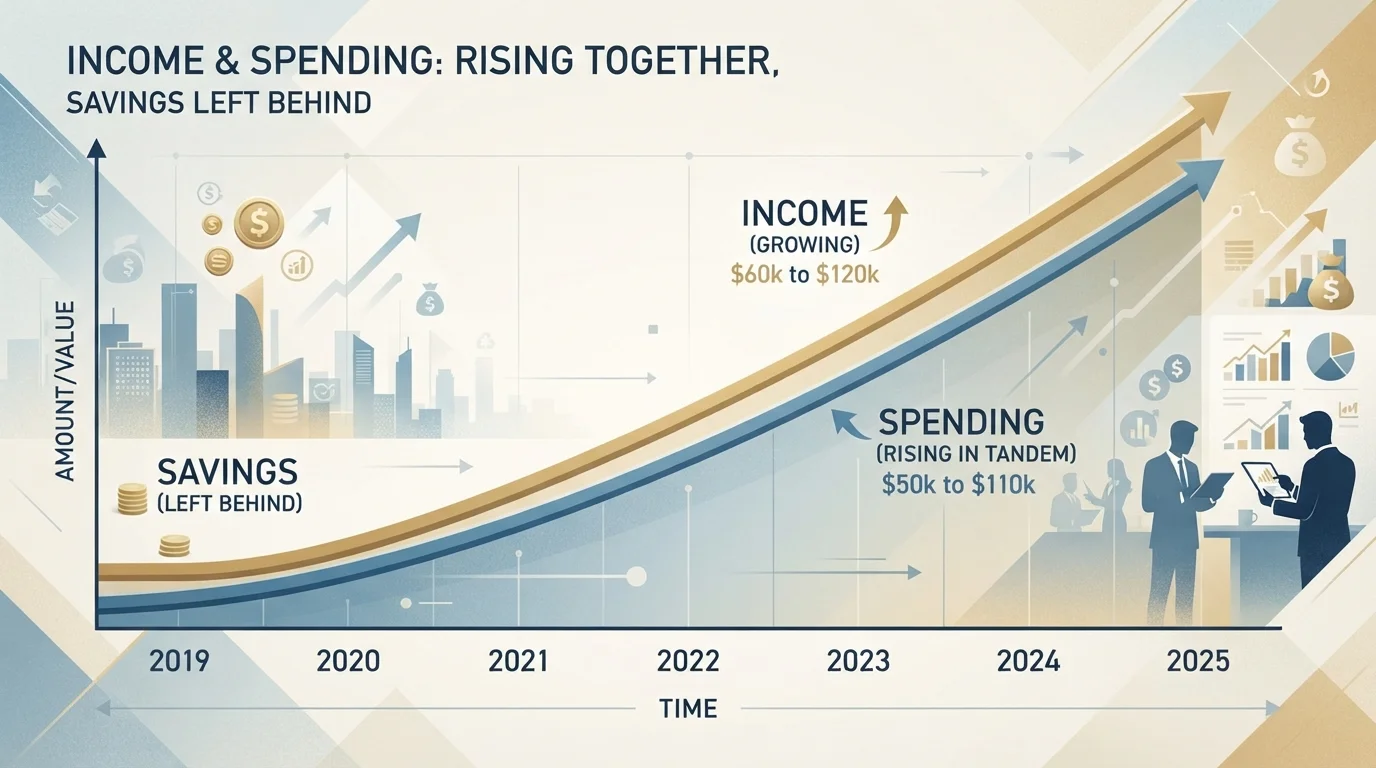
Most people expect that earning more will translate directly into financial progress. In practice, that link often breaks. Each step up in income tends to bring a corresponding step up in spending - a nicer apartment, a newer car, more frequent dining out - and the savings gap stays right where it was.
The mechanism is subtle. Individual upgrades feel modest and justified. A streaming service added here, a gym membership upgraded there: none of these feel significant in isolation. But when many small increases stack up across housing, transportation, food, and entertainment, the cumulative effect can fully absorb an entire raise. This is why spending habits that quietly stall savings progress are so easy to overlook until the pattern is already entrenched.
Social dynamics also play a role. Spending norms tend to shift alongside income - a new job, a new neighborhood, or a new peer group can all quietly redefine what feels like a normal standard of living.
Lifestyle Inflation Is Not the Same as Necessary Spending
Not every increase in spending represents lifestyle inflation. Responding to genuine needs - such as moving to a safer neighborhood, purchasing more reliable transportation for a longer commute, or increasing food quality for health reasons - can be appropriate uses of rising income. The concern is habitual, unconsidered upgrades that happen automatically rather than deliberately. Context matters when evaluating your own spending patterns.
Why It's Hard to Detect in Real Time
Lifestyle inflation is particularly difficult to recognize because it happens gradually and feels entirely reasonable at each step. A raise that arrives in a paycheck doesn't come with a label reading "save half of this." Without a deliberate plan, the money flows naturally into existing and new spending patterns.
Compounding the problem, the financial baseline shifts. After six months in a larger apartment, it no longer feels like a luxury - it feels like the minimum. This psychological adaptation means the previous lifestyle can start to feel inadequate even though it was perfectly functional. Over time, this makes it harder to scale back spending voluntarily, even when circumstances change.
~25%
Average US personal savings rate in 1975
The US Bureau of Economic Analysis has tracked the personal savings rate for decades; mid-1970s rates were substantially higher than they've been in recent years, illustrating how spending norms can shift over time alongside rising living standards.
< 5%
US personal savings rate in recent years
The US Bureau of Economic Analysis reports that the personal savings rate has frequently remained below 5 percent in recent years, reflecting how spending tends to keep pace with income at a societal level.
50%+
Americans living paycheck to paycheck
Multiple national surveys - including those by the Federal Reserve - have consistently found that roughly half or more of US adults report difficulty covering an unexpected $400 expense, a pattern consistent with income gains being absorbed by spending.
Understanding this pattern is a prerequisite for changing it. Readers who suspect their budget may have drifted should consider reviewing signs their budget needs a reset as a starting point.
Practical Patterns That Counteract Lifestyle Creep
Awareness alone doesn't redirect money - structure does. A few concrete habits consistently help people separate income growth from spending growth.
Automate Savings Before Spending
Setting up an automatic transfer to a savings or retirement account on payday removes the temptation to spend what isn't immediately visible. When savings happen first, spending adjusts to whatever remains - not the other way around. If you're building this habit from a limited starting point, the approach covered in building a savings habit when money feels tight applies directly here.
Assign Raises Before You Receive Them
When a raise or bonus is confirmed but not yet in your account, decide in advance how to allocate it. A common framework is to direct a predetermined share - many personal finance practitioners suggest at least 50 percent - toward savings or debt reduction, and only then allow the remainder to fund discretionary upgrades.
Review Recurring Expenses Regularly
Subscriptions, memberships, and service contracts are the most common vehicle for lifestyle inflation because they require no active purchase decision after sign-up. A quarterly review of all recurring charges helps surface items that no longer reflect conscious priorities.
Try the 'Raise Rule' Before Adjusting Lifestyle
When you receive a raise, commit to living on your previous take-home pay for at least three months while the additional income accumulates in savings. This creates a buffer and allows you to evaluate which lifestyle upgrades are genuinely meaningful before making them permanent recurring costs.
For a broader look at the financial red flags that accompany spending-income imbalances, reviewing warning signs of living beyond your means can provide useful context alongside these strategies.
This article is for general informational and educational purposes only and does not constitute personalized financial advice. Consult a qualified financial adviser for guidance specific to your situation.