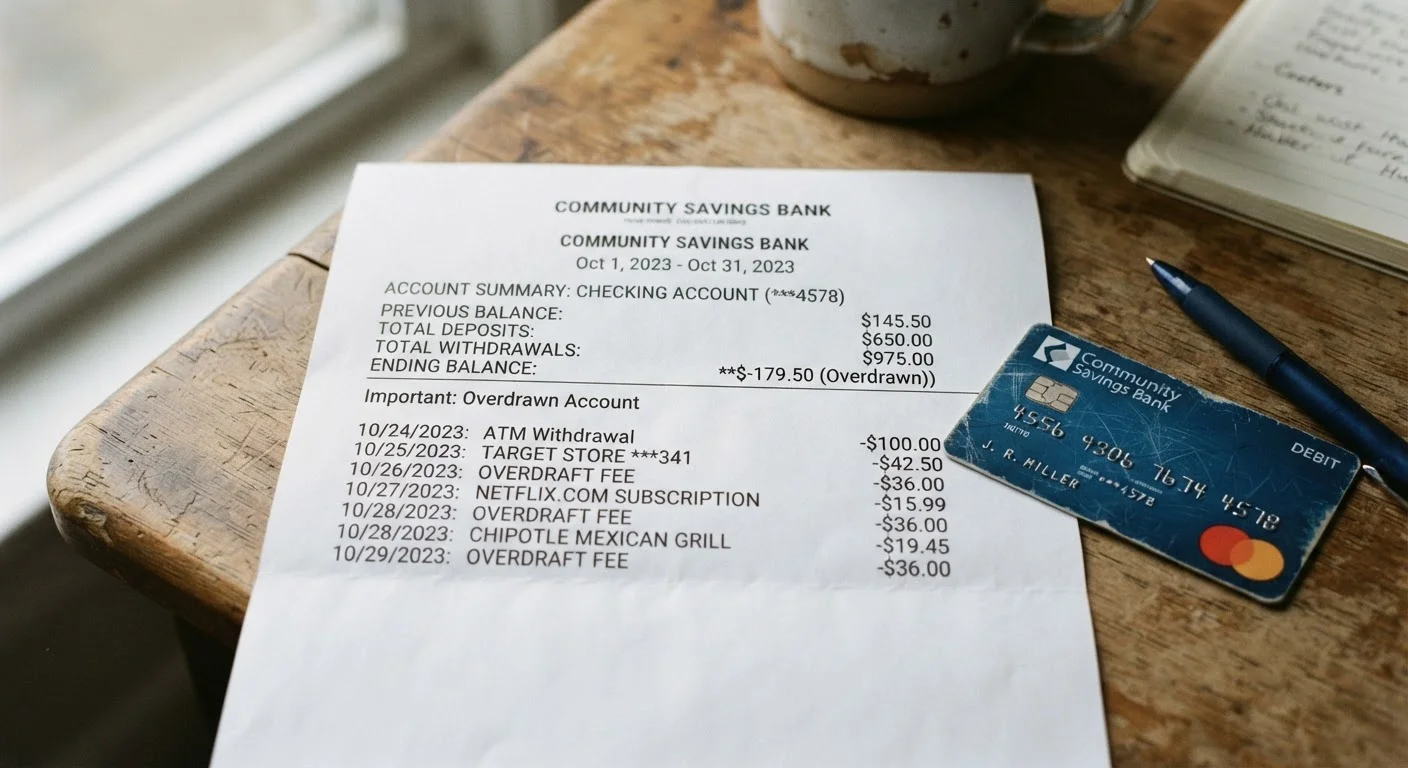
How Overdraft Fees Are Structured
When you spend more than your available checking balance, your bank faces a choice: decline the transaction or cover it and charge you. Most institutions offer to do the latter through what is broadly called overdraft coverage. The fee for that coverage is typically a flat dollar amount per transaction - historically around $30 at large US banks, though the figure varies by institution.
What makes these fees particularly easy to underestimate is the concept of transaction ordering. Banks process transactions in a specific order - sometimes largest to smallest rather than chronological. If a large debit clears first and empties your account, every smaller transaction that follows can trigger its own fee, even if those smaller purchases happened earlier in the day.
Understanding basic banking terms like ACH and available balance is essential context here: your available balance (what you can spend right now) may differ from your ledger balance (your official balance including pending items), meaning you can overdraw without realizing it.
$26.61B
Overdraft and NSF fees collected annually by US banks
According to the Consumer Financial Protection Bureau (CFPB), US banks and credit unions collected over $26 billion in overdraft and non-sufficient funds fees in a single recent year.
~$35
Typical flat overdraft fee at large US banks
The CFPB has reported that the most common overdraft fee charged by large US banks has historically been around $35 per transaction.
9%
Share of account holders generating most overdraft revenue
CFPB research found that a small share of heavily overdrawn consumers - roughly 9% of account holders - account for the majority of all overdraft fee revenue.
The Opt-In Rule: What It Means for Debit Card Users
A key consumer protection introduced by federal regulation requires banks to obtain your affirmative consent before enrolling your debit card purchases and ATM withdrawals in standard overdraft coverage. If you never opted in, those transactions will simply be declined when your balance is too low - potentially embarrassing at checkout, but free of a fee.
However, this opt-in requirement does not extend to checks, recurring electronic debits (like a gym membership or utility autopay), or ACH transfers. Those can still overdraw your account and generate fees regardless of whether you opted in for debit purchases. This distinction catches many people off guard, especially those who rely heavily on automated bill pay without monitoring their balance closely.
Check Your Overdraft Opt-In Status Now
Log in to your online banking portal or call your bank and ask directly: 'Am I currently opted in to overdraft coverage for debit card purchases?' Many consumers do not know their status. If you opted in years ago and would prefer purchases to be declined, you can request to opt out at any time - there is no penalty for doing so.
Overdraft Protection: A Lower-Cost Alternative
Many banks offer overdraft protection - a linked account arrangement that automatically transfers funds from a savings account, money market account, or a dedicated line of credit to cover a shortfall. This is distinct from standard overdraft coverage and generally costs less per incident. A transfer fee (often $10 or under) or a low interest charge on a credit line is typically far cheaper than a $30-$35 flat fee.
The trade-off: transfers from a savings account count against federal transaction limits historically tied to Regulation D, though those limits have been relaxed in recent years. Transfers from a line of credit accrue interest from the moment funds are advanced, so carrying a balance on that line can get expensive. Still, for most consumers, protection options are more manageable than repeated flat fees.
If you are weighing banking products more broadly, it also helps to understand how your money could be working for you elsewhere - for instance, how interest compounds in a savings account - to make sure a linked buffer account is earning something rather than sitting idle.
Practical Ways to Avoid Overdraft Charges
Avoiding overdraft fees does not require a large balance - it requires awareness and a few deliberate habits.
- Set low-balance alerts. Most banks offer free text or email alerts when your balance falls below a threshold you choose. Getting a same-day warning gives you time to transfer funds before a scheduled payment clears.
- Keep a small buffer. Treating $50-$100 as your personal floor - spending as if your account is empty when you hit that level - provides a cushion against timing surprises.
- Audit your automatic payments. List every recurring charge and its typical clear date. Cross-reference with your paycheck schedule. Misalignment between billing dates and deposit dates is a leading cause of overdrafts.
- Opt out of debit card overdraft coverage. If you would rather have a purchase declined than pay a fee, confirm with your bank that you have not opted in - or request to opt out.
- Link a backup account. Even a small savings account as a linked backup can prevent flat-fee charges for the cost of a transfer fee or nothing at all.
For a broader approach to keeping spending on track, budgeting basics offers practical frameworks that reduce the guesswork around your monthly cash flow.
When Overdraft Fees Signal a Deeper Cash-Flow Problem
Occasional overdrafts are a timing issue - fixable with alerts and a buffer. Repeated overdrafts, however, often indicate that spending consistently exceeds income, or that income arrives too late to cover fixed obligations. In that case, the fees themselves become a compounding burden, similar to the fee spiral described in high-cost short-term borrowing situations - a pattern explored in depth in our article on escaping a payday loan cycle.
If your account regularly runs close to zero, the most effective fix is a budget that maps every dollar of income against every scheduled outflow before the month begins. Overdraft fees are a symptom; a cash-flow gap is the underlying condition. Addressing both the fees and the gap - rather than simply opting for coverage that enables spending beyond your means - puts you on a more stable financial footing.
This article is for general informational and educational purposes only and does not constitute personalized financial or banking advice. Banking products, fees, and regulations vary by institution and may change. Consult your bank's account disclosures and, where appropriate, a qualified financial adviser for guidance specific to your situation.