Why Two Scoring Models Exist
Most consumers encounter credit scores through a free app or a bank dashboard and assume they're seeing the same number a lender will see. That assumption is usually wrong - and understanding why starts with knowing who created each model and for what purpose.
FICO (Fair Isaac Corporation) introduced its credit scoring model in 1989. Over the following decades, it became the dominant tool lenders use to evaluate credit risk. Today there are many FICO model versions - FICO 8, FICO 9, FICO 10, plus industry-specific variants - and different lenders use different versions. Understanding what a credit score actually measures helps clarify why any scoring model matters in the first place.
VantageScore was introduced in 2006 as a joint project by the three major credit bureaus - Equifax, Experian, and TransUnion - partly to create a more consistent scoring model across all three bureaus and to extend scoreable credit to more consumers. The current version is VantageScore 4.0.
Both models use the same 300-850 scale, and both draw data from your credit report. But the formulas behind the scores differ in ways that genuinely affect your number.
How the Models Differ in Practice
The most consequential differences between FICO and VantageScore involve how they weight factors, handle limited credit histories, and treat certain financial behaviors.
| Criterion | FICO Score | VantageScore |
|---|---|---|
| Score range | 300-850 | 300-850 |
| Created by | Fair Isaac Corporation (1989) | Equifax, Experian, TransUnion (2006) |
| Minimum credit history required | 6 months, 1 active account | 1 month, 1 account ever reported |
| Rate-shopping inquiry window | Up to 45 days (mortgage/auto) | 14 days (all loan types) |
| Mortgage lender usage | Required by federal guidelines | Not typically used for mortgages |
| Free monitoring availability | Some card issuers offer FICO | Widely available via free apps |
| Number of versions in use | Many (FICO 8, 9, 10, industry-specific) | Fewer (current: VantageScore 4.0) |
Factor Weighting
FICO publicly identifies five categories: payment history (35%), amounts owed (30%), length of credit history (15%), new credit (10%), and credit mix (10%). VantageScore groups factors differently - emphasizing payment history and the depth of credit, while treating credit utilization and balances as highly influential. The precise weights aren't published by VantageScore in the same granular way. Credit utilization plays a significant role under both models, but VantageScore may respond more quickly to utilization changes depending on when data is reported.
Minimum Scoring Requirements
FICO requires at least six months of credit history and at least one account reported within the past six months before it will generate a score. VantageScore can produce a score with as little as one month of history and one account ever reported. This means millions of consumers with thin files - recent graduates, new immigrants, or people returning to credit - may have a VantageScore but no FICO score at all.
How Hard Inquiries Are Grouped
Both models allow rate-shopping by grouping multiple hard inquiries for the same loan type within a short window. FICO's window is typically 45 days for mortgages and auto loans; VantageScore uses a 14-day window across all loan types. This distinction matters if you're shopping for a mortgage or car loan and pulling quotes from several lenders.
Your Score Can Differ Between Models - Even on the Same Day
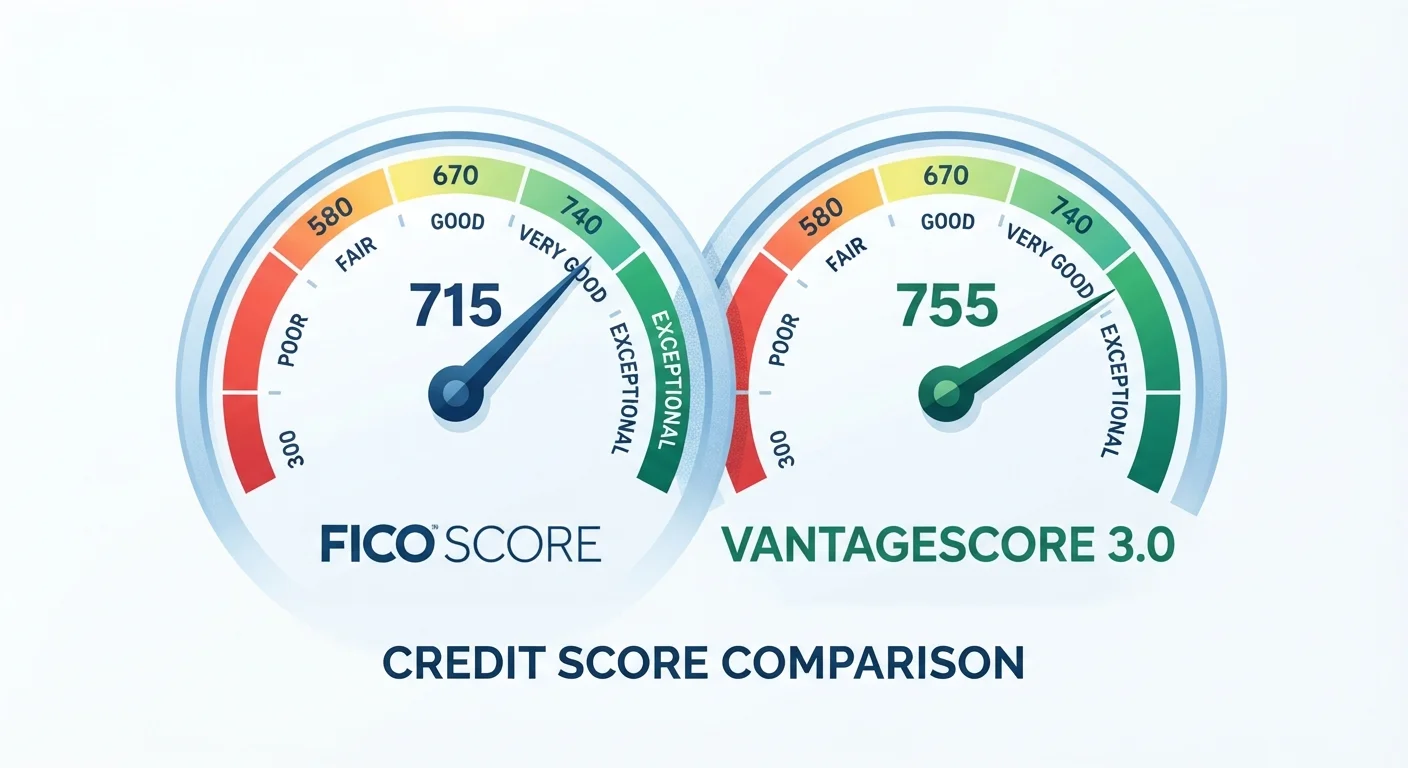
It's entirely normal for your FICO Score and VantageScore to differ by 20-50 points or more, even when drawn from the same bureau file. This doesn't mean one is wrong - it reflects genuinely different formulas. If you see a significant gap, focus on the factors both models share: paying on time, keeping balances low relative to your credit limits, and avoiding unnecessary new credit applications. Strengthening those habits moves both scores in a positive direction over time.
Which Score Lenders Actually Use
The score you monitor is often not the score a lender evaluates. This gap creates confusion - and occasionally unpleasant surprises at the loan application stage.
Most mortgage lenders are required under federal guidelines to use specific FICO model versions: typically FICO Score 2 (Experian), FICO Score 5 (Equifax), and FICO Score 4 (TransUnion). They pull all three and often use the middle score. See how lenders use your credit score in mortgage underwriting for a fuller picture of that process.
Auto lenders frequently use FICO Auto Scores, and credit card issuers may use FICO Bankcard Scores - both industry-specific versions that weight relevant behaviors more heavily than the base model. Many borrowers hold misconceptions about what lenders actually see during a credit check, including which score version is pulled.
VantageScore usage is growing among some fintech lenders and credit card issuers, but it remains less common in traditional lending than FICO. Free tools from banks and credit card issuers - and most standalone credit monitoring apps - typically display a VantageScore. That score is still useful for tracking trends, but treat it as a directional indicator rather than the definitive number a lender will see.
Because both models pull data from the same bureau files, variations between bureaus also contribute to score differences. A lender pulling your Experian FICO Score may see a different number than one pulling your TransUnion VantageScore - even on the same day.
This article is for general informational and educational purposes only and does not constitute personalized financial or credit advice. Consult a licensed financial professional for guidance specific to your situation.