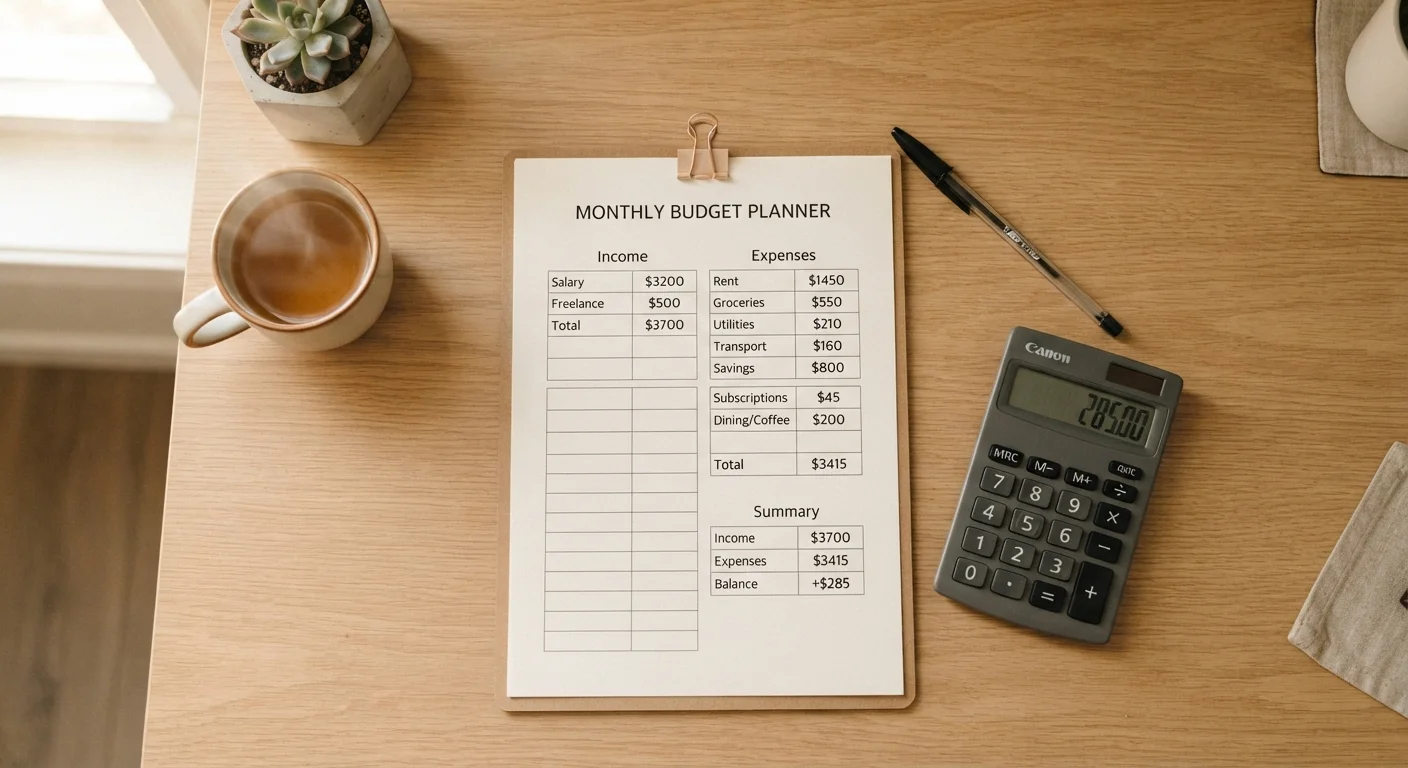
The Core Idea: A Plan, Not a Prison
Strip away every spreadsheet and app, and a personal budget comes down to one question: Where do I want my money to go this month? That forward-looking intention is what separates a budget from simply checking your bank balance after the fact.
A budget has three moving parts:
- Income: Every dollar coming in - wages, freelance pay, government benefits, side work.
- Expenses: Every category of spending, from rent and groceries to subscriptions and savings contributions.
- The gap: What remains after expenses are subtracted from income - ideally zero, meaning every dollar has a purpose.
When those three elements are balanced on paper (or a screen) before the month begins, you are budgeting. For a fuller walkthrough of putting these elements together, see our beginner's guide to personal budgeting.
Start With Take-Home Pay, Not Gross
When building your first budget, always use your net income - the amount deposited into your bank account after taxes and deductions - not your gross salary. Budgeting from a number you never actually receive sets you up for a shortfall from day one.
What a Budget Is Not
Misconceptions about budgeting stop millions of Americans from ever starting. A few worth clearing up:
- It is not only for people in financial trouble. High earners who budget consistently tend to build wealth faster precisely because they direct more money toward goals rather than letting it drift. See why this and other ideas are wrong in our look at common budgeting myths.
- It is not a fixed rulebook. A budget is adjusted whenever life changes - a pay raise, an unexpected bill, a new goal. Rigidity is a design flaw, not a feature.
- It is not about deprivation. A budget that never includes anything enjoyable is one you will abandon. Discretionary spending - dining out, hobbies, entertainment - belongs in a real budget.
- It is not the same as a savings account or a credit score. Those are separate financial tools. If you want to understand how they relate, the personal finance glossary is a useful reference.
Budgets Look Different for Everyone
There is no single correct budget format. Some people use the 50/30/20 framework (needs, wants, savings); others use zero-based budgeting where every dollar is assigned a job. The format matters less than the habit of planning. Choose whatever structure you will actually use consistently.
The Most Common Budgeting Mistake Before You Even Begin
Most people who try budgeting and quit do so because their numbers were wrong from the start - specifically, their spending estimates were too low. When the plan says groceries cost $300 but reality is $480, the budget feels broken almost immediately.
The fix is using actual data: pull two or three months of bank and credit card statements to see what you genuinely spend before writing a single category. This is the foundation of a realistic plan. Our article on underestimating your spending explains why this error is so common and how to avoid it.
~33%
Americans with a detailed household budget
Gallup polling has consistently found that only about one in three U.S. adults maintains a detailed monthly budget.
$1,000
Emergency savings threshold many households lack
Multiple Federal Reserve consumer finance surveys have found a significant share of U.S. households report difficulty covering an unexpected $1,000 expense without borrowing.
Once you have a working budget, it also becomes the foundation for bigger financial moves - reducing debt, building an emergency fund, or improving your credit profile. Those topics are covered in our hubs on saving and debt and credit and banking.
This article is for general informational and educational purposes only and does not constitute personalized financial, tax, or legal advice. Consult a qualified financial professional for guidance specific to your situation.