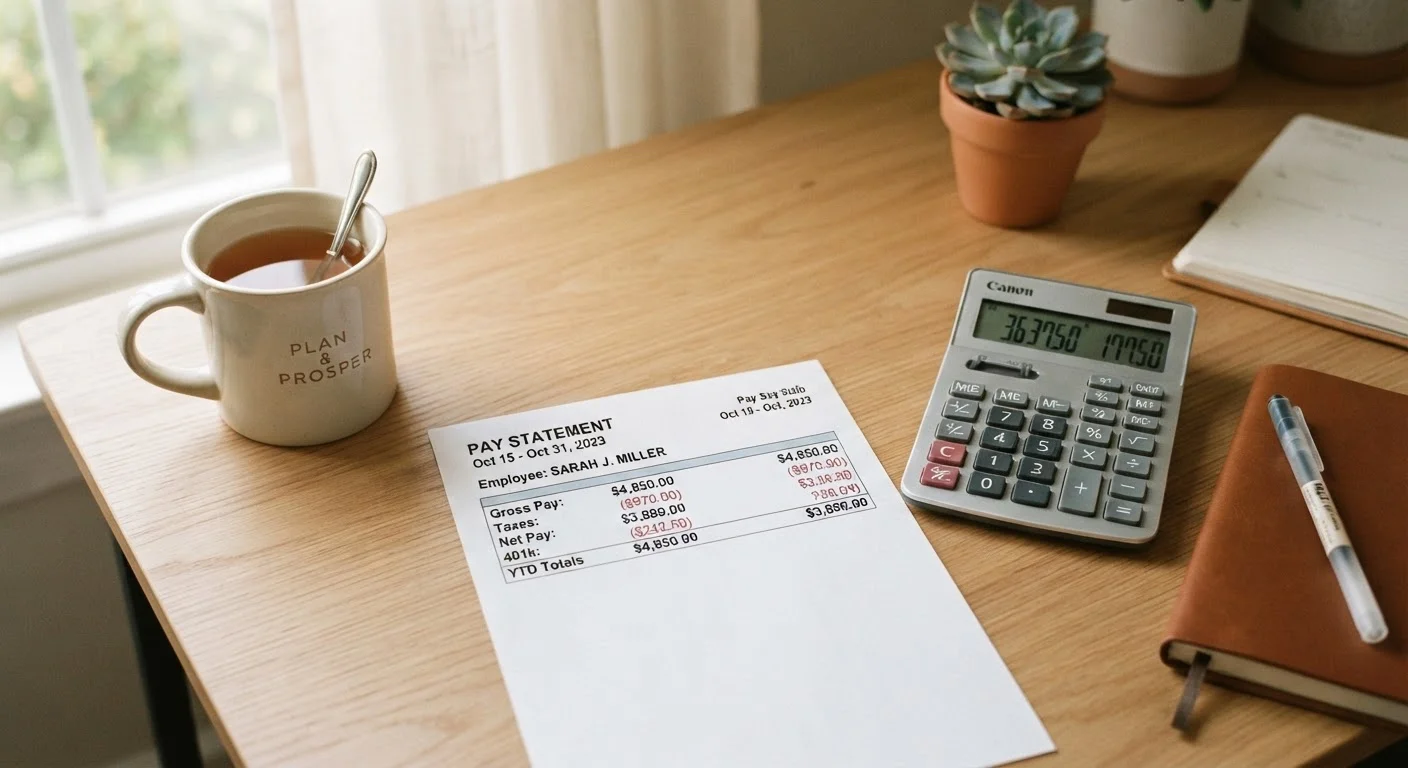
Why Gross Income Is the Wrong Number to Budget With
Most budgets fail before they begin - not because of poor willpower, but because they're built on the wrong number. When an employer offers a $60,000 annual salary, that figure is your gross income: what you earn before any deductions. The amount that actually lands in your bank account - your net pay, or take-home pay - is meaningfully lower.
The gap between gross and net can easily reach 25-35% of your paycheck, depending on your tax situation and benefit elections. Building a spending plan on gross income means you're planning to spend money you never receive. That single error cascades into overdrafts, missed savings goals, and the frustrating sense that your budget "just doesn't work."
Understanding what a personal budget actually is is the first step - but it only works when you're using accurate income figures from the start.
| Common pay period types | Weekly (52/yr), Bi-weekly (26/yr), Semi-monthly (24/yr), Monthly (12/yr) |
| Social Security tax rate (employee share) | 6.2% of gross wages up to annual wage base (IRS Publication 15) |
| Medicare tax rate (employee share) | 1.45% on all wages; +0.9% surcharge above income threshold (IRS Publication 15) |
| Typical gross-to-net reduction range | 25-35% of gross paycheck (Varies by income level, state, and benefit elections) |
| Where to find your net pay | Pay stub (payroll portal) or bank deposit history |
| Best income baseline for variable earners | 3-6 month average of net deposits |
What Gets Deducted Before You See a Dollar
Several categories of deductions reduce your gross pay on every paycheck. Knowing each one helps you trace exactly where your earnings go.
Gross Income
The total amount you earn before any taxes or deductions are taken out. This is the number listed in your employment offer or salary agreement.
Net Pay (Take-Home Pay)
The amount deposited into your bank account after all mandatory and voluntary deductions have been subtracted from your gross income.
Pre-Tax Deduction
A deduction subtracted from gross income before taxes are calculated, reducing your taxable income and therefore your tax bill. Common examples include 401(k) contributions and health insurance premiums.
FICA Taxes
Federal Insurance Contributions Act taxes, which fund Social Security and Medicare. Employees pay 6.2% for Social Security (up to the annual wage base) and 1.45% for Medicare on all wages.
W-4 Form
An IRS form completed by employees that tells employers how much federal income tax to withhold from each paycheck. Filing status and additional withholding elections directly affect net pay.
Pay Period
The recurring time interval at which an employer pays employees - weekly, bi-weekly, semi-monthly, or monthly. The number of pay periods per year affects monthly cash flow planning.
Mandatory Deductions
- Federal income tax - Withheld based on your W-4 filing status and allowances. The IRS progressive tax system means different portions of your income are taxed at different rates.
- State and local income tax - Varies widely by location. Some states have no income tax; others exceed 10% at higher income levels.
- Social Security tax - 6.2% of gross wages up to the annual wage base limit (set by the IRS each year).
- Medicare tax - 1.45% of all gross wages, with an additional 0.9% surcharge for higher earners.
Voluntary (Pre-Tax) Deductions
These reduce your taxable income, so they shrink your tax bill as well as your paycheck:
- 401(k) or 403(b) contributions
- Health, dental, and vision insurance premiums
- Health Savings Account (HSA) or Flexible Spending Account (FSA) contributions
- Dependent care FSA
Post-Tax Deductions
- Roth 401(k) contributions
- Wage garnishments (court-ordered)
- Some life and disability insurance premiums
~30%
Average share of gross pay lost to deductions
For a median US full-time worker, combined federal taxes, FICA, and employer benefit premiums commonly reduce gross pay by roughly 25-35%, depending on state and elections.
6
Months of pay stubs to average for variable income planning
Financial educators commonly recommend using a 3-to-6-month average of actual net deposits as the budgeting baseline for freelancers and gig workers.
How to Find Your Real Take-Home Pay
You don't need to calculate this by hand. The most reliable method is to look at an actual pay stub or your bank deposit history - not an estimate. Follow these steps:
- Locate a recent pay stub. Your employer's payroll portal (such as ADP, Workday, or Paychex) will have this. Look for the "Net Pay" line - that is your real number.
- Annualize it correctly. Multiply your net paycheck by the number of pay periods in the year: 52 for weekly, 26 for bi-weekly, 24 for semi-monthly, or 12 for monthly.
- Confirm consistency. Some months have three pay periods (bi-weekly schedules). Account for this variability rather than assuming every month is identical.
- If you have variable income, average your net deposits over the last three to six months and use that as your planning baseline. Budgeting on a freelance or irregular income requires additional strategies beyond this step.
If your income shifts - due to a raise, a job change, or hours reduction - revisit this calculation immediately. Adjusting your budget when income changes unexpectedly walks through how to revise your plan quickly.
Once you have your real net number, you can pair it with accurate spending data. Underestimating your spending is the next common mistake to avoid. And when you're ready to take the next step, consider pay-yourself-first budgeting, which uses your verified net pay as the anchor for automatic saving.
This article is for general informational and educational purposes only and does not constitute personalized financial, tax, or legal advice. Tax rules and rates change regularly - consult a qualified tax professional or financial adviser for guidance specific to your situation.