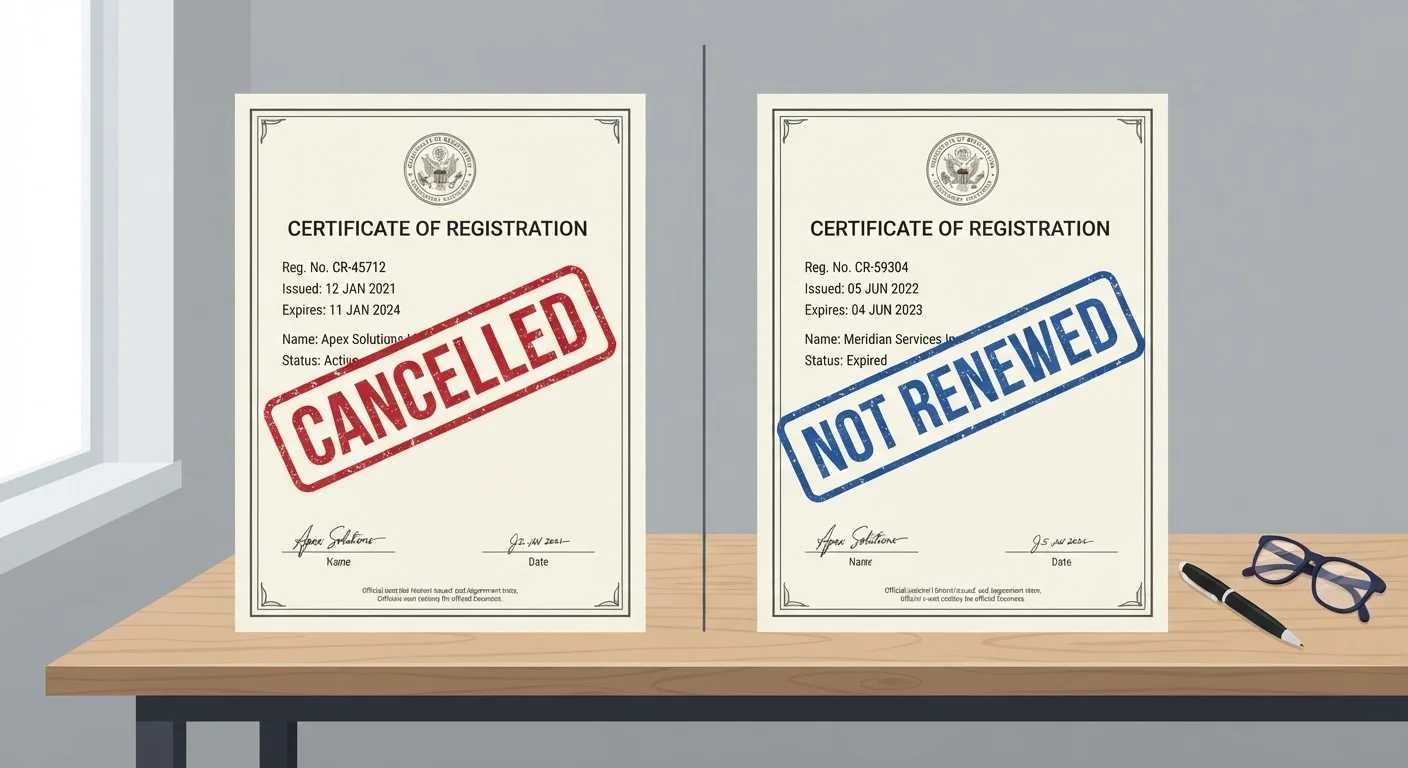
What Each Term Actually Means
Insurance policies use precise language, and cancellation and non-renewal are not interchangeable, even though both result in coverage ending. The distinction hinges on when coverage stops relative to the policy term.
A cancellation occurs when a policy is terminated before its scheduled expiration date. This can be initiated by the insurer or by you, the policyholder. A non-renewal occurs when either party decides not to continue the policy once the current term expires. Your coverage remains fully in force until that expiration date - it simply isn't extended into a new term.
Think of it this way: cancellation cuts a lease short, while non-renewal is simply choosing not to renew when the lease is already up. The consequences, required notices, and your rights differ significantly between the two. For a broader look at how renewal decisions are structured, see what typically changes at renewal.
| Criterion | Cancellation | Non-Renewal |
|---|---|---|
| When it occurs | Before the policy term expires | At the scheduled policy expiration |
| Who can initiate | Insurer or policyholder | Insurer or policyholder |
| Insurer's valid reasons | Limited by law after 60-day window | Broader grounds generally allowed |
| Typical notice period | 10-30 days (varies by state) | 30-60 days before expiration |
| Premium refund | Unused premium typically refunded | No refund; term runs to end |
| Impact on future coverage | May affect insurability if for cause | Generally less impact on record |
| Coverage during notice period | Ends on cancellation effective date | Remains in force until expiration |
When Insurers Can Cancel a Policy Mid-Term
Because cancellation disrupts active coverage you're relying on, state insurance regulations generally restrict an insurer's ability to cancel mid-term. In most states, once a policy has been in force for a set period - commonly 60 days - an insurer may only cancel for a limited number of reasons, which typically include:
- Non-payment of premium - the most common trigger
- Material misrepresentation - providing false information on your application
- Fraud - intentional deception related to the policy or a claim
- A substantial change in risk - such as a new, undisclosed hazard at the insured property
During the first 60 days of a new policy (often called the underwriting period), insurers typically have broader latitude to cancel if they discover information that would have affected their decision to issue coverage. After that window closes, the grounds narrow considerably.
State Rules Vary Significantly
Insurance is regulated at the state level, meaning the specific grounds for cancellation, required notice periods, and policyholder remedies differ across jurisdictions. What applies in one state may not apply in another. Always check your state's department of insurance website or consult a licensed agent to understand the rules that govern your specific policy.
If your policy is cancelled for non-payment or fraud, this can affect your ability to obtain coverage elsewhere and may be reflected in insurance industry databases. A non-renewal generally carries less stigma and has a more limited impact on future insurability.
Notice Requirements and Your Rights
Both cancellation and non-renewal require written advance notice - but the rules governing each differ by state and policy type. As a general pattern:
- Cancellation notice is typically required 10-30 days in advance (with longer notice often required for cancellations that are not due to non-payment).
- Non-renewal notice is often required 30-60 days before the policy expiration date, giving you time to find replacement coverage.
If an insurer fails to provide proper notice, your state's insurance department may require them to reinstate the policy or extend coverage. Always read any notice you receive carefully to determine whether it is a cancellation or a non-renewal - the label matters for understanding your options and timeline.
30-60 days
Typical non-renewal notice window
Most states require insurers to provide written non-renewal notice 30 to 60 days before a policy expires, though the exact requirement varies by state and line of insurance.
60 days
Common insurer cancellation window
In many states, insurers have broader cancellation rights during the first 60 days of a new policy, after which permissible grounds become more restricted.
When a cancellation is insurer-initiated, you are generally entitled to a refund of any unused premium. How that refund is calculated depends on the method used. Pro rata and short rate calculations work differently and can meaningfully affect what you get back.
What To Do When You Receive Either Notice
Receiving either type of notice can feel alarming, but each calls for a different immediate response.
If you receive a cancellation notice: First, identify the stated reason. If it's non-payment, contact your insurer immediately - many will reinstate coverage if payment is made within the notice period. If you believe the cancellation is unjustified, you can file a complaint with your state's department of insurance. Acting quickly is essential because your coverage is being cut off before its natural end.
If you receive a non-renewal notice: You have until your expiration date to obtain new coverage, so begin shopping right away. Review what drove the non-renewal - if it relates to claims history or property condition, address those factors before applying elsewhere. Understanding your renewability clause in your existing policy can also clarify whether the insurer had the right to decline continuation.
In either situation, document everything in writing, keep copies of all notices, and consult a licensed insurance agent or your state's insurance consumer advocate if you are unsure of your rights. This article provides general information only and is not a substitute for advice tailored to your specific policy and state.
This article is for general informational and educational purposes only. Coverage terms, valid grounds for cancellation or non-renewal, and notice requirements vary by state and policy type. Consult a licensed insurance professional and review your actual policy documents for guidance specific to your situation.