What 'Network' Actually Means on Your Health Plan
A provider network is a group of doctors, hospitals, labs, and other health care providers that have signed contracts with your insurance company. Under those contracts, providers agree to accept negotiated, discounted rates for covered services. In exchange, the insurer steers its policyholders toward those providers.
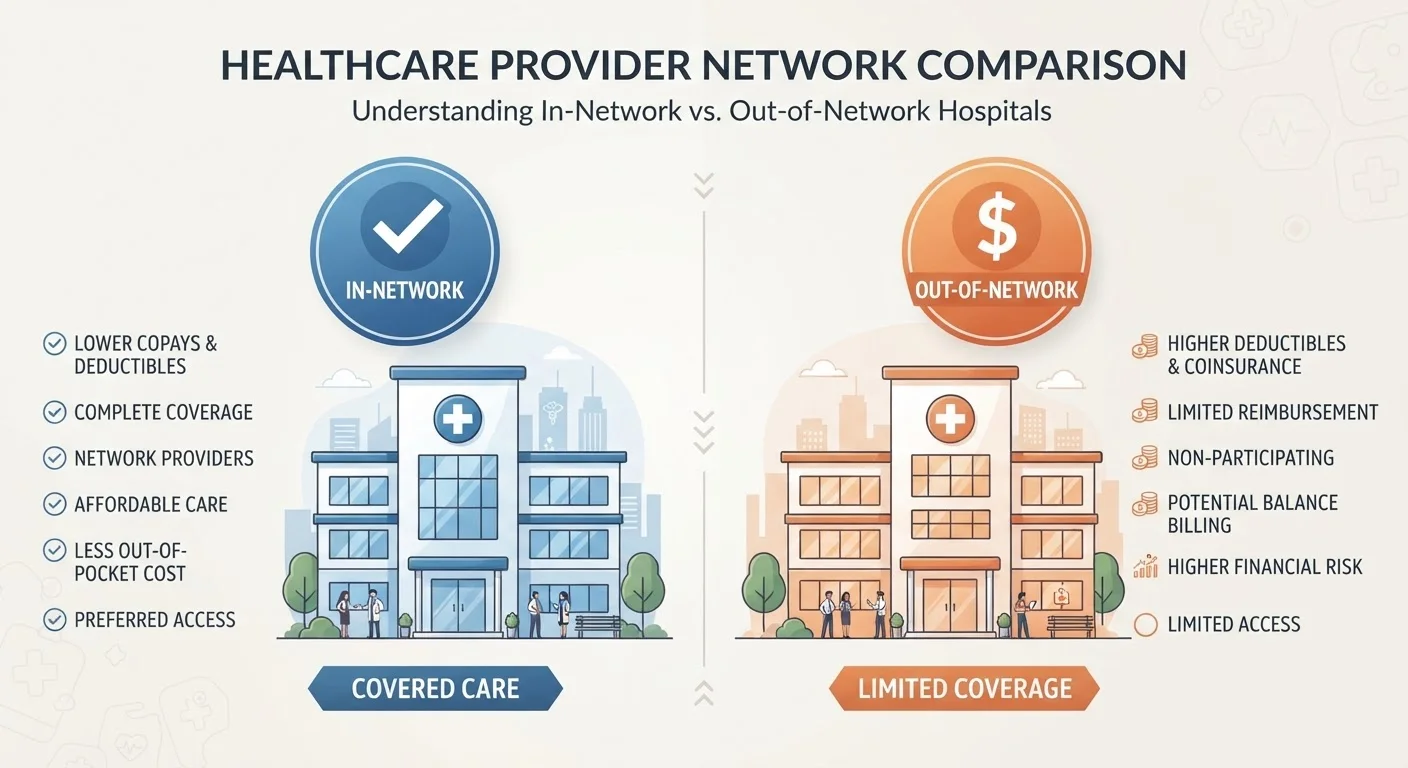
When you use an in-network provider, your insurer applies its pre-arranged rate, and you pay only your share - a copay, coinsurance, or the remainder of your deductible. When you use an out-of-network provider, no such agreement exists. Your insurer may pay a reduced benefit or nothing at all, and the provider can bill you for whatever balance remains.
Understanding how these networks interact with your overall cost structure is essential. For a broader view of how cost-sharing works, see how deductibles, copays, and coinsurance shape your real coverage experience.
| Criterion | In-Network | Out-of-Network |
|---|---|---|
| Provider agreement | Contracted with insurer | No contract with insurer |
| Negotiated rates | Yes - discounted | No - provider sets rate |
| Deductible applied | In-network deductible (lower) | Out-of-network deductible (higher or separate) |
| Coinsurance rate | Lower (e.g., 20%) | Higher (e.g., 40%+) |
| Balance billing risk | None | Yes - in many situations |
| Counts toward OOP max | Yes | Often excluded |
| HMO/EPO coverage | Fully covered (subject to cost-sharing) | Not covered (emergencies excepted) |
| PPO coverage | Covered at preferred rate | Covered at reduced rate |
How Out-of-Network Care Actually Hits Your Wallet
The cost difference is not just a slightly higher copay. Out-of-network care often triggers a separate, higher deductible - one you must meet entirely before your insurer covers anything. Many plans also apply a higher coinsurance rate (say, 40% instead of 20%) to out-of-network claims, and those payments may not count toward your in-network out-of-pocket maximum.
The most alarming risk is balance billing. Here is how it works: your insurer reimburses based on what it considers a "reasonable" rate for that service in your area. If the out-of-network provider charges more than that rate - which is common - the difference lands squarely on you. A surgeon who charges $8,000 for a procedure your insurer values at $5,000 can bill you the $3,000 gap, on top of your regular cost-sharing.
1 in 5
Emergency visits with surprise out-of-network bills
The Kaiser Family Foundation has reported that roughly one in five emergency room visits resulted in at least one out-of-network charge prior to the No Surprises Act.
~$750
Average surprise out-of-network bill for ER visits
Research published in JAMA Internal Medicine found the median surprise bill from out-of-network clinicians at in-network facilities ran into the hundreds of dollars per episode.
67%
Adults unaware of balance billing risk
A survey by the Commonwealth Fund found a majority of insured adults did not know that seeing an out-of-network provider at an in-network hospital could result in additional bills.
To see how these numbers interact with your annual cost caps, review deductible vs. out-of-pocket maximum.
Federal Protections: The No Surprises Act
Since January 2022, the federal No Surprises Act has provided meaningful - though not unlimited - protection against unexpected out-of-network bills. In covered scenarios, the law limits what you can be charged to your in-network cost-sharing amount.
Key situations covered by the law include:
- Emergency care at any facility, regardless of network status
- Non-emergency care at in-network facilities from out-of-network providers you did not specifically choose (such as an anesthesiologist assigned to your surgery)
- Air ambulance services from out-of-network providers
Important limitations apply. The law does not cover all out-of-network scenarios, and it does not apply to ground ambulance services. Providers are required to give you a good faith cost estimate before scheduled services - ask for one if it is not offered.
No Surprises Act: Know the Limits
The No Surprises Act provides important protections, but it does not eliminate all out-of-network exposure. Scheduled care at out-of-network facilities you chose, ground ambulance services, and some specialty billing scenarios fall outside the law's scope. State laws may provide additional or overlapping protections - check your state insurance commissioner's website for details specific to your plan type and location.
Plan Type Determines Your Exposure
How much out-of-network care hurts depends heavily on the type of health plan you carry.
- HMO (Health Maintenance Organization): Generally provides no out-of-network coverage except for emergencies. You must use plan-designated providers and typically need a referral to see a specialist.
- EPO (Exclusive Provider Organization): Similar to an HMO in that out-of-network care is not covered outside emergencies, but referrals may not be required within the network.
- PPO (Preferred Provider Organization): Covers both in-network and out-of-network care, but at different cost-sharing levels. You have flexibility, but freedom costs more.
- POS (Point of Service): A hybrid that requires a primary care physician and referrals, but does offer some out-of-network coverage when referred.
For a complete look at how these plan structures interact with your premium and deductible choices, see how premiums, deductibles, and out-of-pocket maximums work together.
Practical Steps to Protect Yourself
Knowing the terminology is only part of the solution. These habits can prevent costly surprises:
- Verify network status directly with your insurer - not just the provider's office - before any non-emergency appointment. Provider directories can be outdated.
- Request a written cost estimate before elective procedures. The No Surprises Act requires providers to offer a good faith estimate upon request.
- Check every clinician involved in a hospital procedure. Even at an in-network facility, individual surgeons, anesthesiologists, or pathologists may be out of network.
- Request an itemized bill after receiving care and review your Explanation of Benefits (EOB) carefully. For guidance on reading that document, see how to read your EOB correctly.
- Ask about network exceptions if your condition requires a specialist not available in network. Many insurers have a process for granting in-network rates in documented cases.
This article is for general informational and educational purposes only and does not constitute personalized insurance, financial, or legal advice. Coverage terms, cost-sharing structures, network rules, and regulatory protections vary by plan and by state. Always read your plan documents carefully and consult a licensed insurance professional for guidance specific to your situation.