How Medicare Is Structured
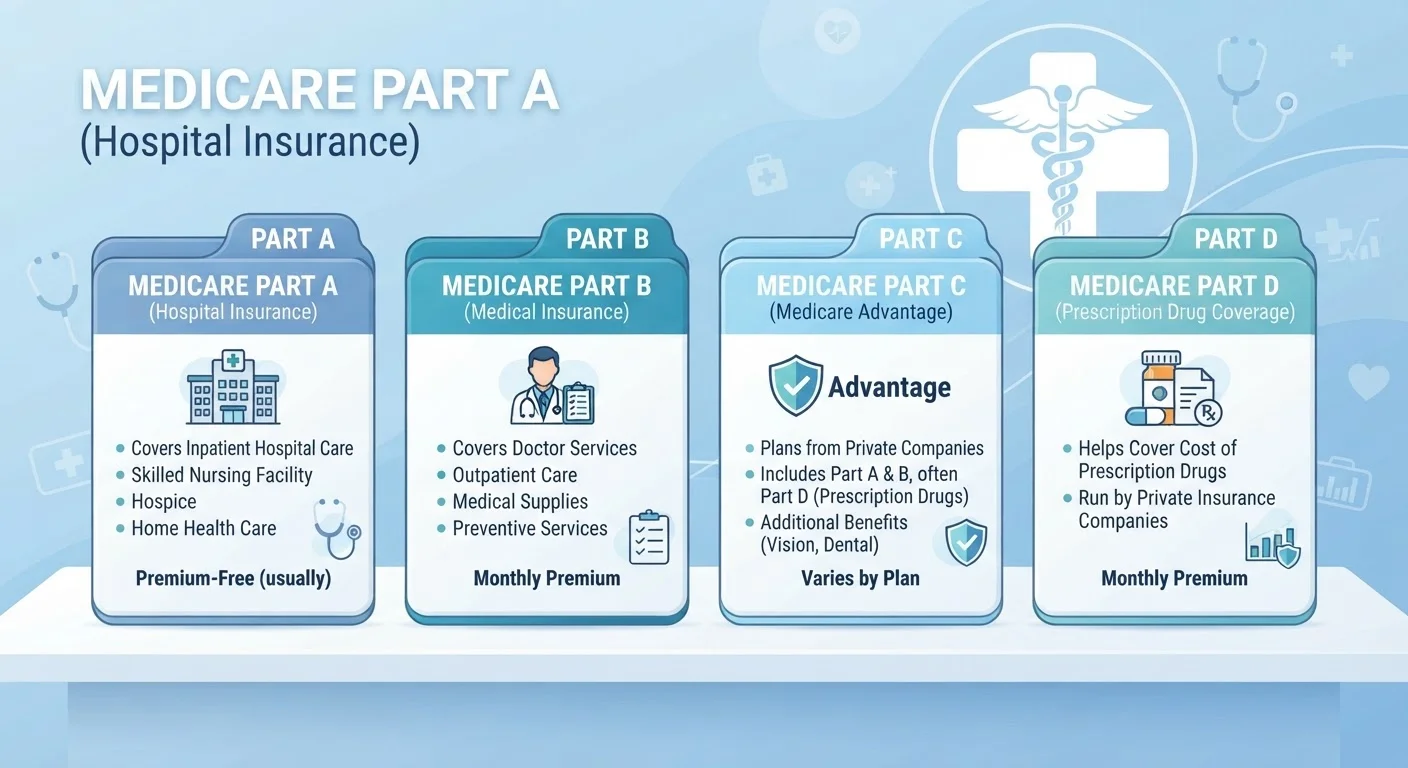
Medicare is the federal health insurance program primarily for Americans age 65 and older, though it also covers certain younger individuals with qualifying disabilities or conditions. Rather than functioning as a single all-in-one policy, Medicare is divided into four parts - A, B, C, and D - each addressing a distinct category of healthcare needs.
Understanding what each part covers helps you recognize gaps, avoid surprise costs, and make more confident decisions about supplemental coverage. For a foundational look at how insurance coverage works in general, see what insurance coverage actually means.
| Program type | Federal health insurance program (Centers for Medicare & Medicaid Services (CMS)) |
| Primary eligibility age | 65 and older (CMS general eligibility guidelines) |
| Number of parts | 4 (A, B, C, D) |
| Part A typical premium | $0 for most enrollees with 40+ work quarters (CMS 2024 Medicare costs) |
| Part B covers | 80% of approved outpatient costs after deductible (CMS standard cost-sharing structure) |
| Late enrollment penalty | Applies to Part B and Part D if enrollment is delayed (CMS enrollment rules) |
Part A: Hospital Insurance
Part A covers inpatient care - services you receive when you are formally admitted to a hospital, skilled nursing facility, or inpatient rehabilitation center. It also covers hospice care and some home health services following a qualifying hospital stay.
- Inpatient hospital stays (semi-private room, meals, nursing care, medications administered during the stay)
- Skilled nursing facility (SNF) care after a qualifying 3-day hospital admission - up to 100 days per benefit period
- Hospice care for terminal illness, including pain relief and support services
- Limited home health care when medically necessary and ordered by a physician
Most people pay no Part A premium if they or their spouse paid Medicare taxes for at least 10 years. However, there is a per-benefit-period deductible and daily coinsurance for extended stays. Understanding how deductibles interact with your overall costs is covered in premiums, deductibles, and out-of-pocket maximums.
Part B: Medical Insurance
Part B covers outpatient medical services - the care you receive without being admitted to a hospital. This is the part that handles most doctor visits, preventive screenings, and medically necessary equipment.
- Physician services (primary care and specialist visits)
- Outpatient hospital care and same-day surgery
- Preventive services (flu shots, mammograms, colonoscopies, annual wellness visits)
- Durable medical equipment (DME) such as wheelchairs, walkers, and blood glucose monitors
- Mental health services and substance use disorder treatment
- Some home health care not tied to a prior hospital stay
Part B requires a monthly premium, which is adjusted based on income. After meeting the annual deductible, Medicare generally pays 80% of approved costs and you pay the remaining 20% - with no out-of-pocket maximum under original Medicare alone.
Benefit period
A benefit period begins the day you are admitted as an inpatient to a hospital or skilled nursing facility and ends when you have been out of inpatient care for 60 consecutive days. A new benefit period - and a new Part A deductible - can begin after that.
Formulary
A formulary is a plan's official list of covered prescription drugs, organized into cost tiers. Drugs on higher tiers typically require greater cost-sharing from the enrollee.
Skilled nursing facility (SNF)
A facility that provides short-term, intensive medical or rehabilitative care following a qualifying hospital stay. Part A covers up to 100 days per benefit period under specific conditions.
Evidence of Coverage (EOC)
A detailed document that Medicare Advantage or Part D plan enrollees receive annually, spelling out the plan's covered services, costs, rules, and provider network for that plan year.
Creditable coverage
Prescription drug coverage (from an employer, union, or other source) that is at least as good as standard Medicare Part D coverage. Having creditable coverage allows you to delay Part D enrollment without penalty.
Part C: Medicare Advantage
Part C, known as Medicare Advantage, is not a separate benefit category but an alternative way to receive Parts A and B coverage. Private insurers approved by Medicare offer these plans, and most include Part D drug coverage as well.
Medicare Advantage plans often include extra benefits not found in original Medicare - such as routine dental, vision, and hearing services. However, they typically operate within defined provider networks (similar to HMO or PPO structures). To understand how those network structures affect your access to care, see health insurance plan types.
Enrollees must still pay the Part B premium. Cost-sharing structures, covered benefits, and provider access vary considerably by plan and location. Always review a plan's Evidence of Coverage document before enrolling.
Original Medicare vs. Medicare Advantage
Choosing between original Medicare (Parts A and B) and Medicare Advantage (Part C) is one of the most consequential decisions a new enrollee makes. Original Medicare allows you to see any provider nationwide who accepts Medicare; Medicare Advantage plans typically require you to use a defined network. Costs, extra benefits, and provider access differ significantly by plan and region. Reviewing your specific healthcare needs before choosing is strongly recommended.
Part D: Prescription Drug Coverage
Part D adds outpatient prescription drug coverage to original Medicare (Parts A and B). It is offered exclusively through private insurers under Medicare contract.
- Each plan maintains a formulary - a tiered list of covered drugs - with lower cost-sharing for preferred generic medications and higher cost-sharing for brand-name or specialty drugs.
- Plans have their own premium, deductible, and copay or coinsurance structure.
- Enrollees who delay enrollment beyond their Initial Enrollment Period and go without creditable drug coverage may face a permanent late enrollment penalty.
Part D does not cover drugs administered in a hospital or doctor's office - those typically fall under Part A or B. For a broader comparison of what standard health insurance covers versus Medicare, see health insurance coverage and what it doesn't pay for.
Also worth noting: Medicare generally does not cover long-term custodial care. For that gap, see long-term care insurance.
This article provides general information about Medicare and is not a substitute for personalized advice. Coverage details, costs, and eligibility rules change periodically. Consult Medicare.gov or a licensed insurance counselor (such as a State Health Insurance Assistance Program, or SHIP, counselor) for guidance specific to your situation.