What the Declarations Page Actually Contains
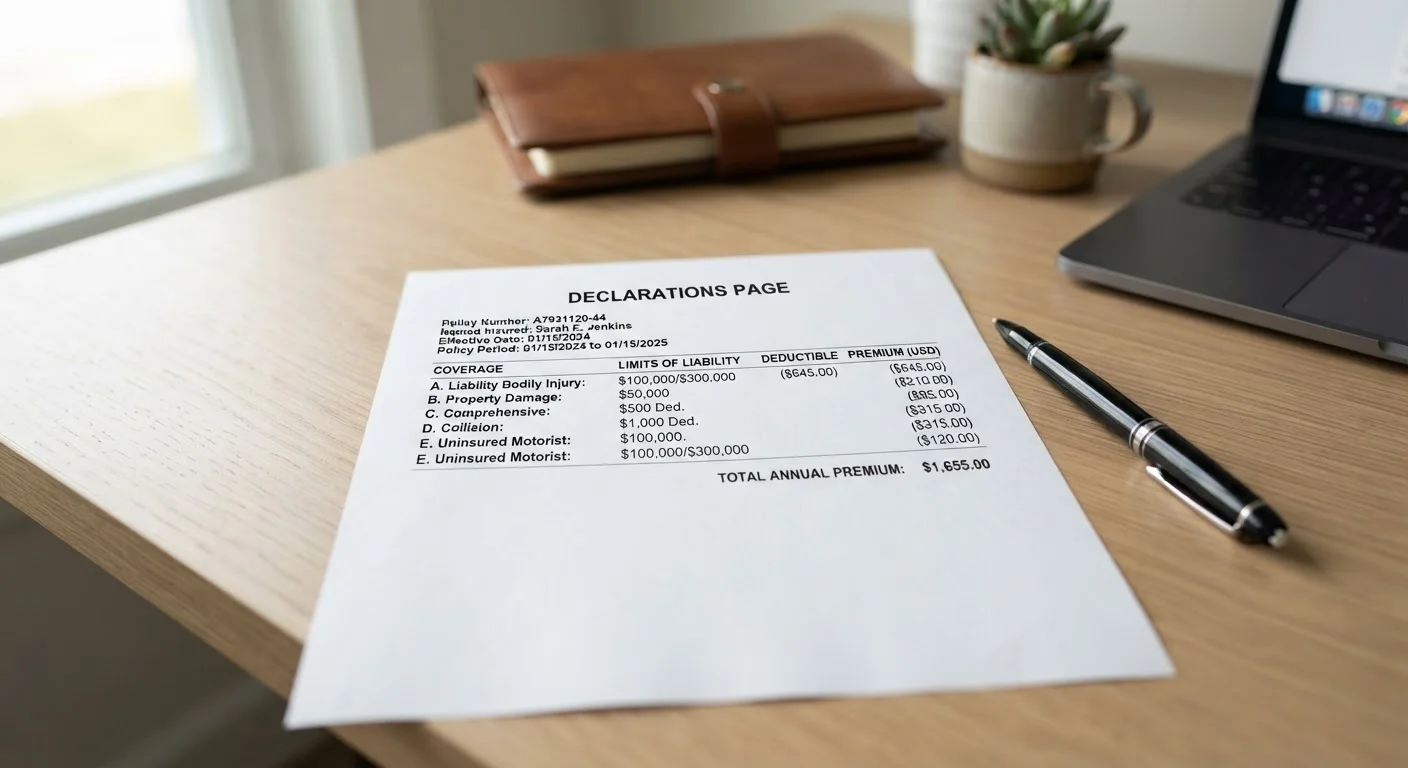
Every insurance policy - auto, homeowners, renters, life - begins with a declarations page. While formats vary by insurer and policy type, every dec page includes the same core elements:
- Named insured: The individual or entity the policy legally covers.
- Policy number: Your unique identifier for every interaction with the insurer.
- Policy period: The exact start and end dates of your coverage.
- Insured property or risk description: The home address, vehicle VIN, or other covered item.
- Coverage types and limits: Each coverage line (dwelling, liability, collision, etc.) with its dollar limit.
- Deductibles: The amount you pay out of pocket before insurance applies - listed per coverage type.
- Premium: What you owe for the policy period, sometimes broken into installments.
- Endorsements: Any add-ons or changes attached to the base policy.
For a deeper look at how these elements connect to the rest of your policy, see the full policy term-by-term breakdown.
1-2 pages
Typical length of a declarations page
Despite summarizing an entire policy, the dec page is deliberately concise - full policies can run 30 or more pages.
At renewal
Most common time consumers receive updated dec pages
Insurers issue a new or revised declarations page at each policy renewal and after any mid-term change to coverage.
Multiple
Coverage lines listed on a single dec page
A standard homeowners declarations page may list dwelling, other structures, personal property, loss of use, liability, and medical payments coverage separately.
Why Errors on the Dec Page Matter
Because the declarations page is generated from the data you provided during application, it reflects what the insurer agreed to cover - not necessarily what you assumed they agreed to cover. A wrong home address, an incorrect vehicle year, or a missing co-owner's name are not trivial typos. They are material facts that can affect whether a claim is paid in full, reduced, or disputed.
For example, if your homeowners dec page shows the wrong square footage or construction type, your dwelling limit may be calculated incorrectly. If an additional driver is missing from an auto dec page, a claim involving that driver could be complicated by the omission.
Review Your Dec Page Within 30 Days
Most insurers allow a window - often 30 days from issue - to flag and correct errors without penalty or disruption to coverage. Set a reminder to review your declarations page as soon as it arrives. If anything looks wrong, contact your insurer or agent promptly and request a corrected copy in writing.
Understanding what is not on the dec page is equally important. Exclusions - the situations and losses your policy will not cover - appear in the policy body, not the summary. See policy exclusions explained for what to look for there.
How to Read Your Declarations Page Effectively
Treat every new or renewed dec page as a document that requires your active review, not just a filing task. Work through these steps:
- Confirm identity details: Check that all named insureds are spelled correctly and that any required additional insureds (a mortgage lender, for example) are listed.
- Verify the property description: On an auto policy, confirm the VIN, year, make, and model. On a homeowners policy, confirm the insured address.
- Check coverage limits against your needs: Compare the listed limits to what you originally requested and to the value of what you're protecting. Understanding what coverage limits really mean can help you assess whether your amounts are adequate.
- Review deductibles: A lower premium often comes with a higher deductible. Make sure the amounts listed match your expectations and your financial capacity.
- Look for endorsements: These modify standard coverage. Confirm any riders you added - or removed - appear correctly.
For a more detailed walkthrough of this process, reading your declarations page without getting lost offers a section-by-section guide. Auto policyholders can also consult understanding your car insurance declarations page for vehicle-specific guidance.
The Dec Page Is a Summary, Not the Full Contract
The declarations page is legally part of your policy, but it does not contain all the terms that govern your coverage. Conditions, definitions, and exclusions are contained in the policy form itself. If there is ever a conflict between what the dec page implies and what the policy body states, the full policy language typically controls. Always keep both documents together.
This article provides general insurance education and is not personalized insurance, financial, or legal advice. Coverage terms, limits, and exclusions vary by insurer, policy type, and state. Always read your complete policy documents and consult a licensed insurance professional for guidance specific to your situation.