Why the Network Label Carries a Price Tag
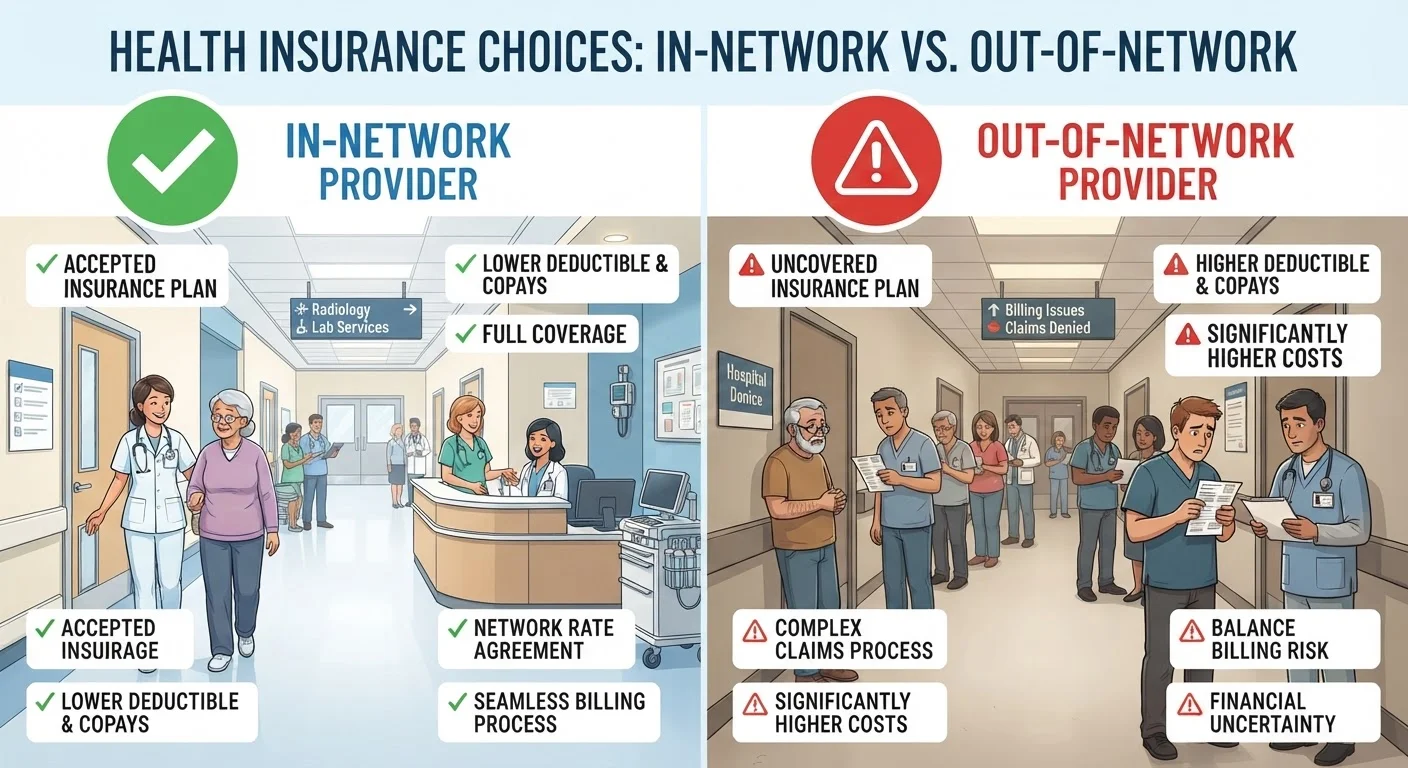
When you enroll in a health insurance plan, you're not just buying coverage - you're buying access to a specific set of providers at negotiated prices. That set is called a provider network. Every physician, hospital, lab, and specialist either belongs to that network (in-network) or doesn't (out-of-network), and that single designation shapes how much you actually pay when care happens.
In-network providers have signed contracts with your insurer agreeing to accept predetermined rates. Because the insurer has limited what the provider can charge, your share of the cost - the portion after your deductible and coinsurance - is calculated on a lower base number. Out-of-network providers set their own rates. Your insurer may reimburse a portion, but the calculation starts from a higher billed amount, and the remainder may fall entirely on you.
For a deeper look at how your share of costs is calculated once a claim processes, see copays, coinsurance, and out-of-pocket maximums.
Your Summary of Benefits and Coverage (SBC)
Every health plan is required to provide a standardized Summary of Benefits and Coverage document. This document lists your in-network and out-of-network deductibles, coinsurance rates, and out-of-pocket maximums side by side. It's the clearest single source for understanding the cost difference between network tiers on your specific plan. You can request it from your insurer or employer benefits administrator.
How Your Plan Type Changes the Rules
Not every plan handles out-of-network care the same way. Your plan's structure determines your exposure before you ever see a bill:
- HMO (Health Maintenance Organization): Typically covers only in-network care except in emergencies. Seeing an out-of-network provider usually means paying the entire bill yourself.
- EPO (Exclusive Provider Organization): Similar to an HMO in network exclusivity - out-of-network care is generally not covered, though premiums are often lower to reflect this restriction.
- PPO (Preferred Provider Organization): Covers both in-network and out-of-network care, but at different rates. You pay significantly more out-of-network, and your deductible and out-of-pocket maximum may be separate and higher.
- POS (Point of Service): A hybrid that requires a primary care referral but allows out-of-network access at a higher cost share.
Understanding your plan type is foundational before assessing any specific cost. The Policy Terms Explained hub is a useful reference for additional terminology clarifications.
Verify Network Status Before Every Scheduled Visit
Don't rely solely on an online provider directory - they can be months out of date. Before any non-emergency appointment, call your insurer's member services line and the provider's billing office to confirm in-network status for your specific plan. For procedures involving multiple providers, verify each one individually, including specialists and facility staff.
The Real Dollar Difference: What the Numbers Show
The gap between in-network and out-of-network costs isn't just a percentage - it compounds across multiple parts of your cost-sharing structure.
3x
Higher out-of-network deductibles vs. in-network
It is common for PPO plans to set out-of-network deductibles at two to three times the in-network deductible amount, meaning costs accumulate faster before coverage kicks in.
40%+
Typical out-of-network coinsurance rate
Many PPO plans apply coinsurance of 40% or more for out-of-network services, compared to 20% in-network, per standard plan design structures cited in insurer Summary of Benefits documents.
1 in 5
Insured ER visits with an out-of-network charge
Research published by the Kaiser Family Foundation found that roughly one in five emergency room visits by insured patients resulted in at least one out-of-network charge prior to surprise billing protections.
Consider a PPO plan where the in-network deductible is $1,500 and the out-of-network deductible is $4,000. After those deductibles, in-network coinsurance might be 20%, while out-of-network coinsurance is 40% - applied to a higher billed amount. In a plan that excludes out-of-network spending from the in-network out-of-pocket maximum, costs can accumulate without a ceiling.
To understand how the deductible and out-of-pocket maximum interact on your own plan, see how deductibles and out-of-pocket maximums differ.
Practical Steps to Protect Yourself
Network status is something you can verify - but it requires active effort before care, not after. Online provider directories are a starting point, but they can be months out of date. The reliable method is to call your insurer's member services line and the provider's billing office, and ask both to confirm in-network status for your specific plan and plan tier (some insurers offer multiple network tiers within the same product).
For scheduled procedures, also ask whether every provider involved - the surgeon, the anesthesiologist, the facility - is in-network. A hospital can be in-network while an on-staff specialist is not, which is a common source of unexpected bills. Federal protections under the No Surprises Act now limit certain surprise bills in these situations, but knowing your exposure in advance is always preferable to disputing a bill afterward.
Learn more about how provider networks are structured and how to avoid surprise billing.
This article is for general informational purposes only and does not constitute personalized financial, legal, or insurance advice. Coverage terms, costs, and protections vary by plan and state. Consult a licensed insurance professional and review your actual policy documents before making coverage decisions.