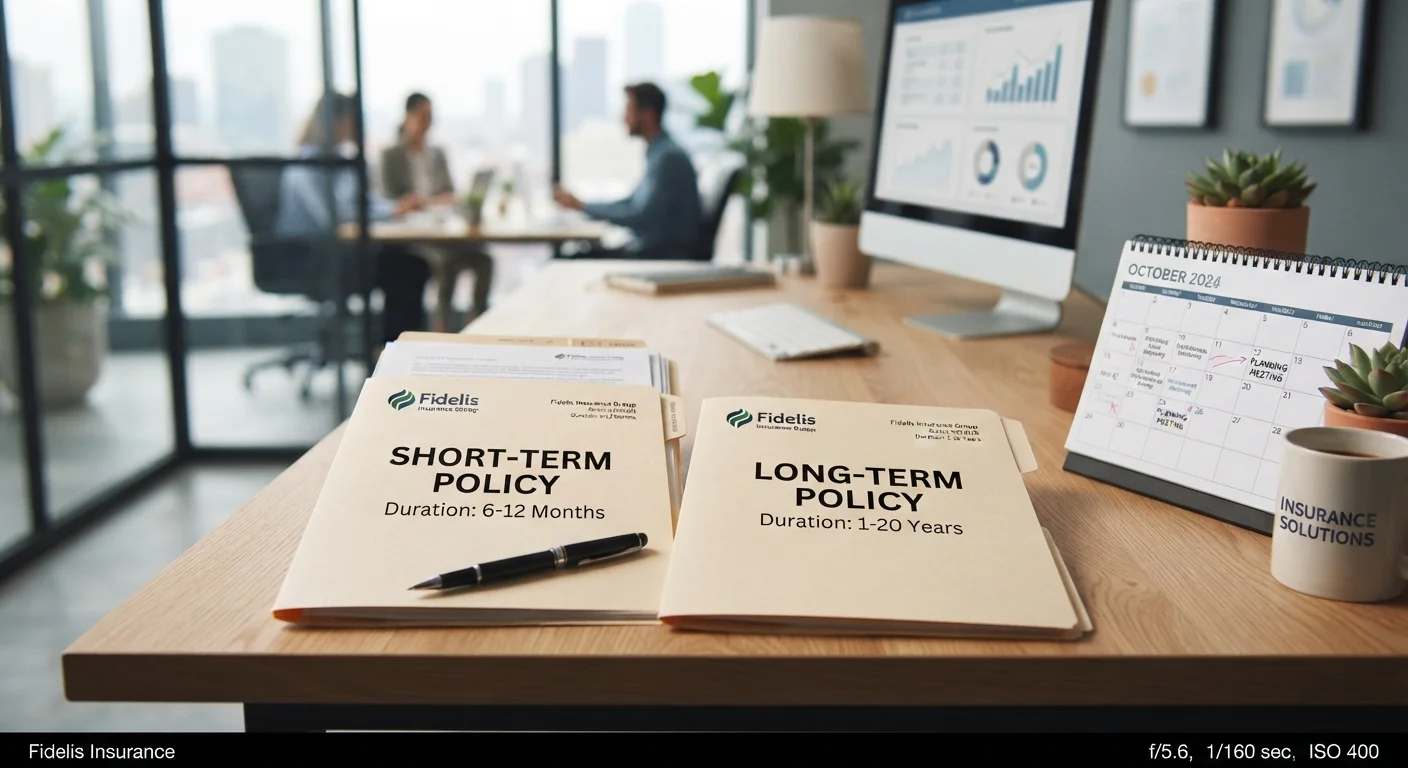
Why Disability Insurance Is Often Overlooked
Most Americans insure their cars, homes, and health - but far fewer protect their most financially critical asset: their ability to earn an income. According to the Social Security Administration, roughly one in four workers will experience a disability lasting 90 days or more before reaching retirement age. Despite this risk, disability insurance remains one of the least understood coverage types in personal finance.
Part of the confusion stems from the fact that there are two distinct products - short-term and long-term disability insurance - that serve different purposes and work very differently in practice. Knowing how each one functions gives you the foundation to assess your own coverage needs. For a broader look at the coverage landscape, see our overview of common coverage types.
How Short-Term Disability Insurance Works
Short-term disability (STD) insurance is designed to replace a portion of your income when a medical condition, injury, or qualifying health event temporarily prevents you from working. Key features include:
- Elimination period: The waiting period before benefits begin - typically 0 to 14 days for accidents, and 7 to 14 days for illness. This is sometimes called the waiting period or qualifying period.
- Benefit duration: Coverage generally lasts between 9 and 52 weeks, most commonly 3 to 6 months.
- Replacement rate: Benefits typically replace 50% to 70% of your gross pre-disability weekly income.
- Common qualifying events: Recovery from surgery, a serious illness, pregnancy complications, or a non-work-related injury.
Many employers offer STD plans as a group benefit, and premiums are often low because the coverage window is short. However, employer-sponsored plans may not be portable - meaning you could lose coverage if you change jobs.
Check Your Employer Plan First
Before purchasing individual coverage, review any group disability benefits offered through your employer. Many workers are automatically enrolled in a basic short-term plan but are unaware of optional long-term coverage that can be added during open enrollment. Understanding what you already have prevents duplication and helps identify real gaps. You can also review common policy terms to better interpret your plan documents.
How Long-Term Disability Insurance Works
Long-term disability (LTD) insurance picks up where short-term coverage ends. It is built for more serious, lasting impairments that prevent you from returning to work for an extended period. Key features include:
- Elimination period: Typically 90 to 180 days - meaning you must be disabled for several months before benefits begin. This gap is often bridged by short-term disability coverage.
- Benefit duration: Coverage can last 2 years, 5 years, 10 years, or until age 65 - depending on the policy you purchase.
- Replacement rate: Also typically 50% to 70% of pre-disability income.
- Definition of disability: Policies use either an own-occupation definition (you cannot perform your specific job) or an any-occupation definition (you cannot perform any job for which you are reasonably suited). Own-occupation definitions offer broader protection.
LTD coverage is also available through employers, but individual policies purchased directly tend to offer more flexible definitions and portability. For a side-by-side breakdown of these policy mechanics, see our detailed comparison of short- and long-term disability coverage.
| Short-Term Disability | Long-Term Disability | |
|---|---|---|
| Elimination (waiting) period | 0-14 days | 90-180 days |
| Benefit duration | 3-6 months (up to 52 weeks) | 2 years to age 65 |
| Income replacement rate | 50%-70% of gross income | 50%-70% of gross income |
| Typical use case | Surgery, illness, injury recovery | Serious or permanent disability |
| Portability | Often tied to employer plan | Individual policies are portable |
| Definition of disability | Unable to perform current job | Own-occupation or any-occupation |
| Cost relative to coverage | Generally lower premium | Higher premium, longer protection |
Gaps, Overlaps, and What to Watch For
The most dangerous gap in disability protection is the period between the end of short-term benefits and the start of long-term benefits. If your STD plan pays for 12 weeks but your LTD plan has a 180-day elimination period, there is a window of roughly 16 weeks with no coverage. Workers without substantial savings are particularly vulnerable to this gap.
Do Not Assume Social Security Will Cover You
Social Security Disability Insurance (SSDI) has a strict definition of disability, requiring that your condition prevent any substantial gainful activity and be expected to last at least 12 months or result in death. Initial SSDI applications are denied at a high rate, and the average processing time is measured in months. Private short- and long-term disability policies are generally faster, more predictable, and offer higher benefit amounts for most working Americans.
Another common oversight is assuming that workers' compensation or Social Security Disability Insurance (SSDI) will cover the shortfall. Workers' comp applies only to on-the-job injuries, and SSDI has strict eligibility requirements with an approval process that can take months or years. Private disability insurance is typically faster and more predictable.
It is also worth understanding how disability coverage interacts with other income-protection products. For instance, critical illness insurance pays a lump sum upon diagnosis of a covered condition - which can complement but does not replace disability income coverage. Similarly, long-term care insurance addresses a separate need: the cost of custodial care, not income replacement.
This article is for general informational and educational purposes only and does not constitute personalized financial, insurance, or legal advice. Coverage terms, benefit amounts, exclusions, and eligibility vary by insurer, policy, and state. Consult a licensed insurance professional to evaluate your specific situation and review actual policy documents before making any coverage decisions.