What Disability Insurance Actually Covers
Disability insurance replaces a portion of your income when a medical condition - illness, injury, or sometimes a mental health diagnosis - prevents you from working. It does not pay your medical bills directly; that is the role of health insurance. Instead, disability coverage functions as a paycheck substitute, helping you meet ordinary living expenses while you are unable to earn.
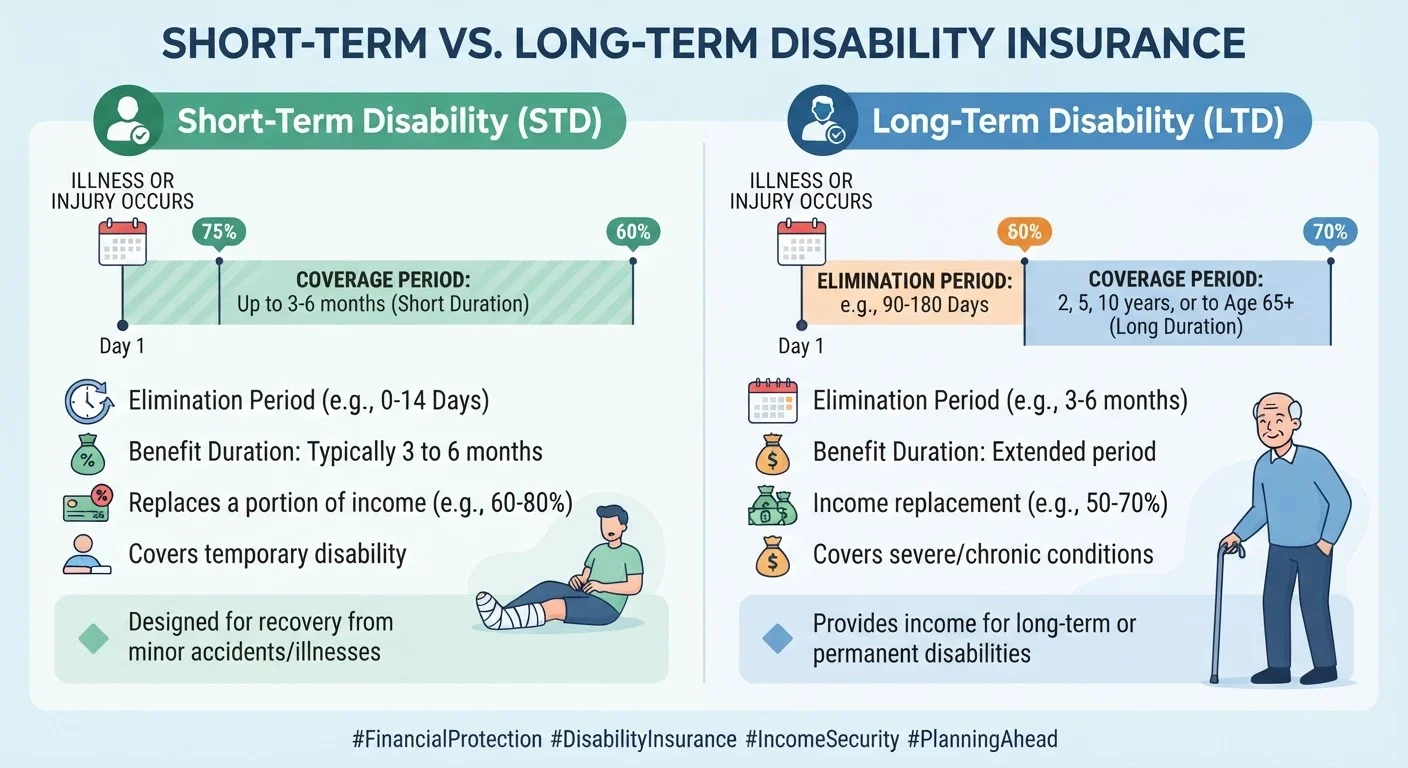
Policies are generally structured around three core variables: the elimination period (the waiting time before benefits begin), the benefit period (how long payments continue), and the benefit amount (what percentage of pre-disability income is replaced). Where short-term and long-term policies differ most sharply is in those first two variables. For a plain-language glossary of terms like these, see the Policy Terms Explained hub.
| Short-Term Disability | Long-Term Disability | |
|---|---|---|
| Elimination Period | 0-14 days (typically) | 90-180 days (typically) |
| Benefit Period | 9 weeks to 1 year | 2 years to age 65 |
| Income Replacement Rate | 60-80% of gross income | 50-70% of gross income |
| Common Source | Employer group plan or state mandate | Employer plan or individual policy |
| Best Suited For | Temporary illness, injury, or surgery | Serious or long-lasting conditions |
| Own-Occupation Definition | Less common | Often available, especially individual policies |
Short-Term Disability: Bridging the Immediate Gap
Short-term disability (STD) insurance is designed to replace income during a temporary inability to work. Typical benefit periods run from nine to twenty-six weeks, though some plans extend to one year. The elimination period is usually short - often zero to fourteen days - meaning benefits begin quickly after a qualifying disability is confirmed.
STD coverage is commonly offered through employers as a group benefit, and many workers receive it at low or no direct cost. Some states - including California, New York, New Jersey, Rhode Island, and Hawaii - mandate that employers provide short-term disability coverage. If you live elsewhere and your employer does not offer it, individual STD policies are available but less common.
Check Whether Your State Mandates STD Coverage
Five states - California, New York, New Jersey, Rhode Island, and Hawaii - require employers to provide short-term disability benefits. If you live in one of these states, you may already have baseline coverage through your payroll deductions. Verify the benefit amounts and duration, because mandated minimums may not fully meet your income replacement needs.
Because the benefit period is limited, STD is best understood as a bridge: it covers the gap between the onset of a disability and either your return to work or the point at which long-term disability benefits activate.
Long-Term Disability: Protection Against Extended Loss of Income
Long-term disability (LTD) insurance activates after a longer elimination period - typically 90 to 180 days - and is engineered for serious, lasting conditions. Benefit periods commonly run for two, five, or ten years, or all the way to age 65 or Social Security retirement age. This makes LTD the more consequential of the two policy types for most workers.
According to the Social Security Administration, roughly one in four 20-year-olds will experience a disability lasting 90 days or more before reaching retirement age. Despite this, LTD coverage is frequently underestimated or skipped. Employer-sponsored LTD plans exist, but individual policies offer more portability and, in many cases, stronger own-occupation definitions - a policy term describing whether you qualify for benefits if you cannot perform your specific job, versus any job.
1 in 4
20-year-olds who will experience a 90+ day disability
According to the Social Security Administration, about one in four workers entering the workforce today will face a disability before retirement.
60-70%
Typical income replacement rate for LTD policies
Most long-term disability policies are structured to replace between 60 and 70 percent of pre-disability gross income, not the full amount.
It is worth comparing LTD with adjacent coverage types. Long-term care insurance is a distinct product designed for custodial care needs rather than income replacement. Similarly, critical illness insurance pays a lump sum on diagnosis but is not a substitute for ongoing income protection.
How the Two Policies Work Together
Short-term and long-term disability policies are intentionally designed to complement each other. The STD benefit period ideally overlaps with - or at minimum reaches - the LTD elimination period. For example: if your STD plan covers up to 26 weeks and your LTD plan has a 180-day elimination period, the two policies connect almost seamlessly. A gap between them means a period with no income replacement at all.
When evaluating your own situation, map out these timelines explicitly: when does STD end, and when does LTD begin? If a gap exists, options include using accrued sick leave or paid time off, or adjusting the elimination period on the LTD policy. For broader guidance on evaluating coverage layers, the Choosing Coverage hub provides a structured starting point.
This layered approach to disability coverage parallels how term and permanent life insurance can be stacked for different time horizons - a concept explored in Term vs. Permanent Life Insurance: Matching Coverage to Life Stage.
This article is for general informational purposes only and does not constitute personalized insurance, financial, or legal advice. Coverage terms, benefit amounts, elimination periods, and eligibility vary by provider, plan, and state. Always review actual policy documents carefully and consult a licensed insurance professional to assess your individual needs.