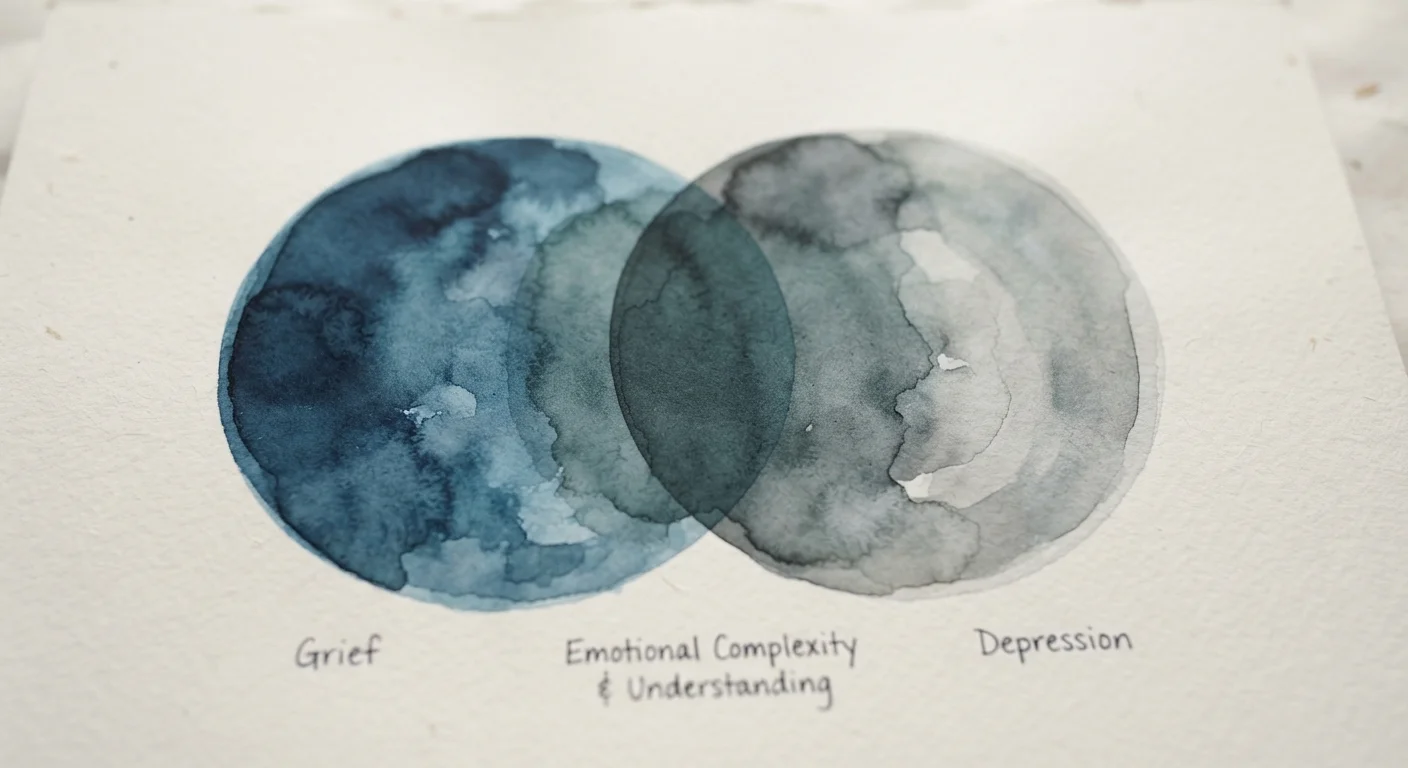
Why the Distinction Matters
Grief and depression overlap so significantly in their surface appearance - sadness, fatigue, withdrawal, difficulty concentrating - that even trained clinicians approach the distinction with care. For everyday readers, the confusion is entirely understandable. But recognizing what separates them has real consequences: it shapes whether a person seeks counseling, medication, peer support, or simply time and community.
As part of the broader spectrum of mental health experiences, both grief and depression deserve acknowledgment - but they call for different responses. Treating normal grief as a disorder can pathologize healthy human experience; missing depression masked by grief can leave someone without necessary care.
This article is for general informational purposes only and is not a substitute for professional mental health advice, diagnosis, or treatment. If you are concerned about your mental health or that of someone you know, please consult a qualified healthcare professional.
What Grief Looks Like
Grief is the natural emotional response to loss - most commonly the death of someone close, but also the end of a relationship, a job, a health status, or any deeply meaningful part of life. It does not follow a rigid sequence of stages; rather, it tends to move in waves. A person may feel functional one afternoon and overwhelmed the next, often triggered by a sensory reminder - a song, a smell, a specific time of day.
Characteristic features of grief include:
- Sadness and longing tied specifically to the person or thing lost
- Moments of positive emotion - fond memories, laughter with others - interspersed with sorrow
- A preserved sense of self-worth, even amid significant pain
- Responsiveness to comfort - connection with others can temporarily ease the distress
Grief typically diminishes in intensity over time, though anniversaries and milestones can reawaken it. This trajectory is considered a normal part of human experience, not a pathology. Experiences like pet loss can also trigger genuine grief - something explored in the emotional dimensions of pet ownership.
What Depression Looks Like
Major depressive disorder (MDD) is a clinical condition defined by specific diagnostic criteria, not simply a period of sadness. Its hallmarks include a persistently depressed mood or loss of interest and pleasure in nearly all activities, lasting at least two weeks and representing a change from previous functioning.
Key features that tend to distinguish depression from grief include:
- Pervasiveness - the low mood is constant rather than wave-like, and not tied to specific reminders
- Feelings of worthlessness or excessive guilt unrelated to the loss
- Inability to experience positive emotion even briefly (anhedonia)
- Cognitive impairment - marked difficulty thinking, deciding, or concentrating
- Recurrent thoughts of death or suicidal ideation
Like other distinct mental health experiences, depression has a specific profile that separates it from ordinary distress - similar to how clinical anxiety differs from everyday worry. Depression often requires professional treatment, which may include therapy, medication, or both.
| Criterion | Grief | Depression |
|---|---|---|
| Primary trigger | Identifiable loss or life event | May have no clear external trigger |
| Emotional pattern | Wave-like; fluctuates in intensity | Persistent; pervasive low mood |
| Positive emotion | Present in intervals between waves | Absent or severely diminished (anhedonia) |
| Self-worth | Generally preserved | Often impaired; worthlessness common |
| Response to comfort | Temporarily soothing | Often not relieved by connection |
| Thoughts of death | May wish to join the deceased; passive | Suicidal ideation more active or recurring |
| Typical duration | Eases over weeks to months | Persists ≥2 weeks; may be chronic |
| Professional treatment needed | Supportive care often sufficient | Usually requires professional care |
When Grief and Depression Overlap
The two experiences are not mutually exclusive. Grief can trigger a depressive episode, particularly in people with a prior history of depression or in cases of traumatic or sudden loss. Clinicians sometimes refer to this as complicated grief or, more recently, prolonged grief disorder - a recognized condition where grief remains intensely disruptive well beyond what is typical.
~10%
Bereaved people who develop prolonged grief disorder
Research published in peer-reviewed psychiatric literature suggests roughly 10% of bereaved individuals meet criteria for prolonged grief disorder, formerly called complicated grief.
~20%
Adults who experience major depression in their lifetime
The National Institute of Mental Health estimates that major depressive disorder affects approximately one in five U.S. adults at some point during their lives.
2 weeks
Minimum duration for a depressive episode diagnosis
According to DSM-5 diagnostic criteria, a major depressive episode requires symptoms present for at least two consecutive weeks representing a change from prior functioning.
The critical clinical question is not simply how long the symptoms have lasted, but whether specific features of depression - especially feelings of worthlessness, pervasive hopelessness, or thoughts of self-harm - are present. These are not characteristic of uncomplicated grief and warrant professional evaluation.
Evidence-informed practices for emotional recovery can support both processes, but they are not a replacement for professional care when depression is suspected.
A Note on Diagnosis
Only a licensed mental health professional can diagnose depression or prolonged grief disorder. The descriptions in this article are educational and intended to help readers recognize patterns - not to serve as a self-diagnostic tool. If you are uncertain about what you are experiencing, speaking with your primary care physician or a mental health professional is always the right first step.
Knowing When to Seek Support
Both grief and depression deserve compassionate attention, and neither should be dismissed as weakness or self-indulgence. The practical question is what kind of support is appropriate.
Consider reaching out to a mental health professional if:
- Symptoms have lasted more than two weeks and are intensifying rather than easing
- You are unable to carry out basic daily functions - work, self-care, relationships
- You are experiencing thoughts of suicide or self-harm (if in crisis, contact the 988 Suicide and Crisis Lifeline by calling or texting 988)
- You feel persistently worthless, hopeless, or empty regardless of circumstances
- You have a prior history of depression and recognize familiar patterns returning
Grief that does not include these features may be well supported by community, counseling, support groups, or simply the passage of time. The goal is not to rush through grief but to ensure that a treatable condition is not left unaddressed beneath it. Understanding how sustained distress functions differently from acute stress is also relevant here - chronic and acute stress operate through different mechanisms and call for different responses.