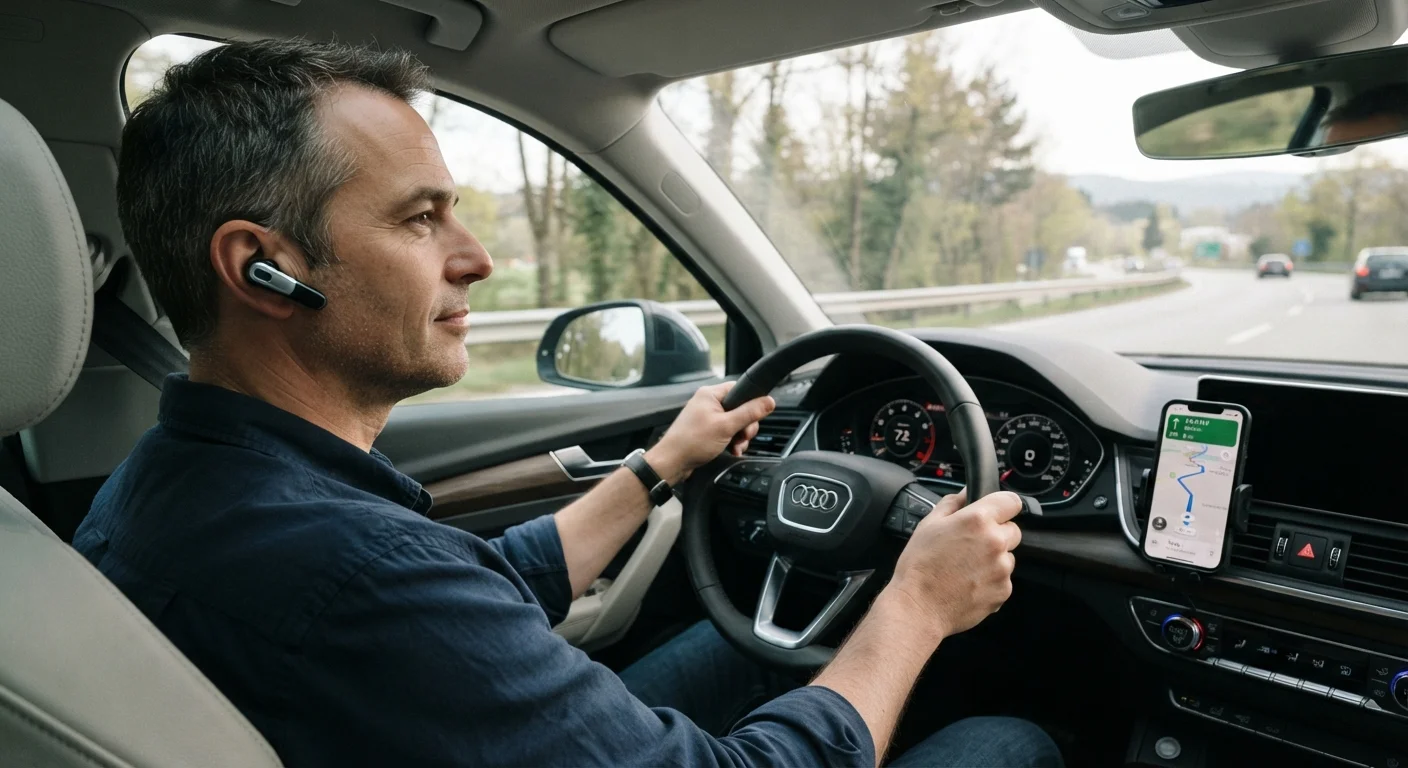
What 'Hands-Free' Actually Means on American Roads
Hands-free phone use covers a range of technologies: Bluetooth earpieces, vehicle-integrated speakerphone systems, steering-wheel controls paired with a mounted phone, and voice-command platforms like Apple CarPlay or Android Auto. What they share is that the driver's hands remain on the wheel rather than holding a device.
As of 2024, the majority of U.S. states prohibit handheld phone use while driving, and several go further by restricting most phone interaction entirely. Laws vary considerably by state, so drivers should verify the rules in their jurisdiction. The legal landscape has generally treated hands-free use as an acceptable middle ground - but the safety science tells a more nuanced story. For a broader look at how phone use fits into the wider picture of driver attention, see our guide to distracted driving in the smartphone era.
The Case For Hands-Free: Genuine Advantages
Both hands remain on the steering wheel
Maintaining a two-handed grip preserves steering control and improves response time to sudden road events, which handheld calling directly compromises.
Legal in most U.S. states
While handheld use is widely banned, hands-free calling remains lawful in the majority of states, reducing the risk of traffic citations and the distraction of worrying about legal compliance.
Enables navigation and communication without stopping
Integrated voice systems allow drivers to receive turn-by-turn directions and manage calls without pulling over, which has genuine value on long or time-sensitive trips.
Eyes stay forward more consistently
Drivers using hands-free systems tend to keep their gaze on the road more than those reading or typing on a handheld device, reducing the visual component of distraction.
The most straightforward benefit is physical: keeping both hands on the wheel preserves steering control and the ability to respond quickly to sudden obstacles. Studies examining handheld vs. hands-free use consistently show that handheld calling creates additional impairment beyond the conversation itself, partly because the driver is managing the device. Removing that manual task addresses one real layer of risk.
Hands-free also enables drivers to receive navigational updates, adjust music, or accept urgent calls without glancing away from the road - particularly when integrated into the vehicle's own display system with large-text prompts. For professional drivers or anyone covering long distances, the ability to stay connected without stopping repeatedly has practical value that is hard to dismiss entirely.
The Case Against: What the Research Says
Cognitive distraction persists regardless of device type
Research consistently shows that the mental engagement of a phone conversation impairs driver attention whether the phone is held or not - the brain is still divided between driving and processing dialogue.
Inattention blindness reduces hazard detection
Studies have documented that drivers on phone calls - including hands-free - can fail to register pedestrians, red lights, or other vehicles that are directly in their field of view.
Voice systems vary widely in demand and reliability
Poorly designed or unfamiliar voice interfaces can require multiple interactions to complete a simple task, sometimes creating greater distraction than a quick manual action would have.
Creates a false sense of safety
Because hands-free use is legal and feels less risky, drivers may underestimate the residual impairment - potentially leading to longer or more complex calls than they would otherwise attempt.
Remote callers cannot adapt to road conditions
Unlike passengers who instinctively go quiet during demanding driving situations, a remote caller has no awareness of traffic complexity, which keeps the cognitive demand on the driver constant.
The core scientific objection to hands-free calling is that it addresses the manual distraction while leaving the cognitive distraction largely intact. Research from the National Safety Council and academic traffic-safety laboratories has found that drivers engaged in phone conversations - hands-free or otherwise - show measurable increases in reaction time, reduced scanning of the visual field, and a tendency to miss hazards that appear in plain sight. This phenomenon is sometimes called "inattention blindness."
Passenger Conversations vs. Phone Calls
Traffic safety researchers have noted an important distinction between talking with a passenger and talking on the phone. Passengers share the same road environment and typically pause conversation naturally when conditions become complex. A remote caller has no such awareness and maintains an uninterrupted demand on the driver's attention. This difference may partly explain why passenger conversations appear less hazardous in observational data, even though both involve talking while driving.
Conversations with passengers, by contrast, tend to be less cognitively taxing partly because passengers naturally pause when road conditions become complex - a remote caller cannot do this. That distinction matters when weighing the real-world risk. This overlaps with other impairments that affect attention - driver fatigue carries similarly underappreciated effects on reaction time and judgment.
Where Voice Technology Fits In
4x
Crash risk increase during phone calls while driving
The National Safety Council cites research indicating drivers using a cell phone - handheld or hands-free - are approximately four times more likely to be involved in a crash.
~37%
Reduction in brain activity focused on driving
Carnegie Mellon University imaging research found that listening to someone speak while driving reduced the parietal lobe activity associated with spatial processing by roughly 37 percent.
Modern voice-activated systems are sometimes presented as near-zero-distraction tools, but research has found meaningful variation in how mentally demanding different systems are. A voice system that requires multiple commands, corrections, or confirmations can actually demand more attention than a simple manual tap. The quality and intuitiveness of the interface matters significantly.
Drivers who use these systems would benefit from familiarizing themselves with their vehicle's specific setup before relying on it in traffic, and from understanding that even well-designed systems are not cognitively neutral. Modern vehicle safety technology can offset some risks, but no system substitutes for an attentive driver. For context on how phone habits connect to broader crash risk, see driving habits that quietly increase your crash risk.
This article is for general informational and educational purposes only. Laws governing phone use while driving vary by state and locality; verify current regulations in your area before driving.