The Gap Between Legal and Safe
When most Americans think about drunk driving, they think about the 0.08% BAC threshold. That number is stamped into public awareness through decades of safety campaigns and traffic law. But the threshold is a legal line-not a biological one. It tells you when a driver can be charged with a crime. It does not mark the moment impairment begins.
According to the NHTSA, measurable declines in driving-relevant skills occur at BAC levels as low as 0.02%. The legal limit was established through a combination of research, public policy debate, and enforcement practicality. Understanding that distinction matters for anyone who gets behind the wheel after even a single drink.
This article draws on established research to explain what alcohol does to the skills driving actually requires-and why staying within the legal limit is not the same as driving unimpaired. It is general educational information, not a guide to determining when it is personally safe to drive.
What Alcohol Does to Driving Skills
Driving is a complex, multi-layered task. It requires sustained attention, rapid response to unexpected hazards, smooth coordination of hands and feet, and the ability to process multiple streams of information simultaneously. Alcohol degrades each of these functions-and not all at once, and not in ways the driver always notices.
0.02%
BAC at which NHTSA documents first driving skill declines
According to NHTSA's impairment research, visual tracking and divided attention begin to decline at this level.
~30%
Of all U.S. traffic fatalities involving alcohol-impaired drivers
NHTSA data consistently shows that roughly 30% of annual U.S. traffic fatalities involve a driver with a BAC of 0.08% or higher.
4x
Increased crash risk at 0.08% BAC vs. sober driving
Traffic safety research indicates crash risk is approximately four times higher at the legal limit compared to a zero-BAC baseline.
0.02%-0.05% BAC: At these levels, NHTSA research documents reduced ability to track moving objects visually, difficulty dividing attention between two tasks, and some loss of inhibition. A driver in this range may feel relaxed or slightly confident-but their field of vision is narrowing and their responses to sudden events are already slowing.
0.05%-0.08% BAC: Steering control worsens. Response to emergency situations degrades noticeably. Coordination between visual input and physical response-the basic loop that keeps a car in its lane-is measurably compromised. A driver at 0.07% is legally sober in most states. Their brain is not.
One of the more troubling effects of alcohol is that it impairs a driver's ability to recognize their own impairment. As BAC rises, so does subjective confidence-even as objective performance declines. This is why drivers who have been drinking often genuinely believe they are fine to drive.
“There is no safe level of alcohol use for drivers. Impairment begins with the first drink and increases with each additional drink.”
— National Highway Traffic Safety Administration, U.S. federal road safety agency
Why Low-Level Impairment Still Creates Real Risk
Crash risk does not wait for a driver to hit 0.08%. Studies published in peer-reviewed traffic safety literature show that crash likelihood increases at BAC levels well below the legal limit. The relationship between BAC and crash risk is not a cliff-it is a slope that begins with the first drink.
Consider what happens in the fraction of a second before a collision. A driver must perceive a hazard, decide to brake, and physically execute that response. Alcohol lengthens each of those steps. At highway speeds, even a small delay in reaction time translates to additional feet traveled before braking begins-feet that can make the difference between a near-miss and a crash.
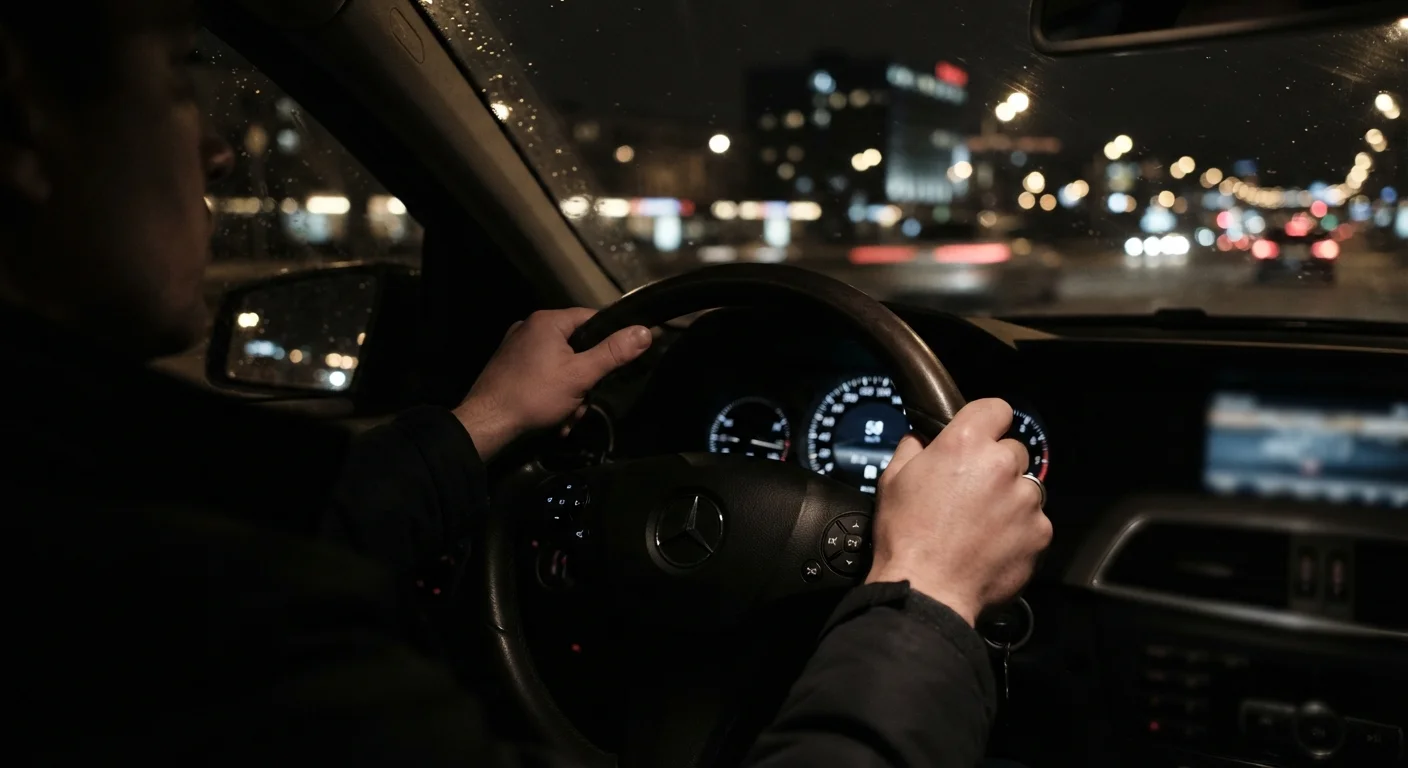
These risks compound with other conditions. Nighttime driving, for instance, already reduces visibility and increases cognitive load-adding even modest alcohol impairment makes those conditions more dangerous. Night driving demands different skills than daytime driving, and alcohol erodes the very adaptations drivers need after dark.
Plan Your Ride Before You Drink
The most reliable way to eliminate alcohol-related driving risk is to decide before you drink how you will get home. Arranging a designated driver, using a rideshare service, or staying overnight removes judgment calls from a moment when judgment is already compromised. Making that plan while sober is the key step.
It is also worth noting the parallels with another commonly underestimated impairment: fatigue. Research has long compared the cognitive effects of sleep deprivation to those of alcohol. Driver fatigue carries risks that are easy to underestimate, and combining it with even low levels of alcohol compounds both hazards significantly.
Reframing What 'Safe to Drive' Actually Means
The question drivers should be asking is not "Am I under the limit?" It is "Are my driving abilities intact?" Those are different questions with potentially different answers. The legal threshold exists to define a criminal standard; it was never designed to certify fitness to drive.
Alcohol impairment is part of a broader picture of behaviors that quietly elevate crash risk. Driving habits that quietly increase your crash risk include many factors beyond impairment-but impairment at any level is among the most consequential.
Individual Factors Affect BAC-But Not Impairment
Body weight, biological sex, food consumption, and metabolism all influence how quickly BAC rises and falls. However, no personal factor reliably protects driving ability from alcohol's effects. Individual variation in BAC does not translate to individual immunity from impairment at a given BAC level.
The practical takeaway from the research is straightforward: if you have consumed alcohol, your driving is likely affected in some measurable way. The degree of that effect depends on individual factors including body weight, sex, food intake, and metabolism-none of which can be reliably estimated by how you feel. Planning ahead, using a designated driver, or using alternative transportation removes the uncertainty entirely.
This article is for general educational purposes only and does not constitute legal or safety advice. Laws regarding impaired driving vary by state. Always consult applicable local laws and make responsible decisions regarding alcohol and driving.