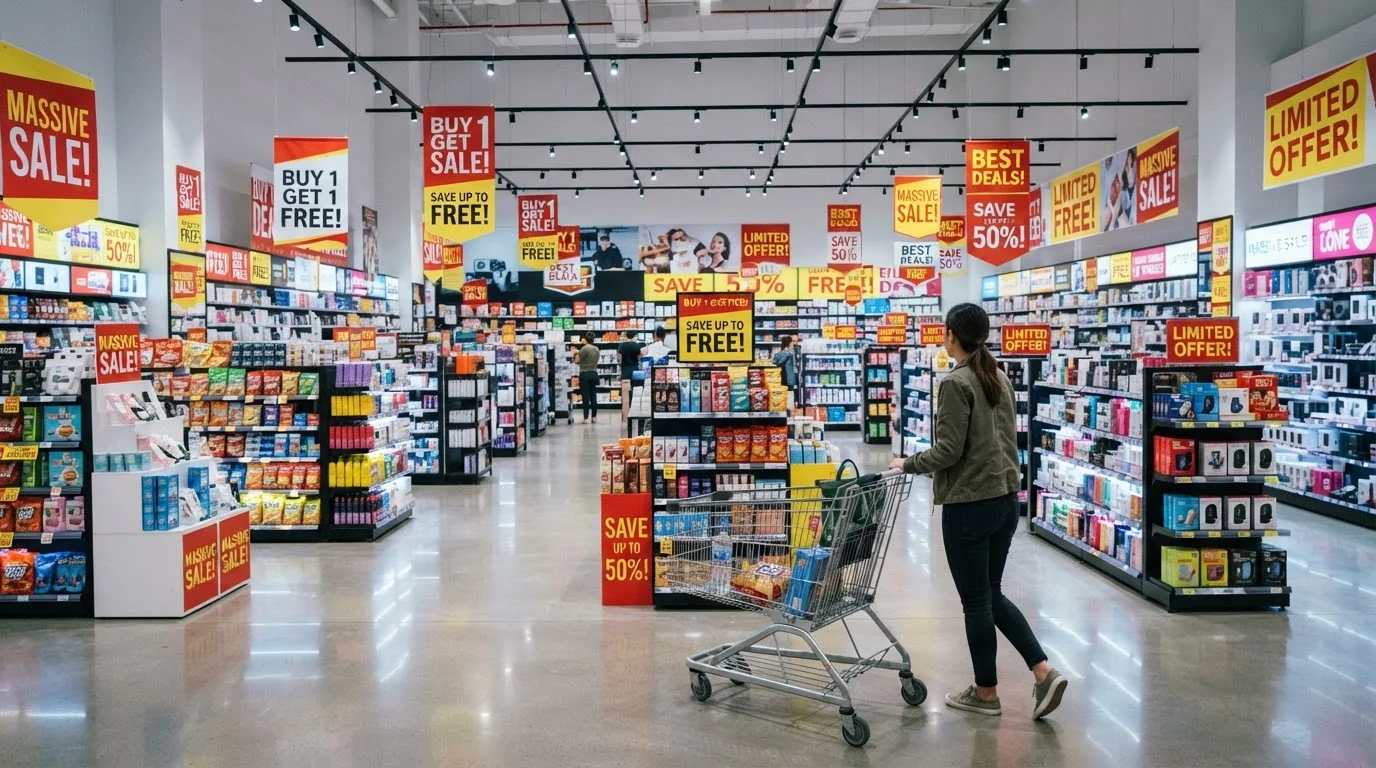
Why Retail Environments Are Designed to Work Against You
Every major retailer-brick-and-mortar or digital-invests significant resources in understanding how shoppers make decisions. Store architects, UX designers, and pricing analysts work from decades of behavioral research to create environments where spending feels natural, even inevitable. The goal is not malicious, but it is deliberate: remove friction from the path to purchase while adding friction to the path out.
Understanding the specific mechanisms retailers use is the most practical first step toward shopping independently. Cognitive biases and emotional triggers do much of the heavy lifting on the consumer side; the tactics below are how retailers activate them. Each one comes with a concrete way to recognize and neutralize it.
Strategic Store Layout and the Forced Path
Grocery and big-box stores routinely place high-frequency essentials-dairy, bread, pharmacy items-at the back or perimeter of the store. To reach them, you walk past thousands of products you didn't come for. This forced-path design is not accidental; it maximizes exposure per visit.
How to spot it: If you notice that the items on your list require a full lap of the store, the layout is working as intended. Counter-strategy: Organize your shopping list by store section before you arrive. Move directly between sections rather than browsing aisles between them.
Organizing your list by store section before you arrive neutralizes forced-path exposure.
Anchor Pricing and the Phantom Original Price
A tag reading "Was $89.99 - Now $59.99" frames $59.99 as a bargain regardless of whether the item ever sold at $89.99. This is anchor pricing: establishing a reference point that makes the actual price feel discounted. The Federal Trade Commission has guidelines on deceptive pricing, but enforcement gaps mean phantom markups remain common.
How to spot it: When you see a crossed-out price, ask: Was this item genuinely sold at that price, recently, and in the same condition? Counter-strategy: Check independent price-history tools before purchase, and evaluate whether the current price is reasonable on its own merits-not relative to the anchor. Anchoring and urgency tactics are explored in more depth in a companion article.
Always evaluate a price on its own merits, not relative to a crossed-out reference number.
Artificial Scarcity and Countdown Timers
"Only 3 left in stock" and ticking countdown clocks trigger loss aversion-the cognitive tendency to weight potential losses more heavily than equivalent gains. Online retailers can display these prompts dynamically, and some are generated algorithmically regardless of actual inventory levels.
How to spot it: Urgency language is most common on items with high margins or slow turnover-exactly the items a retailer most wants to move. Counter-strategy: Impose a personal 24-hour rule on any purchase prompted by scarcity messaging. Most "limited" offers reappear, and genuine stock shortages can usually be verified through the retailer's own inventory or a quick competitor search.
A personal 24-hour rule on scarcity-triggered purchases eliminates most false urgency.
Bundle Pricing and the Decoy Effect
Offering three size or tier options-small, medium, large-where the medium is priced to make the large look like a clear value is a textbook decoy effect. The middle option exists primarily to shift preference toward the higher-priced item. Bundle pricing ("buy 3, save 15%") works similarly by increasing total spend to achieve a per-unit saving you may not actually need.
How to spot it: When a pricing structure has three tiers, calculate the per-unit cost of each option against only what you actually need. Counter-strategy: Decide the quantity you need before seeing pricing tiers, and stick to it. Savings on units you don't need are not savings.
Decide how much you need before looking at pricing tiers-not after.
Loyalty Programs and Data-Driven Personalization
Loyalty programs offer genuine discounts, but they also collect detailed purchase histories that retailers use to send personalized promotions timed to your habits and weaknesses. If you consistently buy a certain category, expect targeted offers in that category designed to increase frequency or trade you up to a higher-margin product.
How to spot it: Personalized emails or app notifications that feel uncannily well-timed are likely data-driven. Counter-strategy: Use loyalty discounts for items already on your planned list, but treat personalized promotions as you would any unsolicited advertising-with skepticism rather than gratitude. Review your data-sharing preferences in the program settings if privacy is a concern.
Use loyalty discounts for planned purchases only-treat personalized promotions like unsolicited ads.
Checkout-Zone and Cart-Abandonment Nudges
Physical checkout lanes are lined with low-cost impulse items sized for the wait. Online, cart-abandonment emails-often with a discount offer-attempt to recover sales from shoppers who paused. Both exploit the same principle: a decision partially made is easier to complete than to reverse.
How to spot it: Any offer that appears only after you've signaled intent to buy (reached the register, started checkout, begun to leave) is a nudge capitalizing on commitment. Counter-strategy: Treat checkout-lane items as out-of-scope by default. If a cart-abandonment discount is genuinely useful, note that you can often generate similar discounts by adding items to a cart and waiting. Understanding the pressure tactics retailers use at the point of sale gives further grounding here.
Any discount that appears only after you signal intent to buy is designed to exploit commitment.
Building a Consistent Counter-Strategy
Spotting individual tactics is useful, but a consistent pre-shopping framework is more durable. Before any shopping trip-physical or digital-note the specific items you need, the maximum you're willing to spend per item, and a hard total budget. Research from consumer behavior studies consistently shows that written intention reduces unplanned purchases more reliably than willpower alone.
The One-Page Shopping Plan
Before any significant purchase trip-online or in-store-write down the item, the maximum price you consider fair, and why you need it now rather than later. This three-field exercise takes under two minutes and creates a concrete reference point to return to when a tactic is pulling you in a different direction. Shoppers with a written plan are better positioned to distinguish genuine value from engineered urgency.
For ongoing purchases, timing a purchase strategically can eliminate pressure-sale temptations before they arise. And comparing savings levers across online and in-store channels helps you choose the environment where you hold more control. The retailers who benefit most from psychological tactics are the ones shoppers visit without a plan.