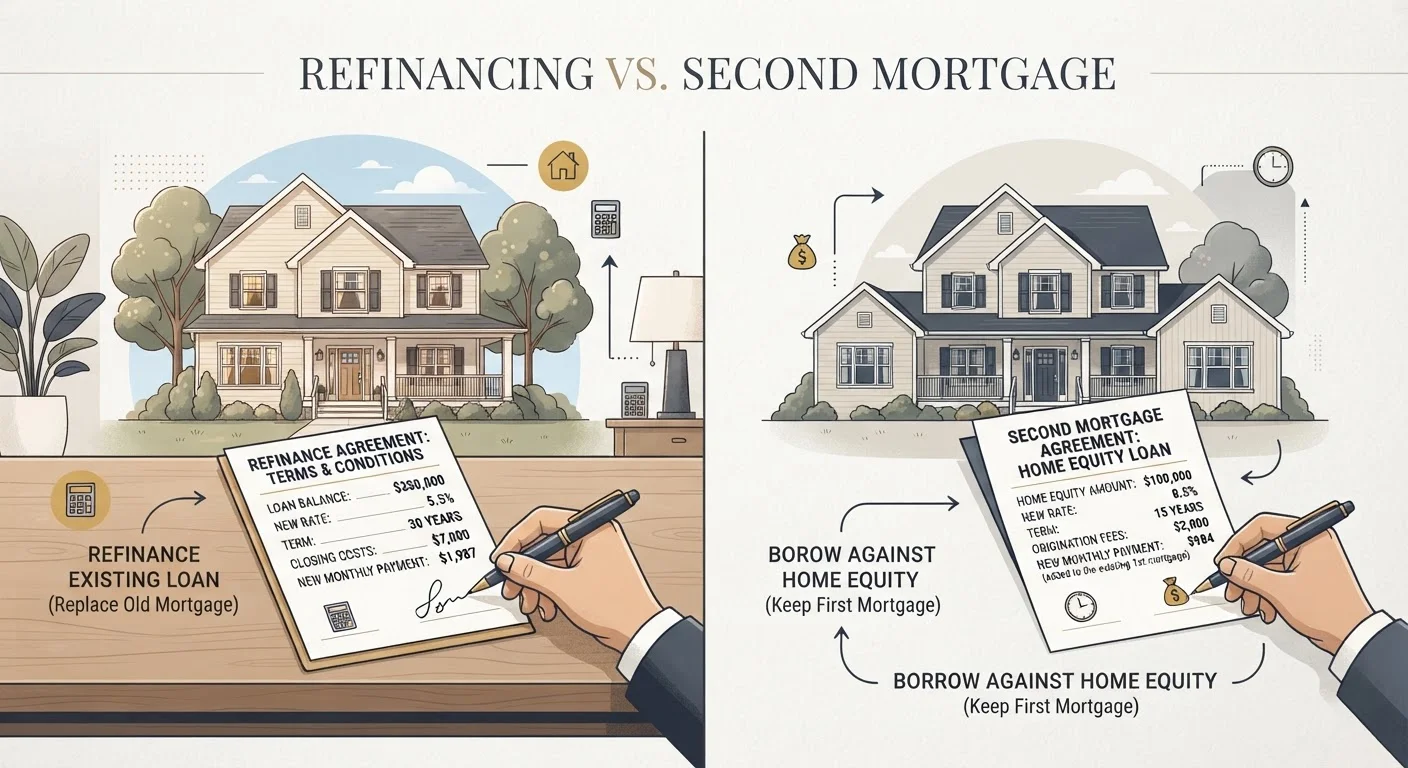
How Each Product Is Structured
Both a cash-out refinance and a home equity loan let you convert a portion of your home's equity into usable funds - but they do so through fundamentally different mechanisms.
A cash-out refinance replaces your existing mortgage with a brand-new, larger loan. The difference between what you owe on the old mortgage and the new loan amount is paid to you in cash at closing. You walk away with one mortgage, one monthly payment, and a new interest rate reflecting current market conditions.
A home equity loan is a separate, second loan placed on top of your existing mortgage. You receive a lump sum and repay it at a fixed interest rate over a set term - commonly 5 to 30 years - while continuing to make your original mortgage payment. Because it's a second lien on the property, lenders typically charge a slightly higher rate than a first mortgage to compensate for the added risk. For a broader look at how these second-lien products compare, see our guide to HELOCs and home equity loans.
| Criterion | Cash-Out Refinance | Home Equity Loan |
|---|---|---|
| Loan structure | Replaces existing mortgage | Second loan alongside existing mortgage |
| Interest rate | Generally lower (first-lien) | Generally slightly higher (second-lien) |
| Closing costs | 2%-5% of new loan balance | Typically $500-$2,000 |
| Monthly payments | One combined mortgage payment | Two separate loan payments |
| Impact on existing rate | Replaces current rate with new rate | Existing mortgage rate unchanged |
| Repayment type | Fixed or adjustable, varies by loan | Fixed rate and fixed term |
| Best rate environment | When current rates are lower than your existing mortgage | When your existing mortgage rate is favorable |
Costs, Rates, and What You'll Actually Pay
Costs are often the deciding factor between these two options.
With a cash-out refinance, you're originating an entirely new first mortgage, which means full closing costs - typically 2% to 5% of the new loan balance. On a $350,000 refinanced loan, that's $7,000-$17,500 in upfront fees. However, interest rates on a cash-out refinance are generally lower than those on home equity loans because the lender holds the first-lien position, which is less risky for them.
Home equity loans carry lower closing costs in absolute terms - often $500 to $2,000 - because the loan amount is smaller and the process is more streamlined. But the interest rate itself will typically be somewhat higher than a comparable cash-out refinance rate, reflecting second-lien risk. Over a long repayment period, that rate difference can add up.
2%-5%
Typical closing costs on a cash-out refinance
The Consumer Financial Protection Bureau notes that refinance closing costs generally fall in this range as a percentage of the loan amount.
80%
Common maximum combined loan-to-value ratio
Most conventional lenders require homeowners to retain at least 20% equity after a cash-out refinance or home equity loan is issued.
~$500-$2,000
Typical home equity loan closing costs
Because home equity loans are smaller and processed as second liens, upfront fees are generally lower in absolute dollar terms than a full refinance.
One often-overlooked cost consideration: if you currently hold a mortgage at a historically low rate and refinance into a new loan at a higher prevailing rate, you may pay significantly more in interest over the life of the loan even if the cash-out refinance rate is technically lower than a home equity loan rate. For a full look at when refinancing makes financial sense, see our refinancing guide.
Qualification, Limits, and Risk
Lenders evaluate both products using similar criteria: your credit score, debt-to-income ratio, and the amount of equity you hold. Most lenders require at least 20% equity remaining in the home after the loan is made - meaning your combined loan-to-value ratio (the total of all loans divided by the home's appraised value) generally cannot exceed 80%, though some lenders go higher with conditions.
How Loan-to-Value Is Calculated
Loan-to-value (LTV) compares total mortgage debt to the home's appraised value. For example, a $200,000 balance on a home worth $300,000 gives an LTV of about 67%. Combined LTV (CLTV) adds all liens together - your first mortgage plus any home equity loan - and most lenders cap this at 80% to 90%. Knowing your CLTV before applying helps set realistic expectations for how much equity you can access.
Both products carry the same fundamental risk: your home is the collateral. If you cannot make payments, the lender can foreclose. This is a meaningfully different risk profile than unsecured debt like personal loans or credit cards, and it deserves careful consideration before proceeding.
If you're an older homeowner wondering about equity-access alternatives that don't require monthly repayments, it's worth understanding how a reverse mortgage differs - see how reverse mortgages work and who they suit. And if your situation involves buying a new home before selling your current one, a bridge loan may be more relevant than either equity product.
This article is for general informational purposes only and does not constitute financial, tax, or legal advice. Consult a licensed financial adviser or mortgage professional before making decisions about your home equity or mortgage structure.