Why Placement Rules Exist - and Who Sets Them
Smoke and carbon monoxide (CO) detectors save lives, but only when they are positioned where they can actually detect a threat in time to allow escape. Building codes establish minimum placement standards to ensure that coverage is both consistent and reliable across different home layouts.
In the United States, detector placement requirements are primarily drawn from two model codes: the National Fire Protection Association's NFPA 72 (National Fire Alarm and Signaling Code) and the International Residential Code (IRC). Most states and municipalities adopt one or both of these as the basis for their local building codes, sometimes with additional requirements layered on top.
Always verify your local jurisdiction's specific rules before installing or replacing detectors. Local amendments can differ significantly from the model codes, and what's required for new construction may also differ from what's required when renovating an existing home.
New Construction vs. Existing Homes
Code requirements for detector placement often differ between newly constructed homes and existing residences undergoing renovation. New construction typically must meet current code fully, while retrofits may be subject to slightly different standards. Additionally, some states have enacted detector laws that go beyond model codes - California, for example, has specific CO alarm requirements that apply to all residential units. Always check with your local building department before making changes.
General Smoke Detector Placement Requirements
While local codes vary, the following placement principles reflect widely adopted standards under NFPA 72 and the IRC:
| Required: Inside every bedroom | Yes (per NFPA 72 and most local codes) (NFPA 72, National Fire Alarm and Signaling Code) |
| Required: Outside sleeping areas | Yes - in the immediate vicinity (e.g., hallway) (NFPA 72 / International Residential Code) |
| Required: Every level including basement | Yes (International Residential Code (IRC)) |
| Preferred mounting location | Ceiling; or wall-mounted 4-12 inches from ceiling (NFPA 72) |
| Minimum distance from cooking appliances | At least 3 feet (NFPA 72 general guidance) |
| CO detector required near sleeping areas | Yes, outside each sleeping area on applicable levels (IRC and many state codes) |
- Every sleeping room: A smoke alarm is generally required inside each bedroom, not just in the hallway outside it.
- Outside each sleeping area: An alarm is also required in the immediate vicinity of every bedroom - typically in the hallway serving that area.
- Every level of the home: This includes the basement. A finished or unfinished basement should have at least one detector on its ceiling.
- Attics and garages: Detectors are generally not recommended inside attached garages due to exhaust fumes causing false alarms. Attics may require coverage depending on finish level and local code.
Mounting Height and Distance
Smoke rises, so ceiling mounting is preferred. If wall-mounted, the detector face should be positioned between 4 and 12 inches from the ceiling. Keep detectors at least 3 feet away from cooking appliances and HVAC vents to reduce nuisance alarms. Avoid placement in dead-air corners where two walls meet the ceiling - smoke can pool before reaching the sensor.
Carbon Monoxide Detector Placement Requirements
CO detectors operate on different physics than smoke detectors. Carbon monoxide is nearly the same density as air, so it distributes relatively evenly throughout a room rather than rising sharply. This affects where they should go.
NFPA 72
The National Fire Alarm and Signaling Code published by the National Fire Protection Association. It is a widely referenced model standard for the installation, testing, and maintenance of fire alarm and signaling systems, including residential smoke and CO alarms.
International Residential Code (IRC)
A model building code developed by the International Code Council (ICC) that many U.S. jurisdictions adopt as the basis for residential construction standards, including detector placement requirements.
Carbon Monoxide (CO)
A colorless, odorless gas produced by the incomplete combustion of fuels such as natural gas, propane, wood, and gasoline. At sufficient concentrations, CO is life-threatening and undetectable without a sensor.
Dead-Air Space
A zone - typically a corner where two walls meet the ceiling - where air and airborne particles like smoke move more slowly or not at all. Placing a detector in a dead-air space can delay detection significantly.
Combination Detector
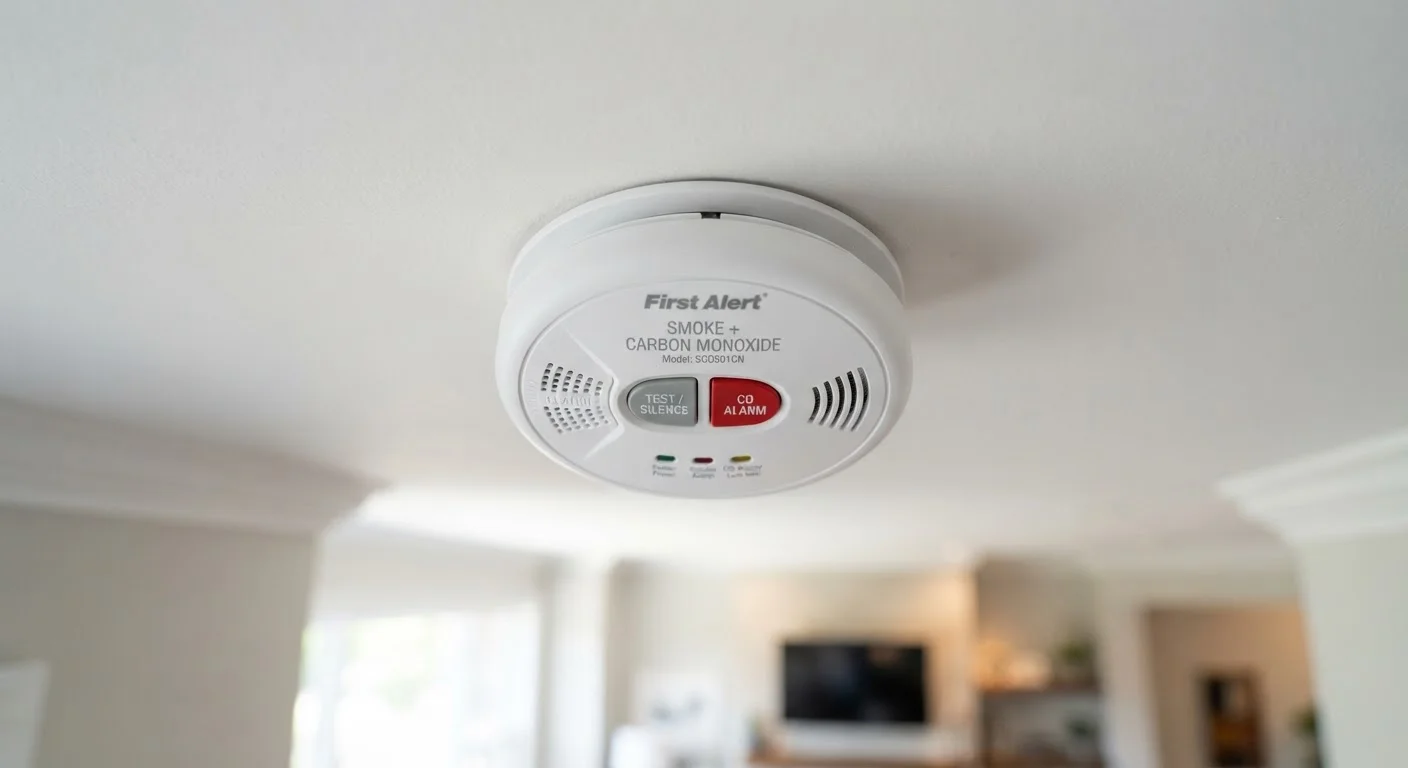
A single device that contains both a smoke sensor and a carbon monoxide sensor. Mounting guidance for combination units generally follows smoke detector rules since smoke detection is height-sensitive.
Under widely adopted model codes, CO alarms are generally required:
- Outside each sleeping area: If the bedrooms are clustered, one alarm in the hallway connecting them may be sufficient - but check local code, as some jurisdictions require one per bedroom.
- On every level of the home that contains a fuel-burning appliance (furnace, water heater, fireplace, range) or an attached garage.
- Not inside garages: Similar to smoke detectors, CO detectors should be placed just outside the garage entry door, not inside the garage itself.
Mounting Height for CO Detectors
Because CO distributes evenly, CO-only detectors may be placed at any height - on the ceiling, on a wall, or even at outlet height - and will still detect a dangerous buildup. Combination smoke/CO units, however, should follow smoke detector mounting guidance (ceiling or high on the wall) since smoke detection drives the placement rule. Always follow the manufacturer's instructions alongside code requirements.
This article is for general informational and educational purposes only. Building codes vary significantly by state, county, and municipality. Consult your local building department and a licensed contractor or electrician before installing, replacing, or upgrading detector systems in your home.