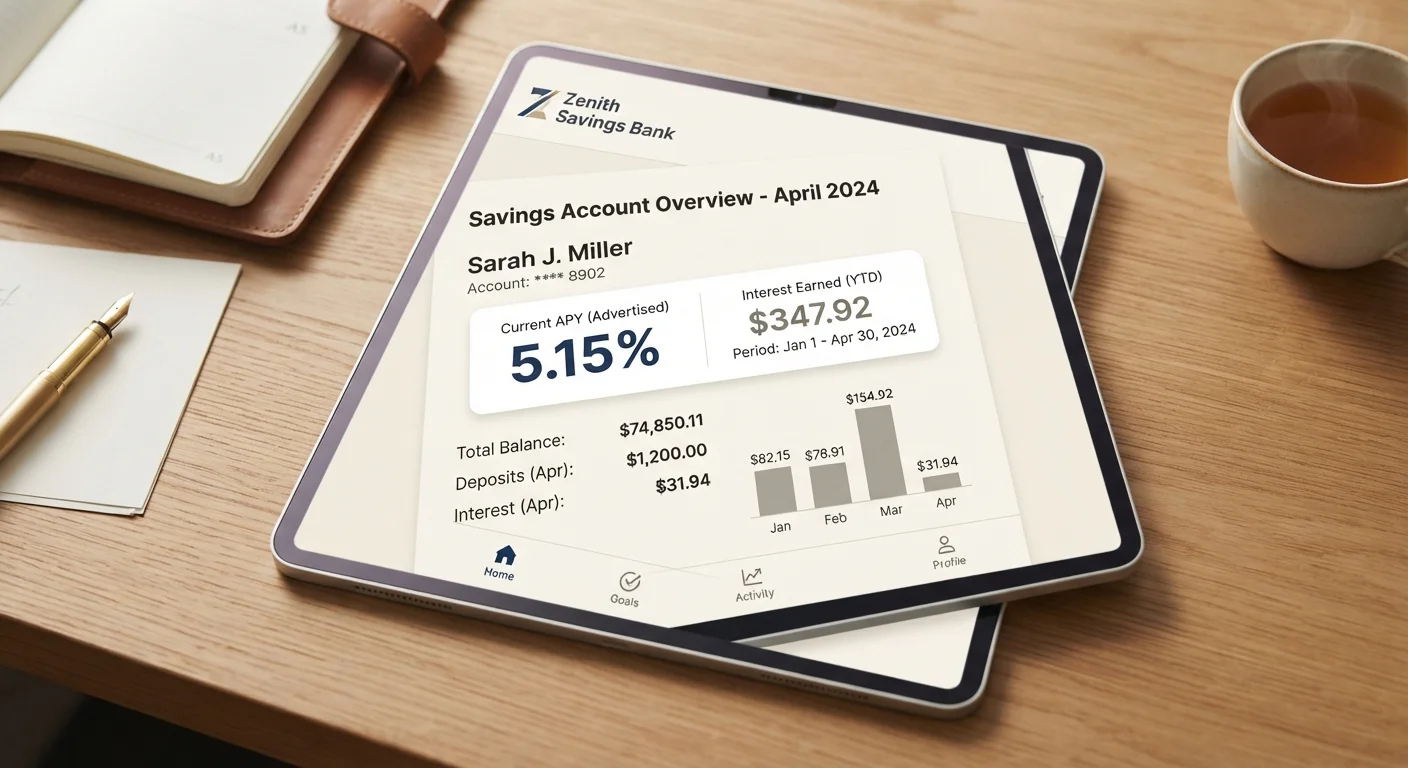
What 'Advertised APY' Actually Means
When a bank promotes a high APY, it is showing you the annualized return you could earn under a specific set of conditions - typically a full year, no withdrawals, no fees, and a qualifying balance maintained throughout. The APY calculation itself is standardized by federal regulation so that banks use the same formula, which makes the numbers comparable across institutions in theory.
In practice, the headline rate is a ceiling, not a guarantee. It represents the mathematical outcome of an idealized scenario. For a deeper look at how compounding frequency affects the number that ends up in your account, see how interest compounds in a savings account. Understanding that mechanics is the first step toward knowing why your actual deposit statement may show something different.
APY Is Standardized - Conditions Are Not
Federal Truth in Savings regulations require banks to use a uniform APY formula, which makes the headline number a fair comparison tool between institutions. However, the conditions attached to earning that rate - balance minimums, fee structures, promotional windows - vary widely and are disclosed separately. Always read the account's full disclosure document, not just the marketing material.
The Most Common Reasons Your Earnings Fall Short
Several structural features of bank accounts can quietly reduce the return you actually receive:
- Minimum balance requirements. Many accounts only pay the advertised APY when you maintain a specific balance - sometimes $1,000, sometimes $25,000 or more. Drop below it and the rate applied to your account may be a fraction of the advertised figure.
- Tiered rate structures. In a tiered account, different rate bands apply to different portions of your deposit. The top APY may apply only to balances above a high threshold, while the majority of your money earns a lower rate.
- Promotional periods. Introductory APYs are common with high-yield savings accounts. After a defined window - often three to twelve months - the rate automatically reverts to a standard rate that could be significantly lower. Reading the fine print before the period ends gives you time to reassess.
- Monthly maintenance fees. A fee charged each month is directly subtracted from your balance, working against every dollar of interest earned. On modest balances, fees can cancel out interest entirely, leaving your net return at or below zero.
For a broader glossary of the terms you'll encounter when evaluating these conditions, banking terms every account holder should recognize is a useful starting reference.
Ask About the Post-Promotional Rate Before You Open
Before opening any account with a promotional APY, ask the bank directly what the rate becomes after the introductory period and under what conditions it may change. Set a calendar reminder for the promotional end date so you can revisit whether the account still serves your goals. Switching accounts is often straightforward if you find a better option at that point.
How to Calculate What You'll Actually Earn
Rather than relying on the advertised rate, use the account's own disclosure document - typically called a "Schedule of Fees" or "Truth in Savings" disclosure - to build a realistic picture. Identify the rate that applies to your balance tier, subtract any monthly fees, and note whether the rate is promotional.
A simple approximation: multiply your average daily balance by the applicable rate (not the headline rate), divide by 12 for a monthly estimate, then subtract any fees charged that month. The result is your true net return for that period.
Comparing accounts accurately also requires looking beyond a single number. The difference between APR and APY, for instance, matters when evaluating both savings products and loan costs side by side. And if you're deciding where to keep different pools of money, understanding how checking and savings accounts differ helps you match the account type to its intended purpose.
0.01%
Typical post-promotional APY at large traditional banks
Many large national banks revert to APYs as low as 0.01% after introductory periods, compared to much higher rates at online-only institutions, according to publicly available rate surveys.
$120+
Annual fees at some traditional savings accounts
Some savings accounts carry monthly maintenance fees of $10 or more that are not waived unless a minimum balance is maintained, which can entirely offset interest earned on smaller deposits.
This article is for general informational and educational purposes only and does not constitute personalized financial advice. Consult a licensed financial professional for guidance specific to your situation.