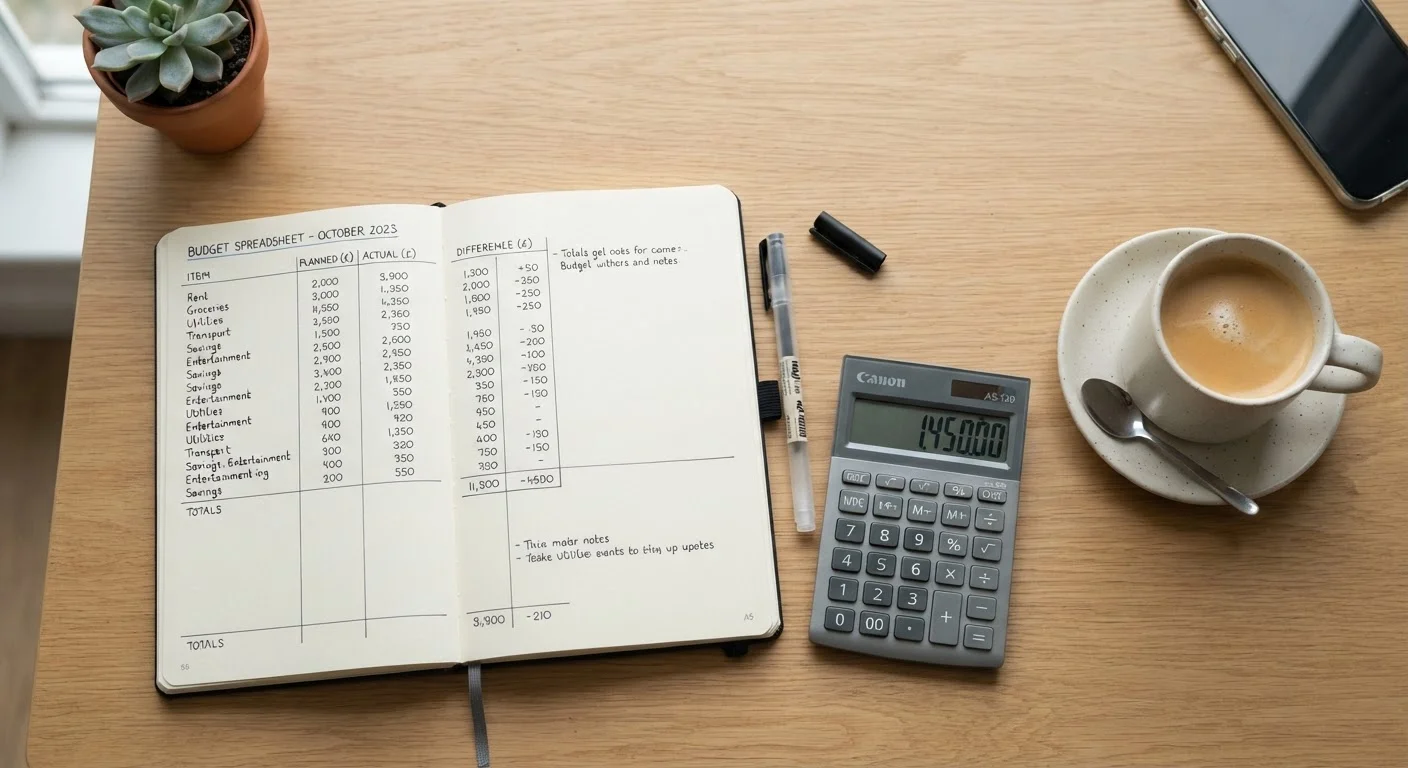
What Budget Variance Actually Tells You
Most people treat a budget overage as a personal failure. Budget variance reframes it as information. When your grocery spend comes in $80 over plan, that gap is a data point - it tells you something about your estimate, your habits, or your circumstances. The goal of tracking variance is not to judge yourself but to build a progressively more accurate picture of how money actually moves through your household.
Variance works in two directions across two dimensions. On the spending side, a negative variance means you spent more than planned; a favorable (positive) variance means you came in under budget. The same logic applies to income: earning more than expected is a favorable income variance; earning less is unfavorable. Both sides matter. A household that earns $300 less than expected while also spending $200 more than planned faces a total variance that threatens cash flow even if neither number looks alarming in isolation.
Variance Is Relative to Your Budget, Not Someone Else's
A $100 grocery overage means something very different for a household budgeting $250 per month versus one budgeting $900. When evaluating variance, focus on the percentage gap from your own plan rather than comparing dollar amounts to national averages or other households. Your budget baseline is the only relevant benchmark.
Why Variance Happens - and What It Means
Variance has two broad root causes: estimation error and circumstance change. Estimation error is simply setting a budget figure that does not match reality - a very common problem, especially when a budget is new. If you have never tracked groceries, your first guess at a monthly grocery number is just that - a guess. As explored in Underestimating Your Spending: The Silent Budget Killer, systematically setting categories too low is one of the most pervasive budgeting errors people make.
Circumstance change is different: your estimate was reasonable, but something shifted. A car repair, a medical copay, a spike in utility costs during a heat wave - these push actual spending above the plan without any fault in the original estimate. Distinguishing between the two matters because they call for different responses. Persistent estimation error requires a budget revision. A one-time circumstance shift may simply require an emergency fund withdrawal and no change to the underlying budget.
Label the Cause When You Record a Variance
When you log a category overage at month-end, add a brief note explaining why - 'car tire replacement,' 'guest visit,' 'price increase.' This single habit transforms your variance record into a searchable history that makes future estimates far more accurate. Over time you will see which variances are truly one-off and which are quietly recurring.
Fixed vs. Variable Categories and Their Variance Patterns
Not all budget categories behave the same way. Fixed expenses - rent, a car payment, a subscription billed at a set rate - produce little or no variance from month to month because the amount is predetermined. Variable expenses - groceries, dining out, gas, entertainment - fluctuate and are therefore the primary source of spending variance in most household budgets.
Understanding this distinction shapes how you interpret variance reports. If your rent shows a variance, something unusual happened: a lease change, a late fee, a move. If your dining category shows variance, the cause is more likely behavioral or seasonal. Fixed vs. Variable Expenses: Why the Distinction Matters for Your Budget explains this categorization in depth, and applying it to your variance tracking immediately makes patterns clearer.
Annual and irregular expenses are a particularly sneaky source of negative variance. Car registration, holiday gifts, and back-to-school costs do not appear every month, so they tend to be forgotten in monthly budgets - and then they show up as jarring overages. Creating a Budget That Accounts for Annual and Irregular Expenses outlines how to smooth these lumpy costs into a monthly plan so they stop generating surprises.
~33%
Americans with a detailed monthly budget
According to Gallup polling, only about one-third of U.S. households maintain a detailed monthly budget, meaning most lack the baseline needed to calculate variance at all.
$1,800+
Annual cost of a $150/month budget overage
A consistent $150 monthly negative variance - roughly $5 a day - compounds to more than $1,800 per year, illustrating how small recurring gaps erode financial plans over time.
3 months
Time to spot a meaningful spending pattern
Personal finance practitioners generally suggest tracking spending for at least three consecutive months before drawing firm conclusions about average category costs.
Turning Variance Into Budget Improvement
The most practical use of variance data is updating your forward-looking estimates. After two or three months of tracking, patterns become visible: the categories you consistently overspend, the ones you reliably underspend, and the income months that run thin. Use that pattern data to revise category limits to reflect reality rather than aspiration.
This is also where precision and consistency find their balance. A budget does not need to be exact to be effective - Does a Budget Have to Be Perfectly Precise to Work? addresses this directly. What matters is that variance is tracked consistently so trends surface. A $15 monthly overage in one category is trivial; a $15 monthly overage in ten categories accumulates to $1,800 a year.
When income itself is the source of variance - a freelance month that fell short, a reduced-hours paycheck - the response needs to be faster and more holistic. Adjusting Your Budget When Income Changes Unexpectedly offers a structured approach for revising spending plans quickly when earnings shift.
This article is for general informational and educational purposes only and does not constitute personalized financial advice. Consider consulting a qualified financial professional for guidance specific to your situation.