Why Quote Comparisons Often Mislead Consumers
Shopping for insurance by premium alone is one of the most common - and costly - mistakes consumers make. A lower number on a quote sheet is only meaningful if the coverage behind it is equivalent to what you're comparing it against. In practice, quotes from different insurers - or even different tiers from the same insurer - frequently differ on the variables that determine what actually gets paid at claim time.
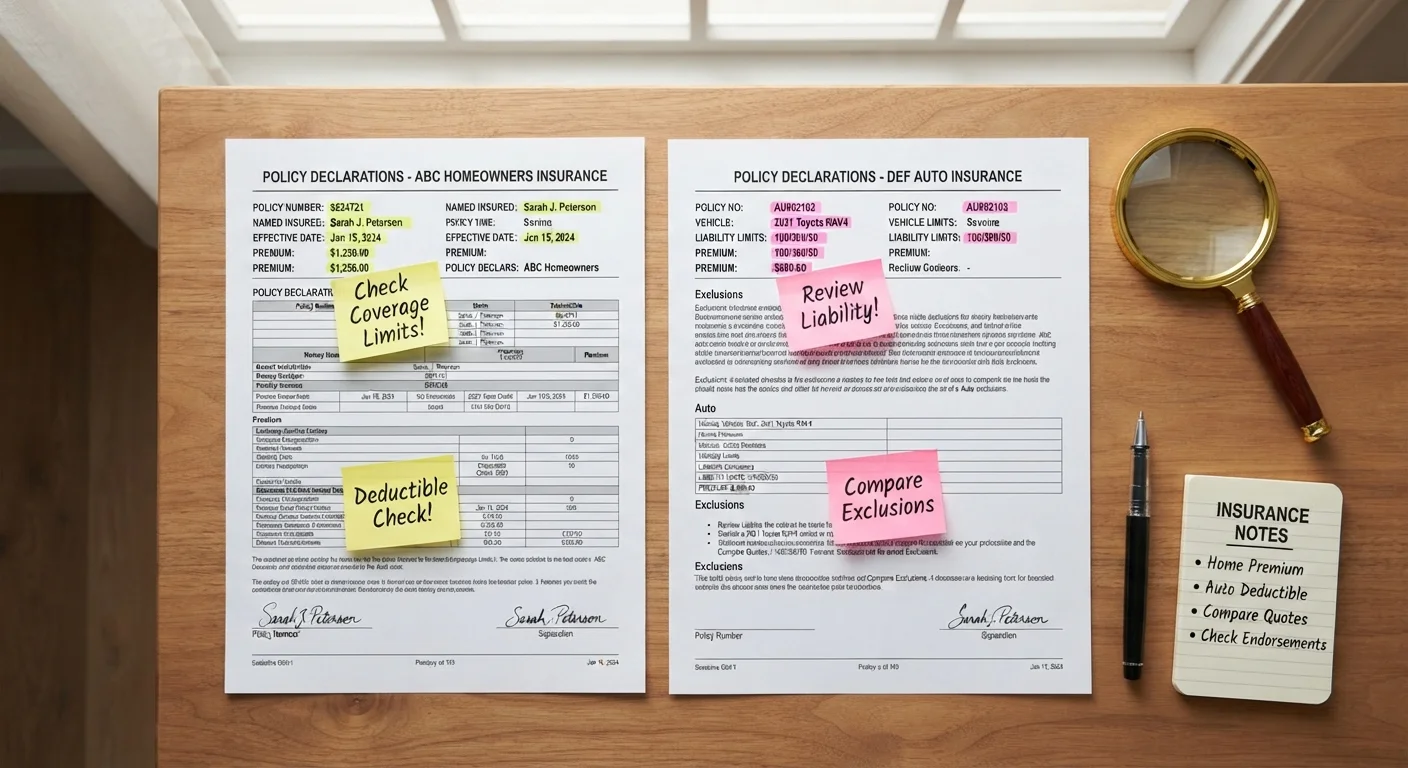
The three most consequential variables are coverage limits (the maximum the insurer pays), deductibles (what you pay first), and exclusions (what the policy won't cover at all). When any of these differ between quotes, you are not comparing the same product. You are comparing products that will perform differently in exactly the moment that matters most - when you file a claim.
Understanding the full vocabulary of a policy helps enormously here. The policy terms explained hub and the coverage types overview provide useful orientation before diving into quote details.
Build a Comparison Grid Before You Shop
Create a simple spreadsheet with rows for each coverage variable - limit, deductible, exclusions, and key riders - and a column for each quote. Filling in the grid forces you to collect the same data points from every insurer, which makes side-by-side analysis genuinely meaningful rather than superficial.
What You'll Need Before You Start
Accurate quote comparison is a structured task, not a quick scan. Before working through the steps below, gather the following:
What you will need
Having these materials in hand before you begin prevents the common mistake of comparing a summary sheet from one insurer against a full policy from another - a mismatch that distorts every conclusion you draw.
Policy Declarations Page
Summarizes the key terms of a policy - named insured, coverage types, limits, and effective dates - in one place for quick reference.
Full Policy Document (or Specimen Policy)
The authoritative source of all coverage terms, exclusions, conditions, and definitions that govern what the insurer will actually pay.
Comparison Spreadsheet
A self-built grid that logs identical data points from each quote, allowing side-by-side evaluation on equal terms.
State Insurance Department Website
Lets consumers verify insurer licensing, check complaint ratios, and access consumer guides specific to their state.
Step-by-Step: How to Compare Quotes on Equal Terms
The following steps walk you through a disciplined comparison process. Each step targets a specific variable that commonly causes quotes to look equivalent when they are not.
Define Your Coverage Baseline Before Requesting Quotes
Before you contact any insurer, document the minimum coverage specifications you need. This baseline should include the coverage type, the dollar limit that reflects your actual exposure, and the maximum deductible you could realistically pay out of pocket in a claim year. Without a written baseline, each quote will reflect the insurer's default assumptions - which differ across companies and may not match your needs.
If you haven't yet mapped your risk profile, the guide to mapping your insurance needs before you shop walks through that process step by step.
Request the Same Coverage Specifications From Every Insurer
When requesting quotes, provide each insurer with identical inputs: the same coverage limit, the same deductible amount, and the same list of any endorsements or riders you want included. If you let insurers quote their own defaults, you will receive structurally different products at structurally different prices - making any price comparison meaningless.
Be explicit. Tell each insurer: "I want a quote for [X] in coverage with a [Y] deductible." Document the exact figures you requested so you can verify them against each quote when it arrives.
Align Coverage Limits Across All Quotes
Coverage limits - the maximum dollar amount an insurer will pay for a covered loss - are the single most consequential number in any policy. A quote with a lower premium but a meaningfully lower limit is not a cheaper version of the same product; it is a different product with a different risk profile for you.
Compare per-occurrence limits and aggregate limits separately. For policies with multiple sub-limits (e.g., medical payments, personal property, liability), align each sub-limit across quotes, not just the headline number. The coverage limits explainer covers how to choose amounts that reflect real exposure.
Compare Deductibles on Equal Terms
A deductible is the amount you pay out of pocket before insurance coverage begins. Quotes with lower premiums often carry higher deductibles - meaning you absorb more of each claim's cost. These are not equivalent offers at different prices; they represent different risk-sharing arrangements.
For each quote, calculate your worst-case annual out-of-pocket cost: deductible plus premium. This gives you a more complete picture of the financial exposure each quote actually represents. For a structured look at this trade-off, see the high-deductible vs. low-deductible comparison.
Identify and Map Exclusions in Each Policy
Exclusions define what the policy will not cover. They are where many consumers discover, after a loss, that they paid premiums for coverage that did not apply to their situation. Exclusions vary significantly between insurers and between policy tiers from the same insurer.
Pull the exclusions section from the full policy document - not the summary - and list each exclusion for every quote you are comparing. Flag any exclusion that would apply to a risk you identified in your baseline. An exclusion that eliminates coverage for your most likely loss scenario effectively voids the value of that quote, regardless of premium.
[warning_callout]Score Each Quote Against Your Baseline and Make a Structured Decision
Return to the comparison grid you built in Step 1. For each quote, mark whether it meets, exceeds, or falls short of your baseline on every variable: limit, deductible, and exclusions. Only quotes that meet your baseline on all dimensions are genuinely comparable. Among those, the premium difference becomes a meaningful data point.
If no quote meets your full baseline, you face a trade-off decision - not a straightforward cost comparison. The guide to evaluating coverage adequacy independently provides a structured method for assessing whether a gap is acceptable given your circumstances. For complex decisions, consulting a licensed insurance professional is advisable.
Quote Comparisons Are Not Coverage Guarantees
Nothing in this article constitutes personalized insurance, financial, or legal advice. Coverage terms, premiums, exclusions, and eligibility vary by insurer, policy, and state. Always read the full policy documents and consult a licensed insurance agent or adviser before making any coverage decision.
After the Comparison: What the Numbers Tell You
A well-executed comparison will leave you with one of three outcomes: a clearly equivalent set of quotes where premium is the deciding factor; a set of quotes with meaningful coverage differences that require a trade-off decision; or a gap between what any available quote offers and what your baseline requires.
Each outcome calls for a different next step. Equivalent quotes can be evaluated on price and insurer reliability. Trade-off situations benefit from the structured framework in the coverage adequacy evaluation guide. Coverage gaps may require adjusting your baseline, requesting custom endorsements, or speaking with a licensed agent.
What the process should never produce is a decision based solely on the lowest number on a quote sheet. The premium is the cost of coverage - only the policy terms define what that coverage actually is.
This article is for general informational and educational purposes only. It does not constitute personalized insurance, financial, or legal advice. Coverage terms, availability, premiums, and regulations vary by insurer, policy type, and state. Always read full policy documents carefully and consult a licensed insurance professional before making any coverage decisions.